
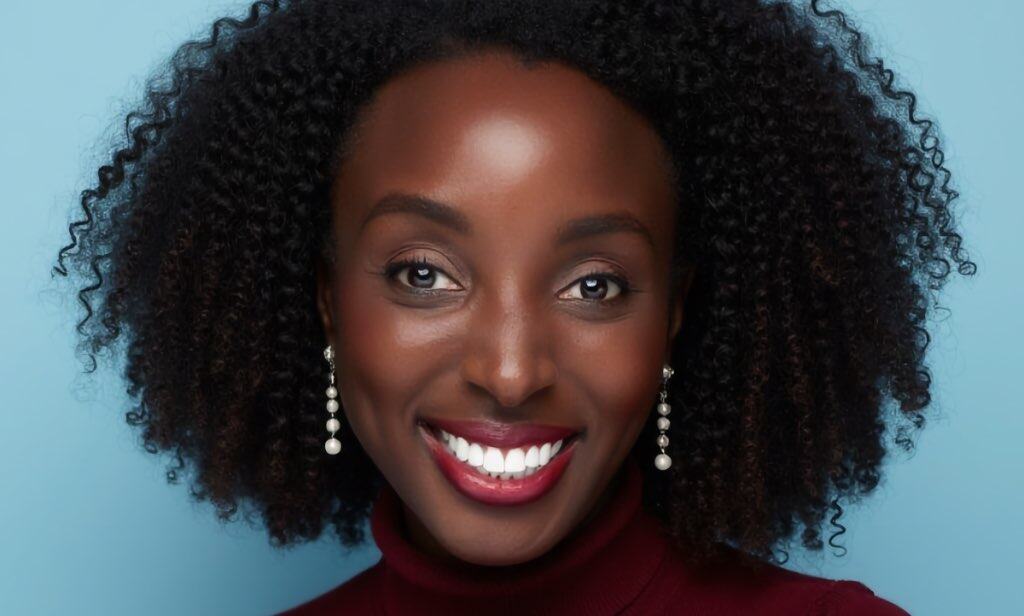

Above: Christelle Mombo-Zigah. Photo via LinkedIn.
BitDepth#1510 for May 12, 2025
The Caribbean chapter of Women in AI Governance hosted its second meeting on April 30, hosting Christelle Mombo-Zigah for an online presentation on Digital Colorism.
Mombo-Zigah is a French-American technology executive with, as she describes it, ‘deep Congolese roots” who has worked in Silicon Valley with CISCO for the last fifteen years.
Her first major encounter with digital bias in technology systems came during Covid lockdowns, when she discovered that the automated background creation tools used in meeting platforms could not deal with her online presence if her hair was styled in a full afro.
The AI systems simply cropped out the hairstyle, and she ended up having to visit IKEA to buy furniture to dress the background behind her.
Her concerns with digital colorism have only grown with the widespread use of Large Language Models (LLMs) to create digital avatars and entirely new interpretations of human identity.
These issues are hardly new. Until the 1970’s, colour film for photography was notorious for its inability to properly render the subtlety of non-white skin.
To compensate, makeup was used to flatten brown and black skin tones, a disturbingly obvious adjustment to modern eyes seeing movies in 4K resolution that clearly renders the ham-fisted makeup applied to people of colour during that era.
One might be inclined to think that a social intervention changed the formulated colour response of film in the 1970s, and you would be right.
But it wasn’t some noble attempt at trying to render all human skin tones with fidelity, it was the complaints of advertisers, specifically advertisers selling chocolate and wood products such as fine furniture that turned the tide, since these businesses would no longer stand for the clumsy response of colour film to the nuances of darker tones.
Mombo-Zigah is trying to raise greater awareness of the issue in modern AI, and she is not alone in this. People of colour, particularly in Africa, have seen the problem and are speaking out about it.
Her discoveries align with my own experimentation with AI portrait tools, Mombo-Zigah discovered a pronounced preference for Caucasian facial features, natural hairstyles erased in favour of straightened hair, hair added to bald heads and the visual identity of users being run through a Euro-blender.
Left to their own devices, many of these tools will, quite deliberately, lighten skin, sometimes to the point of turning people of colour into white versions of themselves.
Something I hadn’t considered when experiencing this propensity of AI image generation is its unhealthy alignment with the phenomenon of skin bleaching.
“You do have the technological aspects of making sure that people are represented accurately and qualitatively and authentically, but you also have the social and mental health aspect in making sure that those images are not going to continue to to serve and feed into all the skin bleaching,” said Mombo-Zigah.
“What is the skin bleaching global market looking like? It’s dominant in Asia and more specifically in China and India. The second biggest market is Africa, and the third biggest is the Caribbean.
These are markets where bleaching creams are already significantly being used for various reasons. The key drivers can be cultural ideals, beauty, status, marriage and job opportunities.”
Mombo-Zigah expects the market for virtual humans to explode over the next decade, beginning with avatars used in the gaming and entertainment industries.
“That [market] will reach US$1.8 trillion by 2033 for all digital representations of a human being. The avatars that some are talking about in the banking industries will dominate the world. How are we going to represent ourselves in these digital worlds?”
The business of AI imagery, as she sees it, is characterized by limited diversity, favoring limited features and lighter skin tones that align with European standards, stereotypical facial features and exaggerated characteristics and unequal representation across the board, with some racial groups appearing less frequently and in contexts that are dubious at best.
In her testing, she found that requests for images of a CEO generated white males 90 per cent of the time and Asian males for the other ten per cent. Requests for a farmer always resulted in images with a darker skin tone.
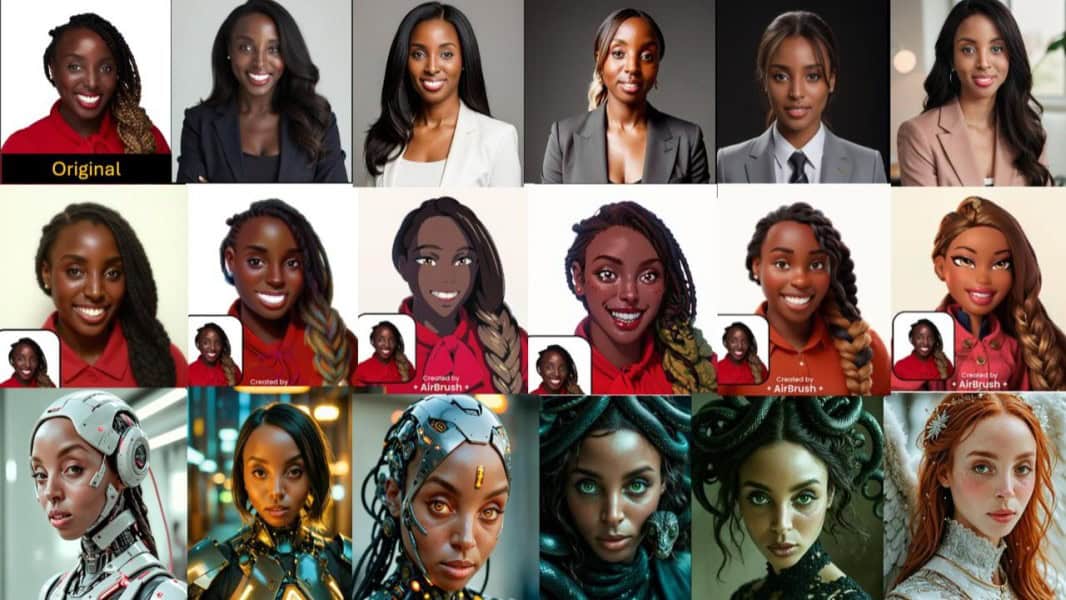
‘I had an old picture that I’ve been using for quite some years. I was wearing a lot of braids then. I just wanted to update my profile, and I started leveraging AI to edit or generate headshots.”
“My hair was systematically transformed. I don’t believe that I look that old, but I was seeing little changes in the way the tools were representing my age. I was also seeing myself slimmed into someone that I wished I could have looked like, but who was not a real representation of who I am.”
Mombo-Zigah locates AI-generated humans at the intersection of computer vision, which relies on image synthesis, computer graphics for 3d modeling and animation and generative AI, which uses deep learning and natural language processing.
Mombo-Zigah has created an analysis tool that ranks the output of image generation platforms that’s priced for developers looking for an assessment of how their LLMs are generating bias in their results, but her samples, examining a range of popular AI portrait generation and enhancement tools are instructive on their own.
Beyond that, awareness of and informed reactions to digital colorism in AI are critical tools in understanding what these technologies are offering to the impressionable and should form part of a regional reaction to the way AI is imagining the human population and quietly erasing the distinctions of race, colour and even human uniqueness.

















 In a US university film lab,...
September 7, 2026
In a US university film lab,...
September 7, 2026
 Declaring independence from mobile roaming
August 31, 2026
Declaring independence from mobile roaming
August 31, 2026
 Urgency, awareness needed to combat sextortion
August 24, 2026
Urgency, awareness needed to combat sextortion
August 24, 2026
 The silent, growing danger of ransomware
August 17, 2026
The silent, growing danger of ransomware
August 17, 2026
 How should a newsroom of the...
August 10, 2026
How should a newsroom of the...
August 10, 2026
 FNP’s halting stumble to dubious relevance
August 3, 2026
FNP’s halting stumble to dubious relevance
August 3, 2026
 Samsung’s big bet on AI
July 27, 2026
Samsung’s big bet on AI
July 27, 2026
 The data centre dilemma
July 20, 2026
The data centre dilemma
July 20, 2026
 How should business and government embrace...
July 13, 2026
How should business and government embrace...
July 13, 2026
 How influencer marketing works in the...
July 5, 2026
How influencer marketing works in the...
July 5, 2026
 Yes, a website is work. Yes,...
June 29, 2026
Yes, a website is work. Yes,...
June 29, 2026
 No more fire in these wires
June 22, 2026
No more fire in these wires
June 22, 2026
 What the heck is chip binning?
June 14, 2026
What the heck is chip binning?
June 14, 2026
 Solving the region’s journalism problem
June 8, 2026
Solving the region’s journalism problem
June 8, 2026
 Tambini to journalists: “Keep doing what...
May 31, 2026
Tambini to journalists: “Keep doing what...
May 31, 2026
 How do we unfetter journalism from...
May 25, 2026
How do we unfetter journalism from...
May 25, 2026
 What the Canvas hack tells us...
May 15, 2026
What the Canvas hack tells us...
May 15, 2026
 Ghost women in AI? Hardly!
May 10, 2026
Ghost women in AI? Hardly!
May 10, 2026
 IShowSpeed: Here and gone
May 4, 2026
IShowSpeed: Here and gone
May 4, 2026
 How TT journalists can turn modern...
April 26, 2026
How TT journalists can turn modern...
April 26, 2026



[…] Caribbean – The Caribbean chapter of Women in AI Governance hosted its second meeting on April 30, hosting Christelle Mombo-Zigah for an online presentation on Digital Colorism… more […]