
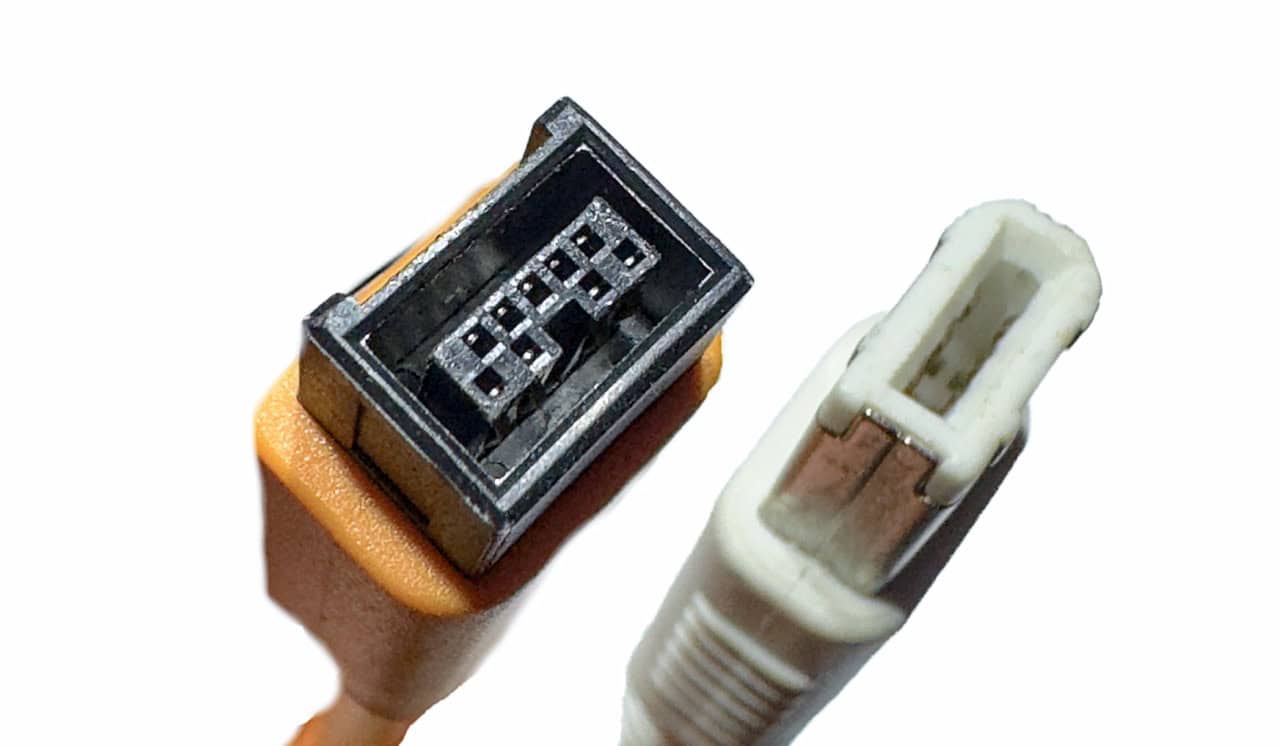

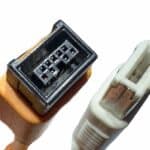
Above: The FireWire 800 and 400 plug connectors. Photo by Mark Lyndersay
BitDepth 1567 for June 22, 2026
Apple introduced the IEEE 1394 connection protocol, known commercially as FireWire, with the Power Macintosh G3 in 1999.
The connection was in development at Apple since the 1980’s and was formally adopted as an industry standard in 1995.
Until then, big data moved across heavy, finicky cables using the SCSI interface. The widely adopted SCSI-2 was fast (10MB/s) but fallible.
Sometimes a connection just wouldn’t work and let’s not get started on termination issues. FireWire introduced a thinner cable and simpler connection interface with a transfer speed of 400 Mbps.
A faster version, with a different connection pinout, FireWire 800, was introduced in 2003, offering speeds of 800Mbps.
The connection appeared on all Apple computers and many higher-end Windows PCs, where adoption was driven by the peripherals that used the connection, including the newest digital video and some medium format digital cameras, the first iPod and as we shall see, some critical digital audio tools.
The ports started disappearing on Apple’s hardware in 2012, replaced by the first versions of the Intel-developed Thunderbolt connection (created in a collab with Apple), which proved hugely popular, raising speeds to 20 Gbps allowing reliable daisy chaining of devices and collapsing multiple port protocols, including video, into a single connection.
FireWire effectively died with MacOS 26 Tahoe, when Apple removed the drivers that enabled the OS-level connection to its operating system. The absurdly expensive Thunderbolt to Firewire adapter also disappeared from the company’s online store.
FireWire drifted back onto my radar three months ago when a friend sent up a flare calling for help.
His life’s work as a photographer was on an ageing LaCie Big Raid. These were gorgeous boxes back in the day, Neil Poulton designed monolith enclosures that, unfortunately, had two outdated ports, FireWire 800 and USB2.
The connection from his modern M1 Mac was enabled by a double adapter, from Thunderbolt 4 (USB-C plug) to Thunderbolt 2 (Display port plug) to FireWire 800.
The reliability of transfers was tenuous at best. A direct USB-C to USB-2 (B-plug) turned out to be more reliable, and was incrementally faster. It was time to get that data out of those old boxes and into something made in this decade.
In the end, it took 28 hours to move 4TB of data off that box.

Last week, Kiwan Landreth-Smith, former guitarist with 3Canal and leader of Kin Soundsystem reached out on Facebook to find a retired Mac with a FireWire connection.
In 2012, Landreth-Smith formalised his study of music, enrolling in the UTT MTech programme, emerging as the top student of his cohort and starting a new side career in production.
Putting his study to practice, he got an M-Audio ProFire 2626, custom modified by Black Lion Audio.
“A military aviation engineer decoupled the preamps and the converters from the power section [of the device],” Landreth-Smith said.
“The result was a very low noise floor, and I got preamps out of it that would punch well above their weight in terms of price. I think it still stands the test of time.”
“I recorded an album with BuzzRock called Eternal Vibration, which is on Spotify and Apple Music, I believe. That was a FireWire 400, so I had to use a Firewire 400 to 800 cable and I used a 2012 MacBook Pro i7 13-inch machine. That was the unit that I was recording with.”
“We moved on to Universal Audio, Apollo systems and various USB-3 and USB-C interfaces but none had the fidelity of the 2626 with the Black Lion mod.”
“I’m going to record a four piece rock band in a few weeks, and I have my sights set on that unit again. That unit sounds better than most things that you could get at a relatively sane price point.”
“So I’m going through pains right now to find an older machine that has FireWire so that I could use that interface again.”
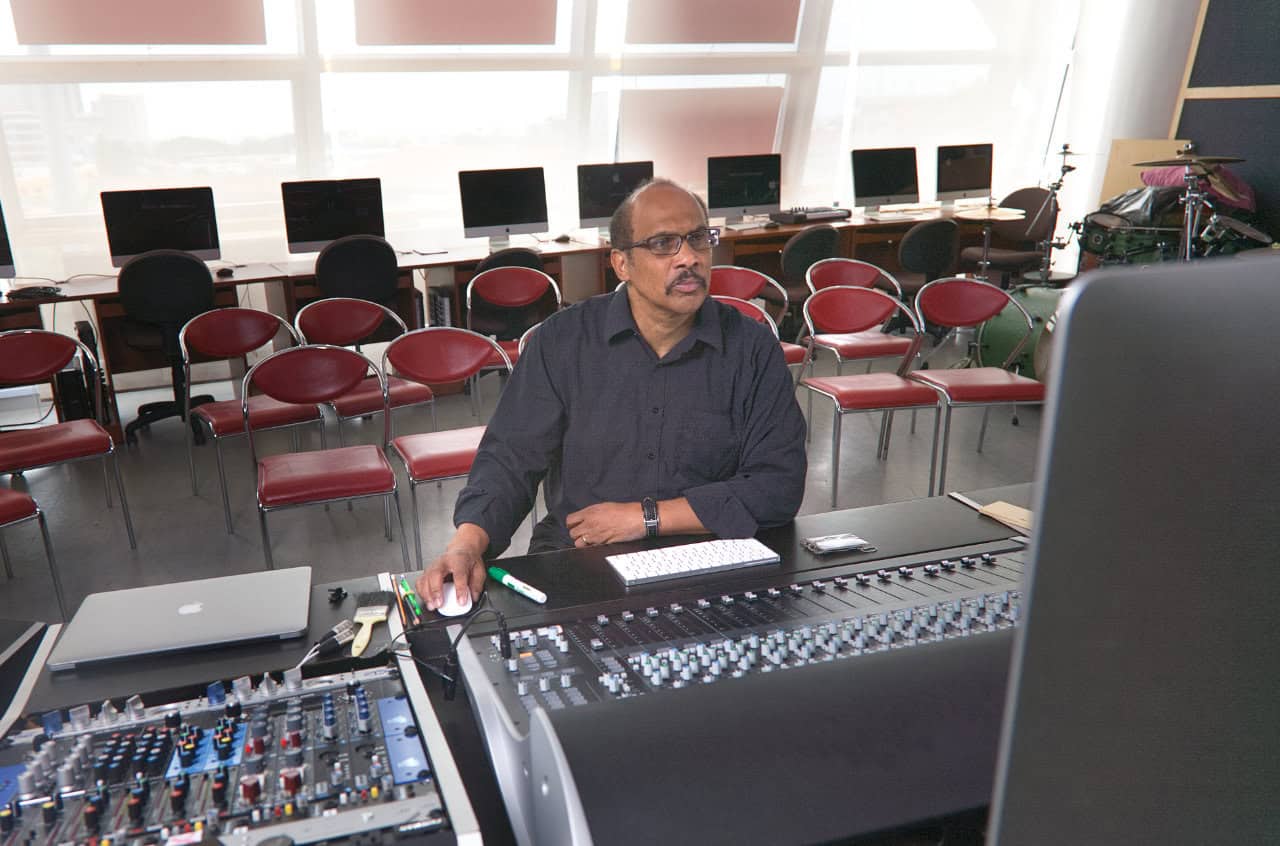
Martin Raymond is Associate Professor in Practice, Digital Media Arts at UTT and coached Landreth-Smith during his studies at the university. His journey using FireWire as an audio connection is extensive.
“I first encountered FireWire in the late 1990s with the switch from SCSI drives,” Raymond said.
“My first FireWire interface was probably the MOTU2408 – which was also the first sub-USD$1000 multi-channel interface. It really revolutionized recording here in Trinidad, as you now had 24 analog ins and outs without having to spend USD$10,000 on a Pro Tools system.”
“Other notable MOTU users included Robin Foster (Engine Room), Pelham Goddard, Carl ‘Beaver’ Henderson, Neil Bernard, Ibo Joseph. For reference, Pro Tools users at the time were Caribbean Sound Basin (Lauritz Liddleow, Lyndon Livingstone, Sean Poland), Mark Fojo (Starsounds Studio) and my late cousin Graham Wilson (with the low-cost Digi 001). Over time I had a few other FW interfaces, including Digidesign 003 (Rack and Console) and Apogee Duet.”
“FireWire is effectively dead in my workflow,” said Yoichi Watanabe, Music Producer/Recording Engineer at UTT.
“I haven’t used it in over 10 years. My current recording systems are based entirely around USB-C and Thunderbolt. During the years I used FireWire, it was generally reliable for multitrack recording and offered better performance than USB at the time.”
“However, I occasionally encountered issues with damaged ports, flaky connections caused by cable movement, and compatibility problems when computer manufacturers began removing FireWire support.”
“What I would really love is if there were more peripherals that cater to physical stresses better,” Landreth-Smith said.
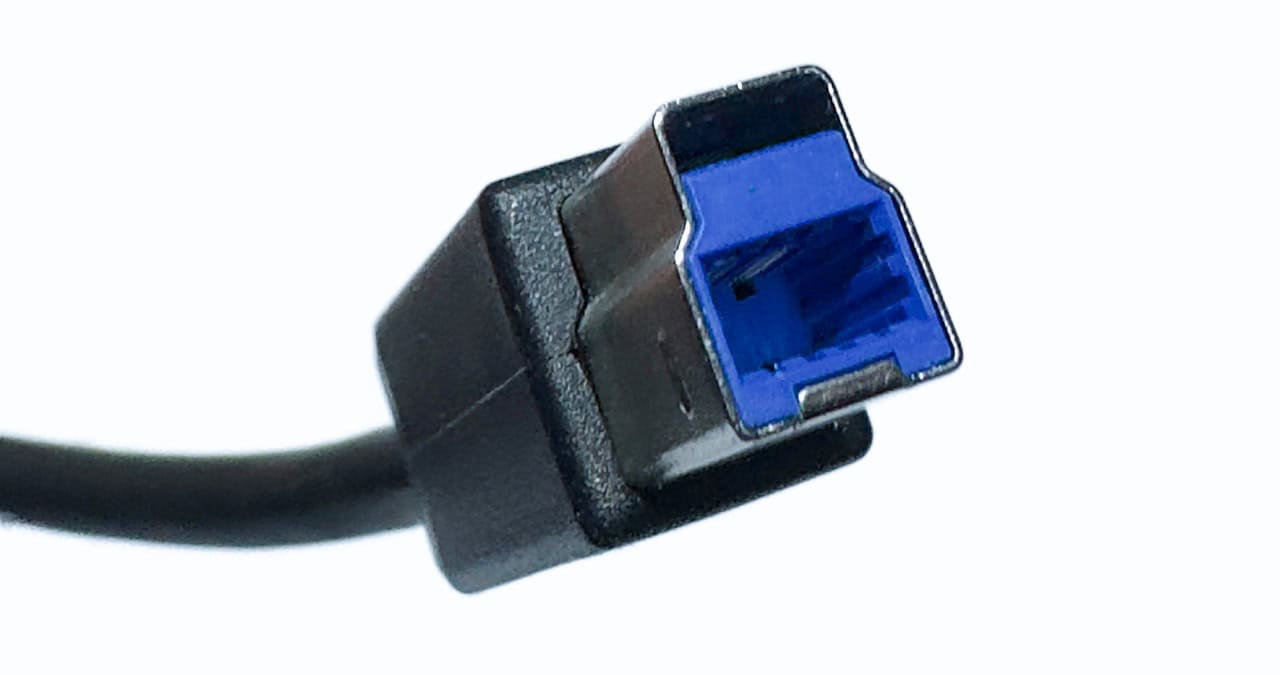
“I think USB-B was the gold standard when it came to that, which is the printer cable USB format. Especially MIDI controllers and hardware with a lot of physical interaction…those printer USB-B type connections are really solid.”
Raymond has switched to Thunderbolt and USB interfaces on his current equipment, he still remembers the protocol fondly, praising it as a reliable connection.
“Multi-channel recording, such as what Kiwan is doing, is increasingly rare these days. Most people are just doing a single vocal against programmed tracks. So a two-channel interface is more than adequate.”
“Thunderbolt is ok, but USB has always been problematic as far as I am concerned. The Antelope interface we use at UTT sounds incredible but has been extremely unreliable.”
“It was the first USB-2 to do 32 analog in and out, and I note that Antelope now uses Thunderbolt 3 exclusively. I have not stress-tested many USB-C interfaces at this point, but most people are using simple two-channel interfaces for cutting vocals.”










 The silent, growing danger of ransomware
August 17, 2026
The silent, growing danger of ransomware
August 17, 2026
 How should a newsroom of the...
August 10, 2026
How should a newsroom of the...
August 10, 2026
 FNP’s halting stumble to dubious relevance
August 3, 2026
FNP’s halting stumble to dubious relevance
August 3, 2026
 Samsung’s big bet on AI
July 27, 2026
Samsung’s big bet on AI
July 27, 2026
 The data centre dilemma
July 20, 2026
The data centre dilemma
July 20, 2026
 How should business and government embrace...
July 13, 2026
How should business and government embrace...
July 13, 2026
 How influencer marketing works in the...
July 5, 2026
How influencer marketing works in the...
July 5, 2026
 Yes, a website is work. Yes,...
June 29, 2026
Yes, a website is work. Yes,...
June 29, 2026
 No more fire in these wires
June 22, 2026
No more fire in these wires
June 22, 2026
 What the heck is chip binning?
June 14, 2026
What the heck is chip binning?
June 14, 2026
 Solving the region’s journalism problem
June 8, 2026
Solving the region’s journalism problem
June 8, 2026
 Tambini to journalists: “Keep doing what...
May 31, 2026
Tambini to journalists: “Keep doing what...
May 31, 2026
 How do we unfetter journalism from...
May 25, 2026
How do we unfetter journalism from...
May 25, 2026
 What the Canvas hack tells us...
May 15, 2026
What the Canvas hack tells us...
May 15, 2026
 Ghost women in AI? Hardly!
May 10, 2026
Ghost women in AI? Hardly!
May 10, 2026
 IShowSpeed: Here and gone
May 4, 2026
IShowSpeed: Here and gone
May 4, 2026
 How TT journalists can turn modern...
April 26, 2026
How TT journalists can turn modern...
April 26, 2026
 Reuters report on young news readers...
April 20, 2026
Reuters report on young news readers...
April 20, 2026
 The state of ransomware in the...
April 12, 2026
The state of ransomware in the...
April 12, 2026
 Digital döstädning
April 5, 2026
Digital döstädning
April 5, 2026