


BitDepth 1569 for June 29, 2026
Handcrafting a website to one’s taste has largely gone out of fashion, but back in the 90’s, it was the only way to get onto what we hilariously described as the ‘information superhighway.’
Oh, the benefit of hindsight. Looking back on users wading through thick mud to get to poorly defined destinations and thinking of that as state of the art is to be both amazed and appalled.
Last week, I rebuilt the user interface for TechNewsTT and if I’ve done my work properly, you should barely notice except for things that work better.
My first website was hand coded with an assist from a software package called Claris HomePage, which allowed the user to quickly view the result of hypertext markup tag language (HTML) as a finished (or more often, unfinished) representation of how it would appear to viewers. A connection to the internet was optional.
In a flash of hubris that I’ve largely failed to outgrow, I dubbed that 1998 site “Mark’s Giant Sprawling Website” on the principle that it was more than ten pages of information (most websites settled for just one) and I’d keep adding to it as I went along, posting bits of personal information, columns as they were published and little galleries of photographs.
Every photograph had to appear on its own page, since there were no pop-up viewers, galleries or slideshows, so things began to get out of hand quickly.
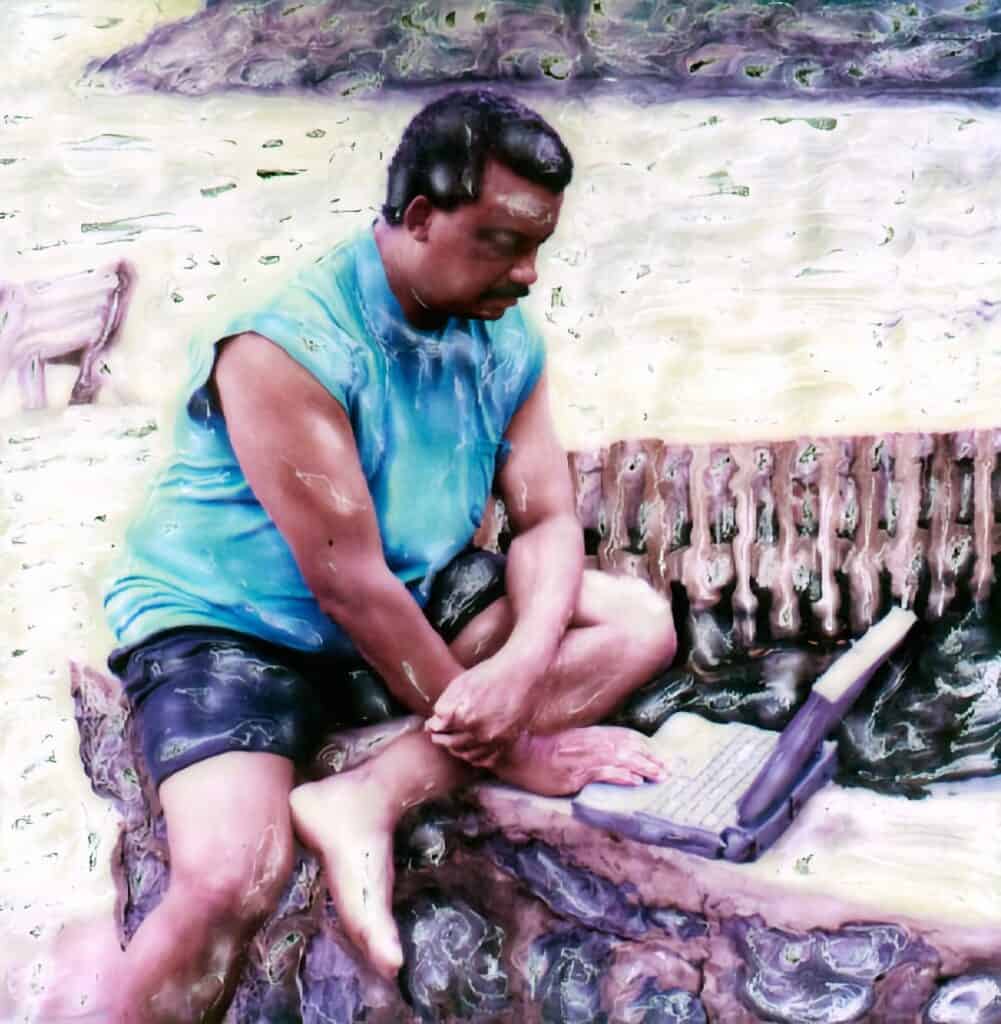
Better visual display would come along in a few years after Macromedia Director made it possible to do animations in a format that would eventually be codified as Flash modules, which required a particularly flaky browser plug-in.
The Internet Service Provider (ISP) WOW.net provided space on their servers for that website, right up until their business model changed and new ISPs entered the market.
A long, digitally fallow period followed. I tried to figure out Dreamweaver and Adobe GoLive, failed, and turned my attention to editorial management as a consultant for a decade, first at the Trinidad and Tobago Express, then at the Guardian, before once again turning my attention to a web presence in 2004.
After one failed attempt at getting budget hosting to work, I put lyndersaydigital.com online with GoDaddy, positioning it as a one-stop destination for anyone curious about my photography, my feature writing and the BitDepth column.
Everything would eventually find a home there, including my documentary photography galleries that were published under the brand, Local Lives.
It was comparatively easy to do all that with the site builder I used for the next ten years, RapidWeaver (you can see a legacy page here), which allowed me to style different subsections of the website distinctly, allowing all the work to coexist without co-mingling.
I’ve written about how TechNewsTT got started before, but not about why it got started the way it did.
I could certainly have created another RapidWeaver website. I knew the software well, but I also knew it well enough to realise that it was beginning to have some serious limitations.
Most of the new development of the software was happening in a plug-in, Stacks, which was great for design-heavy, static websites, but there was little happening on the content management side of the Rapidweaver project.
That tension eventually led to a bifurcation of RapidWeaver and Stacks. The new version of the RapidWeaver product, Elements, borrows heavily from the conceptual underpinning of Stacks while offering no access to either the Stacks plug-in or the many add-ons that were developed for it.
Stacks is supposed to become a rival product supporting existing stacks, but Elements is available now and the original cohesive software ecosystem has been irretrievably shattered.
It hardly mattered by then, because I’d decided to give WordPress a try and a new website on new domain entirely seemed like the right point to make the break.
We’re now just past the twelfth year of the creation of TechNewsTT. I’m now the webmaster of seven domains, five of which are active, and none of them is quite the same.
One is my photography portfolio website, one represents a professional organisation, one supports an NGO, one is a publisher’s website, one is the future home of my photography projects.
Learning basic HTML right from the start has been useful, even as the baseline code of modern websites has become ever more complex and sophisticated.
I’m nowhere near where I should be with authoring even the basic CSS (Cascading Style Sheets) and Javascript code that sometimes have to be deployed to override stubborn feature limitations in even the best websites, but better people than me step up to help with that.
Unfortunately, with an expectation of greater sophistication with minimal effort, the web has evolved in the direction of simplicity and walled gardens instead of the open, individualistic internet that seemed to be its future even at the turn of the century.
Millions of users who might have become involved in basic coding to participate meaningfully on the internet instead lean on the support structures of social media or no-code website builders.
Yes, technically WordPress is classified as “no-code.” You will believe that right up until you need some code to fix something for which there is no backend, user-friendly setting.
Depending on social media to establish and maintain a professional presence on the internet is like building a concrete house on squatter’s land.
Though the state is likely to be more compassionate about any meatworld structure you build illegally than any social media system will be about your account and any perception of an issue with content you create on their real estate.
No-code website builders like Squarespace and Wix are only marginally better, offering packaged features with no way to customise beyond what’s allowed.
My usual starter suggestion, a free website on WordPress.com gives you a velvet glove experience with website building, few customisation options, but you have the option to export your database data into a self-hosted solution.
There are now paid WordPress.com plans that allow you more features, including access to plug-ins, but the process is likely to be heavily curated and the price is pretty close to what you would pay for a self-hosted solution. It’s also, no matter what you are promised, not really your real estate.

When I got started building a website, it was because that was the only way to put information on the internet. There was no social media and the closest we had to that kind of community experience were forums.
Everyone should settle in where they are comfortable, but it’s dangerous to think of a website as anything less than the most valuable digital real estate you can invest in.
Scott Galloway describes social media as a medium this way, “They decide what you see next. Anyone who is totally dependent on a monopoly or oligopoly should just assume at some point they will turn the tables on you.”
“I’ve never wanted to build a business on YouTube, TikTok, or Meta. I see that as marketing to drive people to other channels where the split is more favorable towards the creator.”
The buzz now is all around Substack and Galloway has migrated much of his work there. The real problem with Substack is that it is primarily a destination, not a community.
If you don’t start a Substack with an audience you can effectively direct to your work, it’s even more arduously uphill than just going with an independent, self-hosted website.
Substack wants to replace the old news-gathering model by slamming diverse writing together into a single platform, but that’s been tried before with decidedly mixed results.
Its spiritual predecessor, Medium, collapsed under the weight of what was expected of it and Substack demands even more right from the start.
Getting found by search engines on Substack requires some preplanning and architectural back-end intervention or there’s a good chance your work will just sit there, lost. One Substack writer described the experience vividly as “a honeycomb of lonely writer caves.”
With a self-hosted website, can pick your own domain, design your own presence, manage and control your own data and exert total control over what you say, when and where.
Technology giants are quietly undermining the value of that. AI tools suck up the content of creators across the open internet, turning their work into a pudding of responses that satisfy the punters for now.
Google is bypassing websites almost entirely by offering “good enough” summaries that answer questions posed to its search engine that draw on original author content while making only a token effort to direct the curious to the source material.
For anyone with a website online, this development, entirely powered by Artificial Intelligence, is a double whammy, first by having the source material for responses by AI tools scraped without permission or recompense and then using that information to deny traffic to those very same websites, which are likely to explore the subject of any query in greater detail and with more human nuance.
Put your creative work on social media it will soon be buried by the newsfeed and will likely become part of that platform’s AI offerings.
Put it on a “writer-friendly” site and you will still have to fight to be seen, far less to monetize your work, unless, and this is a big unless, you happen to have a sizeable audience willing to follow you specifically and to pay for that privilege.
Create a self-hosted website and either pay in cash to have it set up and customized to your needs or pay in time and cuss words by learning to do it for yourself (highly recommended).
In all of these cases, original creative works are likely to be sucked into the AI blender and ingested. There is, at this time, no effective way of preventing that from happening.
Canadian author and analyst Naomi Klein pushes back against this new normal, saying that, “You ingested the entire written output of human civilization without consent, without compensation, and without credit, to build a system whose primary commercial application is eliminating the jobs of the people whose work you consumed.”
“You are not liberating human creativity – you are strip-mining it and selling it back at a markup while calling the theft training data.”
Either way, getting your work in front of an audience that is likely to appreciate it is an undertaking you need to be ready for. You must be ready to create the product, prepare the bottle, fill it, then go out on the roadside and shill it to everyone.
That’s some distance from the model of communication that anyone in the business for longer than ten years has experienced. The changes will keep coming, faster, ever more furious and brutally unforgiving.
The only real solution is to put in the work to take charge of your own presence on the internet and to forge your own relationship with your customers/audience.
Once, building a website was the only way to communicate on the internet. Twenty-eight years later, it remains the best option for establishing a direct relationship with a potential constituency.


















 Urgency, awareness needed to combat sextortion
August 24, 2026
Urgency, awareness needed to combat sextortion
August 24, 2026
 The silent, growing danger of ransomware
August 17, 2026
The silent, growing danger of ransomware
August 17, 2026
 How should a newsroom of the...
August 10, 2026
How should a newsroom of the...
August 10, 2026
 FNP’s halting stumble to dubious relevance
August 3, 2026
FNP’s halting stumble to dubious relevance
August 3, 2026
 Samsung’s big bet on AI
July 27, 2026
Samsung’s big bet on AI
July 27, 2026
 The data centre dilemma
July 20, 2026
The data centre dilemma
July 20, 2026
 How should business and government embrace...
July 13, 2026
How should business and government embrace...
July 13, 2026
 How influencer marketing works in the...
July 5, 2026
How influencer marketing works in the...
July 5, 2026
 Yes, a website is work. Yes,...
June 29, 2026
Yes, a website is work. Yes,...
June 29, 2026
 No more fire in these wires
June 22, 2026
No more fire in these wires
June 22, 2026
 What the heck is chip binning?
June 14, 2026
What the heck is chip binning?
June 14, 2026
 Solving the region’s journalism problem
June 8, 2026
Solving the region’s journalism problem
June 8, 2026
 Tambini to journalists: “Keep doing what...
May 31, 2026
Tambini to journalists: “Keep doing what...
May 31, 2026
 How do we unfetter journalism from...
May 25, 2026
How do we unfetter journalism from...
May 25, 2026
 What the Canvas hack tells us...
May 15, 2026
What the Canvas hack tells us...
May 15, 2026
 Ghost women in AI? Hardly!
May 10, 2026
Ghost women in AI? Hardly!
May 10, 2026
 IShowSpeed: Here and gone
May 4, 2026
IShowSpeed: Here and gone
May 4, 2026
 How TT journalists can turn modern...
April 26, 2026
How TT journalists can turn modern...
April 26, 2026
 Reuters report on young news readers...
April 20, 2026
Reuters report on young news readers...
April 20, 2026
 The state of ransomware in the...
April 12, 2026
The state of ransomware in the...
April 12, 2026