


Above: Photograph by kues/DepositPhotos
BitDepth 1560 for April 27, 2026
The power of the audience is firmly on the side of journalists who can speak directly and compellingly to the 18-34 cohort of potential news consumers but making that jump requires the kind of Olympian commitment and effort that hasn’t been the hallmark of media management in TT.
It also demands a company-wide mandate to change. That leap across the age chasm from deteriorating safety to uncertain future also isn’t one that can be casually walked back.
Any other business facing clear changes in customer tastes and spending patterns would have begun evolving their approach long ago.
That the media generally and the media in the region specifically have lagged so disastrously behind obvious shifts in the news consumption landscape might be confusing to anyone who hasn’t actually worked in news.
The simple truth is that almost all media managers today are stokers, long experienced in keeping fires going and never fire-starters, capable of sparking a new blaze in uncharted news territory.
I’d discovered just how entrenched and pervasive stokers were in the business when I ended up working on the first and last local daily print newspaper introduced in Trinidad in this century.
Any attempt to attract this new audience will demand new skills that must be studied, applied and industriously practiced by digital native talent.
Yet cheaper, less educated, marginally experienced and readily disposable has been the quiet underpinning of local media hiring practice for decades now.
It’s hard to dismiss the disdain of the public, our intended audience, for journalism that demonstrates no capacity to aggressively interrogate packaged “facts,” reference recorded history of recent vintage in dispute of corporate or government assertions, analyse datasets or otherwise deliver reporting on critical matters that rises above stenography.
The tragedy of the current situation, particularly for newspapers which have uncommonly high running costs in committing ink to paper and broadcast media to the frequency spectrum, which must amortize huge sunk costs in equipment, is that the canary in the coal mine for this situation started wobbling dizzily off its perch more than ten years ago when local news organisations in the US felt the first burn of internet economics.
When I left the TTGuardian in November 2017, I left a detailed document with senior journalists there that detailed how I thought the paper might begin to marry its digital presence with its print edition. All of it was eventually ignored.
(An abstract was published a year later here. A PDF of the original document is here.)
How regional media address their reporting has always had a lot in common with how small-town US newspapers packaged news. The size of the audience, the reporting menu, local first, some national, a bit global, interesting features and sports stats and pix for the punters.

That made those newspapers more familiar to Caribbean readers picking them up while traveling in small towns than the huge slabs of newsprint published for national consumption.
The vacuuming up of advertising revenue coupled with the dramatically lower cost of internet distribution both signaled this decline in cash flow more than ten years ago as “news deserts” sprung up across America. Towns with no local reporting at all were already becoming increasingly commonplace.
I’d warned about the potential impact of the technology shift in 2012, the year that mobile broadband was introduced in Trinidad and Tobago.
Coverage locally began with slow, fragile mobile broadband connections plagued by widespread dead zones, but where there was coverage, there was the possibility of being connected to a continuously updated news feed of some sort.
And back then, Facebook and Twitter weren’t the enemies of news producers, they were useful and beguiling amplifiers.
Social media seemed to serve its users, and media houses jumped on the newsfeeds, not realising the extent to which doomscrolling would become an attention magnet.
Journalism collectively missed the social shift from offering useful information calculated based on the responses of friends and followers that eventually became the stranglehold of the algorithms.
The changes were quiet and deliberate.
A teenager in 2012 is now an adult, having grown up with no real connection to stacks of newsprint being sold on a street corner or in a parlour.
The current strategy of wringing the last possible dollars out of the brittle economies of mass media advertising placed in traditional news mediums is in endgame.
The Reuters report is clear on what the 18-34 year-old audience demands. They demand personality. They expect informed, even biased perspectives that clarify issues in terms they understand.
The faceless, anonymized journalist adhering to a house style holds little value for this next generation audience.
This isn’t presumption or even analysis. It’s simply stating the clear and eminently visible characteristics of every popular YouTube/Instagram channel, Substack newsletter, or special interest website.
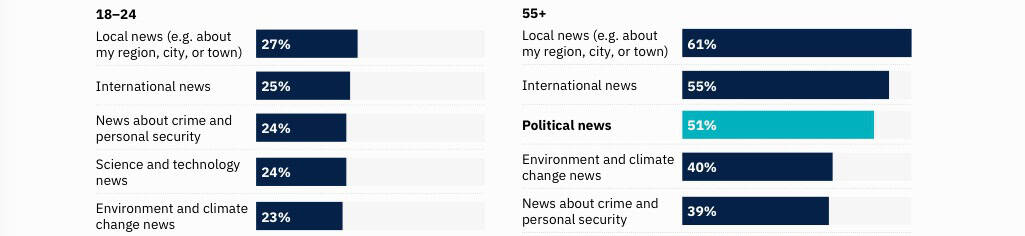
The challenge is in how we get from here, as the slowing train of traditional news production increasingly runs out of track, to there, an entirely different and rapidly evolving rollercoaster of emotive content. That process remains determinedly opaque.
If you’re running a media house, you have to know what the numbers look like and where they are trending. Your choice is simple. Suckle at an increasingly dry teat or start rearing a new cash cow capable of producing a next-generation revenue stream.
If you’re a journalist, pay closer attention to the style and approach of the journalism that is drawing audiences.
There were precious few programmes that actively trained journalists for how things were done yesterday and none that I am aware of that offer media workers a way to gear up to reach a news audience today.
For decades, the next step for a young journalist working locally was not to become an older journalist working locally, it was to become a corporate communications specialist.
If you want to stick around in this business, you can adapt (Advice from 2017 is here). You cannot continue doing things the way they have always been done because that system is walking dead.
The Substack News Pain Points has an excellent summary of the challenge that journalism faces on that front.
If you’re a working journalist, try that out on a personal blog, YouTube channel or social media presence on a topic that’s close to your heart but miles away from your beat, particularly if you are an employee.
Don’t just use platforms, go deep, learning how they work, how to optimise them, how to assess analytics and adapt your approach.
Some companies will require notification if you’re doing something like this, but the effort and likely hassle is worth it.
It’s unlikely that you will get many opportunities to put anything you learn into practice on the job, but there’s nothing stopping you from evolving a new style and approach that makes you relevant to a younger audience.
There’s nothing more educational than failure that’s calibrated using real time responses (or a lack of them) and while the learning can be hard, it’s absolutely necessary.



















 Urgency, awareness needed to combat sextortion
August 24, 2026
Urgency, awareness needed to combat sextortion
August 24, 2026
 The silent, growing danger of ransomware
August 17, 2026
The silent, growing danger of ransomware
August 17, 2026
 How should a newsroom of the...
August 10, 2026
How should a newsroom of the...
August 10, 2026
 FNP’s halting stumble to dubious relevance
August 3, 2026
FNP’s halting stumble to dubious relevance
August 3, 2026
 Samsung’s big bet on AI
July 27, 2026
Samsung’s big bet on AI
July 27, 2026
 The data centre dilemma
July 20, 2026
The data centre dilemma
July 20, 2026
 How should business and government embrace...
July 13, 2026
How should business and government embrace...
July 13, 2026
 How influencer marketing works in the...
July 5, 2026
How influencer marketing works in the...
July 5, 2026
 Yes, a website is work. Yes,...
June 29, 2026
Yes, a website is work. Yes,...
June 29, 2026
 No more fire in these wires
June 22, 2026
No more fire in these wires
June 22, 2026
 What the heck is chip binning?
June 14, 2026
What the heck is chip binning?
June 14, 2026
 Solving the region’s journalism problem
June 8, 2026
Solving the region’s journalism problem
June 8, 2026
 Tambini to journalists: “Keep doing what...
May 31, 2026
Tambini to journalists: “Keep doing what...
May 31, 2026
 How do we unfetter journalism from...
May 25, 2026
How do we unfetter journalism from...
May 25, 2026
 What the Canvas hack tells us...
May 15, 2026
What the Canvas hack tells us...
May 15, 2026
 Ghost women in AI? Hardly!
May 10, 2026
Ghost women in AI? Hardly!
May 10, 2026
 IShowSpeed: Here and gone
May 4, 2026
IShowSpeed: Here and gone
May 4, 2026
 How TT journalists can turn modern...
April 26, 2026
How TT journalists can turn modern...
April 26, 2026
 Reuters report on young news readers...
April 20, 2026
Reuters report on young news readers...
April 20, 2026
 The state of ransomware in the...
April 12, 2026
The state of ransomware in the...
April 12, 2026