


Above: Illustration generated using Google’s Nano Banana generative AI Tool
Nicole Greene published this series on Digital Public Infrastructure on her Substack on April 12, 2026. It is reproduced here with her permission. This is the first of four articles considering DPI and Trinidad and Tobago digital governance.
The Invisible Architecture
When someone dies in Trinidad and Tobago, the grief does not pause for paperwork. And the paperwork definitely does not pause for grief.
A spouse leaves a hospital and steps immediately into an administrative maze, transporting paper forms from office to office in a relentless, in-person journey across a half-dozen agencies…
The path connecting the Registrar General’s office with the funeral home is rarely a straight one. At every single counter, they face the same exhausting uncertainty: Who needs an original? Who will accept a copy? In a system where no two people seem to provide the exact same answer, the burden of proof rests almost entirely on the bereaved.
The frustration is the inevitable result of the architecture – or, rather, the absence of it. The hospital’s system does not communicate with the Registrar General’s system. The Registrar General’s system does not communicate with the bank, the pension office, or the insurance company. Each institution operates in a closed silo and the grieving family becomes the unwitting messenger forced to connect them all.
This is life without digital transformation.
Many people hear the phrase “digital transformation” and think of completing a form on a website instead of at a counter, or paying a bill through an app instead of standing in a line. That is digitalisation, and it matters, but it is not transformation. Digitalisation puts a process online. Transformation changes the process itself – and for that to happen, something more fundamental has to be in place underneath.
In 2023, the world’s twenty largest economies sat down to attempt to standardise a definition for what that foundation should look like. What emerged was a consensus that, months earlier, few observers believed was achievable.

India’s G20 breakthrough: A new global consensus and approach to digital transformation
Trinidad and Tobago has been tracking DPI developments since 2023, the year the concept moved from a technical niche to a global mandate.
India assumed the presidency of the G20 in December 2022 with a specific agenda for its Digital Economy Working Group. The Indian government wanted to put Digital Public Infrastructure (DPI) at the centre of the global conversation. Not as an abstract concept, but as a practical framework: what does a country need to build, at a foundational level, to make digital government work for its people?
The Digital Economy Working Group convened with the International Telecommunication Union (ITU), the Organisation for Economic Co-operation and Development (OECD), the United Nations Development Programme (UNDP), the United Nations Educational, Scientific and Cultural Organization (UNESCO), and the World Bank as knowledge partners.
Their task was to arrive at a shared definition of DPI that twenty very different economies could sign. Most observers thought it was impossible.
After the first meeting in February, few observers thought consensus was achievable. The concept was too new, the political interests too varied, the stages of digital development across the G20 too different. By April, insiders reported that the best realistic outcome might be a light and loosely structured paragraph.
By June, the momentum shifted. Nineteen of the twenty negotiating teams began to converge. Between June and August, a nuanced document emerged. At the final meeting in Bengaluru, negotiations over the draft ministerial declaration ran through the night. According to a first-person account published by a member of India’s Ministry of Electronics and Information Technology, consensus was reached in the early hours of 19 August 2023.
What the G20 Digital Economy Ministers adopted was the only multilaterally agreed language on DPI – a description of shared digital systems that should be secure, interoperable, and built on open standards to promote access to services for all. The following month, this language was incorporated into the New Delhi Leaders’ Declaration.
The world’s largest economies had agreed: digital transformation rests on three foundational pillars.

The three pillars of Digital Public Infrastructure
Interoperability
The first is interoperability – the ability for different systems to exchange information securely with each other. This is the layer that is entirely absent from the death registration experience – and, for that matter, from many government processes across the developing world. The hospital knows that someone has died.
The Registrar General does not, until the family carries the paper across town. The pension office does not know either, nor the bank, nor the insurance company. Each system exists in its own silo.
Interoperability means a death registered at a hospital can flow to every agency that needs to act on it, provided there is proper authorisation and security.
Digital identity
The second is digital identity – a secure, verifiable way for a person to prove they are who they say they are. When a surviving spouse walks into an office, the question of identity should not require a stack of photocopied documents, each one a separate proof that this person is who they claim to be. A national digital credential means verification that is instant, secure, and does not require surrendering more personal information than necessary.
Digital payments
The third is digital payments – the ability to conduct financial transactions digitally. A death benefit, an insurance payout, the closure of an account and transfer of funds – these should not require weeks of in-person visits to separate institutions. Digital payment infrastructure means money moves when it needs to, to the person it needs to reach, with a verifiable record.
The proof at scale
In 2009, fewer than 17 per cent of Indian citizens had bank accounts.
The country faced a challenge that numbers alone struggle to convey: how do you bring formal financial services, government benefits, and verifiable identity to over a billion people, most of whom have no official documentation? India’s answer was Aadhaar – a national digital identity system that assigned a unique twelve-digit number to every resident, verified by biometrics. The project was considered impossibly ambitious. Within eight years, over a billion people had been enrolled – one of the most rapid expansions of a public system in history.
Within eight years, India saw a transformation from just 17 percent of its population having bank accounts to nearly 90 percent access.
On top of Aadhaar, India built UPI – the Unified Payments Interface – a real-time digital payment system that today processes over 13 billion transactions a month. Together with data exchange layers that allowed government systems to share information securely, India had constructed a working proof of concept for all three DPI pillars at population scale.
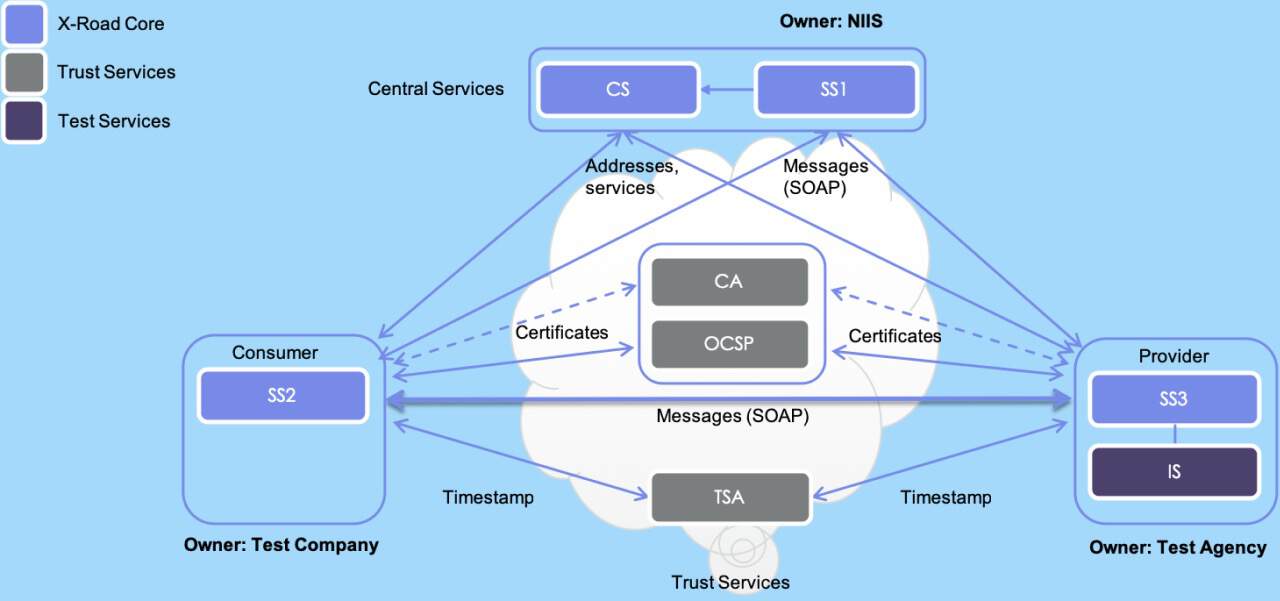
Estonia: 100 percent digitalisation of government services
Half a world away, Estonia had been building its own version of interoperability since 2001, when a small team launched X-Road from the cellar of a foundation on Toompea Hill in Tallinn. X-Road is a secure data exchange layer which allows every government system, and many private sector systems, to communicate with each other. A citizen provides their information once, and the system shares it where it is needed.
Twenty-five years later, X-Road connects over 929 institutions and enterprises in Estonia alone. It processes approximately 295 million requests per month. Estonia has achieved 100 per cent digitalisation of its government services and risen to second place on the United Nations E-Government Development Index.
The open-source commons
India had proven that DPI works. But Aadhaar was built for India – designed for Indian law, Indian infrastructure, Indian scale. It was a proprietary system.
Across the developing world, countries that wanted to build national digital identity systems were turning to commercial vendors – and facing a serious dilemma. Proprietary software meant governments could not customise their systems without tying themselves, financially and functionally, to a single company’s pricing and roadmap. If that vendor raised prices or discontinued support, a country’s national infrastructure was at risk. Donors, meanwhile, found themselves funding identity systems in the Global South that were built for a single use – e.g. a voter registration system good for one election, and which contributed nothing to the country’s long-term digital foundations.
At the International Institute of Information Technology in Bangalore, a team led by Professor S. Rajagopalan asked a different question: what if the technology behind Aadhaar could be rebuilt as something any country could own, adapt, and use for free?
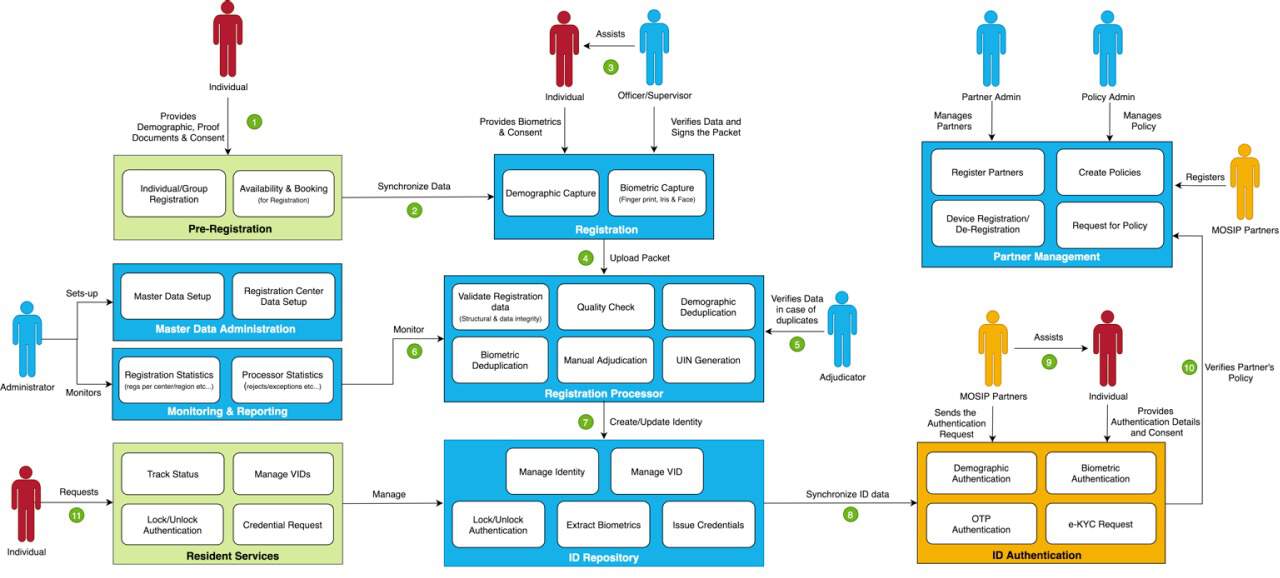
The result was MOSIP – the Modular Open Source Identity Platform. Launched in 2018, MOSIP is not a copy of Aadhaar. It is an open-source platform, built on Aadhaar’s architectural principles but designed to be modular – a country can adopt the whole system or select individual components that fit its own laws, existing infrastructure, and specific needs. The code sits on GitHub. Developers anywhere in the world can contribute to it. Countries that implement it build modules and improvements that flow back into the commons, available for the next country to use.
As of late 2023, over 100 million digital IDs had been issued using MOSIP. Eleven countries – Morocco, the Philippines, Sri Lanka, Guinea, Togo, Niger, Uganda, Ethiopia, Burkina Faso, Madagascar, and Sierra Leone – are in various stages of adoption. The MOSIP Partner Programme and Marketplace maintains vendor neutrality, allowing countries to choose and change their technology partners at any point, without losing control of their systems.
MOSIP is not the only open-source DPI tool. KoboToolbox is used by over 32,000 organisations in more than 220 countries and territories. Mojaloop provides open-source real-time payment infrastructure. Each of these tools exists because the alternative is choosing proprietary systems that lock developing nations into dependency. A choice that could be both expensive, and a threat to sovereignty.
The advantages of open source
DPI built on open source offers:
- Transparency: The code is visible, meaning vulnerabilities are fixed by a global community, not hidden behind corporate secrecy.
- Collaboration and Shared Learning: Smaller nations can benefit from the innovations of larger ones without “reinventing the wheel” or paying millions in licensing fees.
- Independence: It ensures that we own our national infrastructure.
The global ecosystem
The expertise and learnings from building India’s digital stack did not remain in India. Pramod Varma, the former Chief Architect of Aadhaar and India Stack, now co-chairs the Centre for Digital Public Infrastructure (CDPI), an organisation which works directly with countries to turn a framework agreed in Bengaluru into a system deployed in Kigali or Kingston.
CDPI is one node in a much larger network.
In 2024, the United Nations General Assembly adopted the Global Digital Compact – a comprehensive framework for international digital cooperation. The UNDP and the United Nations Office for Digital and Emerging Technologies (UN ODET) developed the Universal DPI Safeguards Framework, to anchor privacy, inclusion, and accountability.
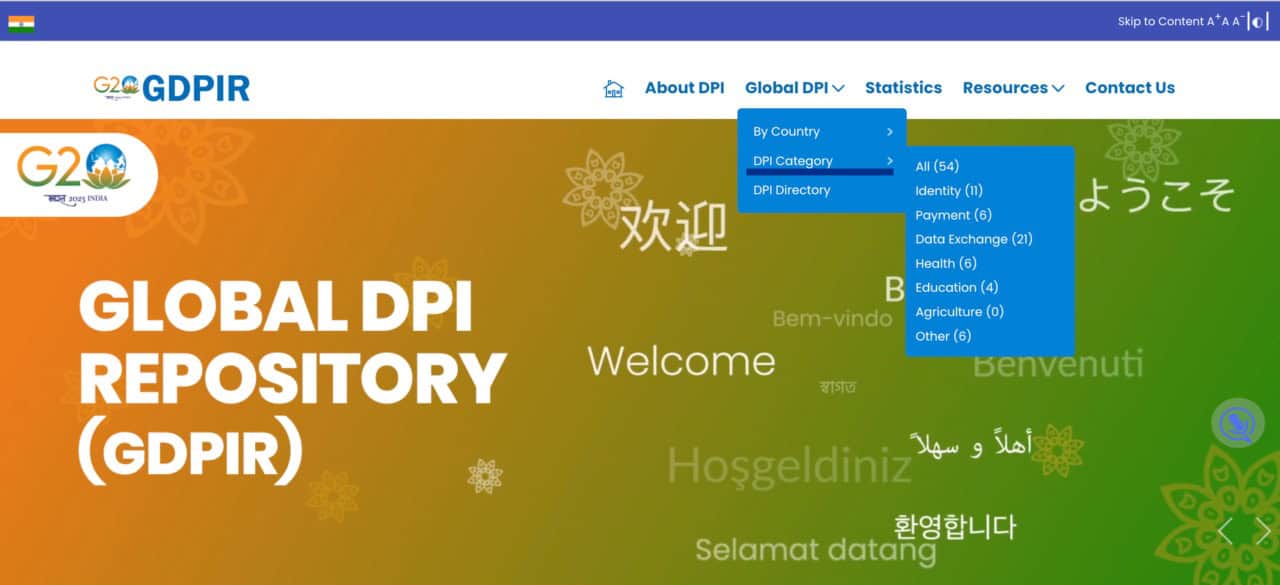
India backed the global vision with capital. In November 2023, Prime Minister Narendra Modi announced the Global Digital Public Infrastructure Repository – which today features over 50 DPI solutions from 16 countries – and a Social Impact Fund with an initial commitment of 25 million US dollars to help developing nations build their own digital infrastructure.
The 50-in-5 campaign, co-led by the Digital Public Goods Alliance (DPGA) and Co-Develop – a global nonprofit fund that provides targeted grant funding to open-source DPI solutions including MOSIP, Mojaloop, and OpenCRVS – is working to support 50 countries to design and launch at least one DPI component by 2028. Trinidad and Tobago is one of those fifty countries. Co-Develop’s role extends beyond funding: it recruits countries into the campaign, organises peer learning exchanges, and provides sustained technical support. The DPGA, for its part, facilitates the discovery, development, and deployment of digital public goods – the open-source tools that make DPI possible without vendor lock-in.
Over two billion people worldwide remain offline. But even for those who are connected, the divide is less about internet access than about what sits on the other end of the connection – systems designed to serve people, or systems designed to replicate the same friction on a different screen.
Securing the infrastructure
A digital highway is only as good as its emergency services. As we move toward a digital society, cybersecurity is no longer an “IT issue”, it is a matter of national resilience, and requires concerted effort toward culture change on a national level.
Going it alone is not an option for developing nations.
According to ITU and World Bank data , the gap is stark: only a fraction of countries in Western and Eastern Africa have operational Computer Security Incident Response Teams (CSIRTs) as of 2024. The ITU has been instrumental in closing this gap, having already assisted 84 countries in evaluating their cybersecurity readiness and establishing National CIRTs. This coordinated global response is critical to protect a nation’s digital “roads” from emerging threats.
Building the builders
GovStack, a multi-stakeholder initiative founded by the ITU, Germany’s GIZ (Deutsche Gesellschaft für Internationale Zusammenarbeit), Estonia, and the Digital Impact Alliance (DIAL), develops reusable, modular building blocks – standardised components that governments can assemble and configure to build their own digital services. Think of it as a set of tested, interoperable parts: identity verification, payment processing, information mediation, registration, workflow management. A government does not start from scratch. It assembles from proven components, dramatically reducing the cost, time, and risk of deployment.
But building blocks need builders.
The GovStack Women in GovTech Challenge (WiGTC) 2026 is a capacity-building programme that trains local practitioners – designers, developers, project managers, policy specialists – to work with GovStack’s methodology and produce implementation-ready solutions. It takes women in technology from across the world and equips them to become the front line of responders for DPI deployment in their own countries.\
A great example of capacity building in action.
Architecture in action
I was pleased to have the opportunity to participate in WiGTC 2026. Our team selected death registration in Trinidad and Tobago as our use case.
Over the course of the Challenge, we moved from problem definition and research, to journey mapping of “as is” and “to be” states, designing the improved process, wireframing and working prototype.
We mapped the friction of the current system against the three pillars of DPI, and saw a new reality emerge. A death registered at a hospital initiates a secure, authorised flow of information to the agencies that need it. And benefit adjustments and account notifications are triggered, not chased. The same journey that currently takes days of travel between offices, is transformed into a process that respects the dignity of the people living through it.
Death registration is one process. But the same architecture applies to birth registration, business licensing, tax filing, access to health records – every point where a citizen touches a government service and either encounters a system that works, or becomes the messenger between systems that don’t.
This is digital transformation, built upon a foundation that empowers a new social contract between the state and its citizens, where friction is removed from daily touchpoints and quality of life improves.
About the author

Nicole Greene is a strategic communications professional and GovTech specialist based in Trinidad and Tobago. Her work focuses on Digital Public Infrastructure (DPI) – the foundational digital systems that allow modern states to recognise, transact with, and serve their citizens – and the communications conditions that determine whether those systems are adopted, trusted, and used.
She is the founder of Women in GovTech Caribbean and the author of ADAPT (Adoption-Driven Adaptive Planning for Transformation), a communications-readiness framework for DPI implementations. Her four-part DPI series examines the architecture beneath digital government. She writes from Port of Spain, and her work can be found at nicolegreenett.substack.com.




















 In a US university film lab,...
September 7, 2026
In a US university film lab,...
September 7, 2026
 Declaring independence from mobile roaming
August 31, 2026
Declaring independence from mobile roaming
August 31, 2026
 Urgency, awareness needed to combat sextortion
August 24, 2026
Urgency, awareness needed to combat sextortion
August 24, 2026
 The silent, growing danger of ransomware
August 17, 2026
The silent, growing danger of ransomware
August 17, 2026
 How should a newsroom of the...
August 10, 2026
How should a newsroom of the...
August 10, 2026
 FNP’s halting stumble to dubious relevance
August 3, 2026
FNP’s halting stumble to dubious relevance
August 3, 2026
 Samsung’s big bet on AI
July 27, 2026
Samsung’s big bet on AI
July 27, 2026
 The data centre dilemma
July 20, 2026
The data centre dilemma
July 20, 2026
 How should business and government embrace...
July 13, 2026
How should business and government embrace...
July 13, 2026
 How influencer marketing works in the...
July 5, 2026
How influencer marketing works in the...
July 5, 2026
 Yes, a website is work. Yes,...
June 29, 2026
Yes, a website is work. Yes,...
June 29, 2026
 No more fire in these wires
June 22, 2026
No more fire in these wires
June 22, 2026
 What the heck is chip binning?
June 14, 2026
What the heck is chip binning?
June 14, 2026
 Solving the region’s journalism problem
June 8, 2026
Solving the region’s journalism problem
June 8, 2026
 Tambini to journalists: “Keep doing what...
May 31, 2026
Tambini to journalists: “Keep doing what...
May 31, 2026
 How do we unfetter journalism from...
May 25, 2026
How do we unfetter journalism from...
May 25, 2026
 What the Canvas hack tells us...
May 15, 2026
What the Canvas hack tells us...
May 15, 2026
 Ghost women in AI? Hardly!
May 10, 2026
Ghost women in AI? Hardly!
May 10, 2026
 IShowSpeed: Here and gone
May 4, 2026
IShowSpeed: Here and gone
May 4, 2026
 How TT journalists can turn modern...
April 26, 2026
How TT journalists can turn modern...
April 26, 2026