


Above: Photo by ASphoto777/DepositPhotos
BitDepth 1559 for April 20, 2026
On March 26, the Reuters Institute for the study of Journalism, in partnership with the University of Oxford, released a new report on trends in journalism consumption.
The report placed an emphasis on the next generation audience, news consumers between the ages of 18-34 years-old.
This audience cohort came of age during the decade and a half that the decline in traditional news channel authority has been actively monitored and analysed.
Reuters is not the only organisation paying attention to the dramatic and continuous shifting of the goal posts that has proved the norm, across that time.
FT Strategies, working in conjunction with the Knight Lab at Northwestern University, published its own resource just a few weeks earlier, offering along with the bad news journalists have come to expect, some successful strategies being used to address the shift in news consumer expectations.
The drop in attention recorded in the Reuters report, Understanding Young News Audiences at a Time of Rapid Change, has been dramatic.
One chilling statistic records the decline in audience interest at the most active levels, “very” or “extremely” interested in news as falling from 60 percent in 2013 to 35 percent in 2025 in the 18-24 age group.
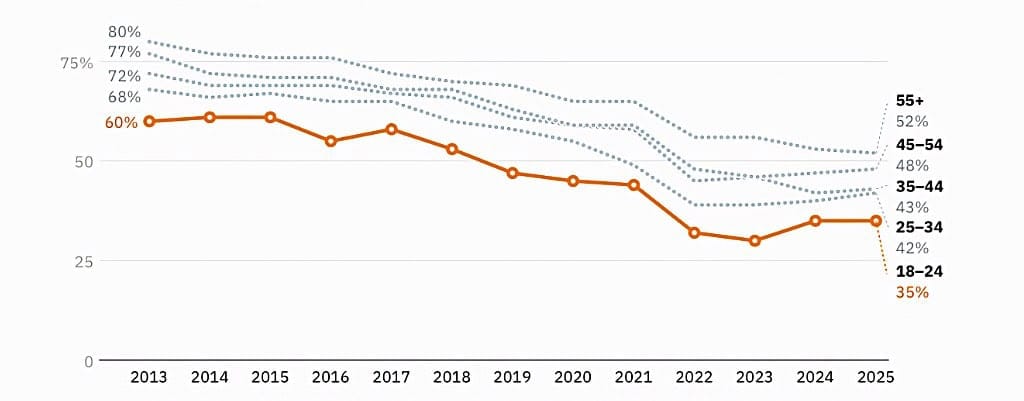
That critical group recorded a decline in enthusiasm for daily news from 79 percent in 2017 to 64 percent in 2025. By comparison, the elder cohort’s interest (55 years and older) dropped from 89 percent to 87 percent over the same period.
Traditional news consumers are steady in their habits. A drop of two percent in potential audience between 2017 and 2025 may be less a matter of a decline in interest than attrition resulting from mortality.
That’s one of the critical issues that the traditional media industry seems dead set on ignoring.
The audience it is designed to address, which has built up a stoutly resistant commitment to consuming news overseen by editors, shaped by editorial agendas and representing a communal understanding of what is happening in the world is, not to put too fine a point on it, dying off.
The generations that have come of age in this century have done so in an era of increasingly pervasive internet access.
Once acceptable broadband speeds became available on mobile devices, these audiences now began seeking information while events are happening instead of waiting for editorial packages.
Over the last ten years, multi-sourcing information has become the prerogative of the target audience, displacing the once Biblical authority of an editor or programme director.
The Reuters report records a notable flip between 2015 and 2025, when 18-24 news consumers started off by consulting news websites and apps 36 percent of the time and gathering information from social media feeds 21 percent of the time.
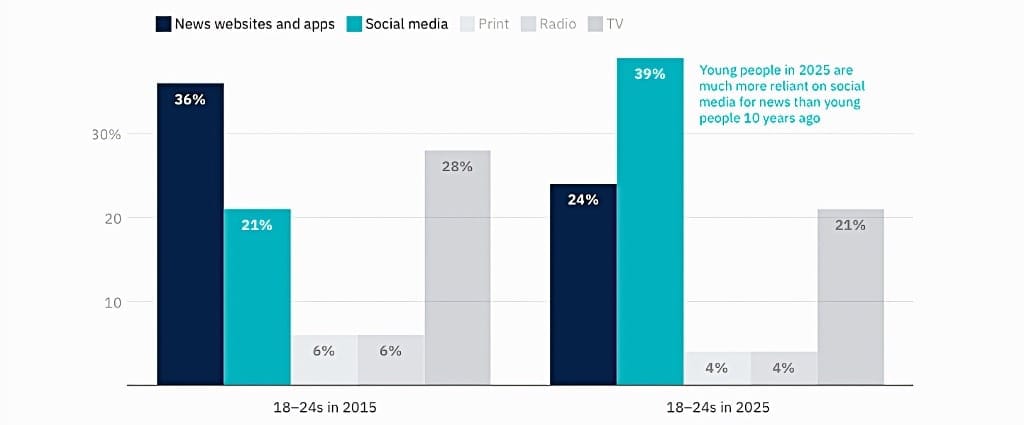
“By 2015 young people had either already moved away from [television and newspapers] as news sources or, in most cases, never used them in the first place,” the report notes.
“Instead, the story is about the move away from news websites as a source of news to social media and other forms of ‘distributed’ access. As we will show, this has emerged hand-in-hand with somewhat diverging interests, expectations, and needs when it comes to journalism – a different understanding of what news is and should be.”
By 2025, a new generation in that age group consulted news websites just 24 percent of the time, opting to access information from social media 39 percent of the time.
When reporting gets poured into the slurry of a social media newsfeed, it not only loses context, it becomes part of a homogenized, unbranded information resource, divorced from the shaping and perspective that’s possible when a considered, integrated resource of information is established on the internet.
Reuters found that formal news resources still command an authority of voice even with readers 18-34, at 36 percentage points, quite close to the over-55 ranking of 39 percent.
Official website sources run a close second for information reliability, with similar numbers, 37 percent (18-34) and 34 percent (over-35).
But taking solace in these isolated islands of staying power is to miss the point of the larger news consumption picture.
The switch to short-form, entertainment flavoured audiovisual delivery has been dramatic.
Between 2014 and 2025, YouTube rose as a forum for news consumption from just 20 percentage points to 23, but Instagram moved from 4 percent to 30 percent while TikTok – which didn’t show up as a social media alternative until 2018 in the US and international markets – rose from zero percent of the news attention market to 22 percent in that time, with no signs of slowing down.
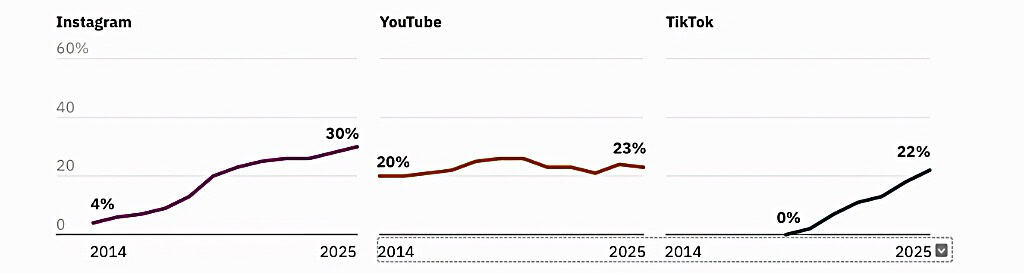
This is not just a shift in news consumption preference. It also cements in place the dramatic undermining of advertising and audience revenue that has traditionally been the life’s blood of media houses.
Getting information of acceptably reliable content is so widespread that today’s news consumers have come of age with no sense that paying for news forms part of the critical equation that governs its very creation.
Having largely never paid to be informed, it is extraordinarily difficult to make a case why they should start doing so. (Some advice from Juan Senor in 2025 is here.)
The other pressure point that traditional media has found challenging to address is the drift from the impartial presenter calmly offering produced, carefully manicured information to today’s more aggressively personal and direct “hot takes” on current events.
Local media houses have created “multimedia,” “web” and “social media” teams to translate produced stories in their standard formats to be posted to their websites and social media channels, but nothing is unique about these posts.
The output remains largely shovelware, dumped into social feeds in the hope that it will drive attention back to the source.
TechNewsTT is as guilty of this as any other media house.
While a special effort is made to format columns and stories as internet-native, making use of the capabilities and features available online, there is empathy here for what anyone can do with limited resources.
Even major international media houses have had their own challenges. Dave Jorgenson broke out as the Washington Post’s “TikTok guy” in 2019 but by 2025 had left the Post to start his own media company Local News International, taking much of that audience to a more informal and age-relateable online presence.
That’s a core challenge of personality driven media presentation. Make a rock star out of a journalist and there’s a good chance they will want to form their own band.
Next week, we revisit strategies that might help to level out this commercial nosedive.
The Reuters report PDF is here.




















 In a US university film lab,...
September 7, 2026
In a US university film lab,...
September 7, 2026
 Declaring independence from mobile roaming
August 31, 2026
Declaring independence from mobile roaming
August 31, 2026
 Urgency, awareness needed to combat sextortion
August 24, 2026
Urgency, awareness needed to combat sextortion
August 24, 2026
 The silent, growing danger of ransomware
August 17, 2026
The silent, growing danger of ransomware
August 17, 2026
 How should a newsroom of the...
August 10, 2026
How should a newsroom of the...
August 10, 2026
 FNP’s halting stumble to dubious relevance
August 3, 2026
FNP’s halting stumble to dubious relevance
August 3, 2026
 Samsung’s big bet on AI
July 27, 2026
Samsung’s big bet on AI
July 27, 2026
 The data centre dilemma
July 20, 2026
The data centre dilemma
July 20, 2026
 How should business and government embrace...
July 13, 2026
How should business and government embrace...
July 13, 2026
 How influencer marketing works in the...
July 5, 2026
How influencer marketing works in the...
July 5, 2026
 Yes, a website is work. Yes,...
June 29, 2026
Yes, a website is work. Yes,...
June 29, 2026
 No more fire in these wires
June 22, 2026
No more fire in these wires
June 22, 2026
 What the heck is chip binning?
June 14, 2026
What the heck is chip binning?
June 14, 2026
 Solving the region’s journalism problem
June 8, 2026
Solving the region’s journalism problem
June 8, 2026
 Tambini to journalists: “Keep doing what...
May 31, 2026
Tambini to journalists: “Keep doing what...
May 31, 2026
 How do we unfetter journalism from...
May 25, 2026
How do we unfetter journalism from...
May 25, 2026
 What the Canvas hack tells us...
May 15, 2026
What the Canvas hack tells us...
May 15, 2026
 Ghost women in AI? Hardly!
May 10, 2026
Ghost women in AI? Hardly!
May 10, 2026
 IShowSpeed: Here and gone
May 4, 2026
IShowSpeed: Here and gone
May 4, 2026
 How TT journalists can turn modern...
April 26, 2026
How TT journalists can turn modern...
April 26, 2026