


Above: The room filling turnout for the launch of VerifyTT was frontlined by 14 government ministers with an entourage of Permanent Secretaries, aides and a hive of social media flitting hither and yon. Photos by Mark Lyndersay.
On April 22, iGovtt hosted a lavish launch for its newest product, VerifyTT, an innovation that the state software development agency hopes will effect an important change in document handling within the civil service and eventually, in the wider ecosystem of documents that require official provenance.
What is VerifyTT?
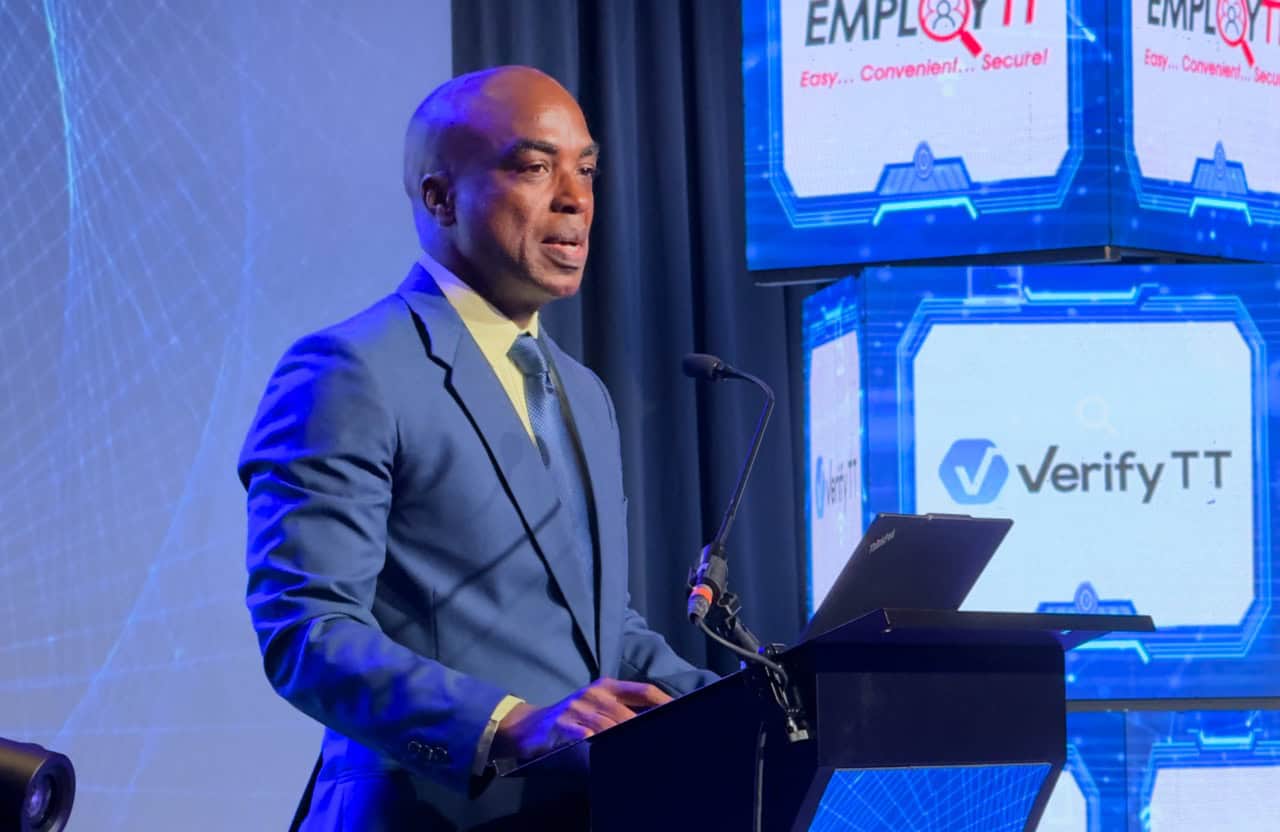
According to Charles Bobb-Semple, CEO (Acting) of iGovTT, the developer of the project, “We are building a foundation, a layer that allows systems, institutions, and people to trust information in a digital world.”
“An application solves a problem in one place. Digital public infrastructure (DPI) solves it across an entire ecosystem. That is the difference. Think about how things are done today. You apply for a job, a program, or an opportunity and the first thing [you’re] asked is, can you send your documents? Then begins the process of scanning, emailing them, and then the organization still has to verify that they are real. That is a problem we are solving.”
“What VerifyTT does is simple but very powerful. It allows institutions to issue credentials digitally. It allows individuals to hold and share those credentials securely and it allows anyone, anywhere, to verify them instantly and with confidence.”
“We are beginning with the education sector. Degrees from institutions such as the University of Trinidad and Tobago and the University of the West Indies. Certificates from national programs like LearnTT under the purview of the Ministry of Public Administration and Artificial Intelligence.”
The project, according to Bobb-Semple, was enabled by the Ministry of Public Administration and AI, the government establishing a government-to-government partnership with the government of India, which enabled a collaboration with the Center for Digital Public Infrastructure (CDPI).
“DPI,” iGovTT chairman Ria Karim explained, “is the trusted digital infrastructure, the rails of the highway on which many services can run.”
“Just as roads allow commerce to move and utilities power homes and businesses, digital rails allow secure services to move across institutions and to reach people efficiently. Once those rails are in place, ministries and agencies do not need to start from scratch each time they wish to modernize or digitize a service.”
“They can build on common foundations, launch services faster, scale proven solutions more efficiently, reduce the duplication, and very importantly, avoid the cost of multiple siloed systems being built to solve similar problems.”

The CDPI perspective
“This feeling of frustration, of losing time in a queue, of having to travel for hours to get some service delivered, that’s a tax we pay, but not a tax we pay in dollars, it’s a tax that we pay with our own time,” said Manuel Aguilera, Senior Regional Lead for Latin America and the Caribbean at CDPI.
“A recent study shows that on average in the Caribbean, it takes 4 hours to complete every government transaction and I can tell you it’s very similar in other countries.”
“It’s worse for those that live in remote areas, those that don’t have someone to leave their kids with, those that can’t afford the bus ride to the bank.”
“VerifyTT enables something very simple. Any institution in the country, from the largest university to the smallest high school, can issue an official document as a digital credential. A document that you can port and a document that cannot be forged.”
“Any person can carry that credential in their phones and share it online with whoever they want. Anyone can verify that credential is authentic. The premise is very simple, any institution can issue, anyone can hold, anyone can verify.”
“This ends our reliance on paper. Paper can still exist, but now citizens have for the first time a trusted option in the digital world. And because forging a document has never been so easy with the race of AI, what used to be our trust anchors, paper, photocopies, stamps, physical signatures, AI has made it unreliable. We’re in a world where government is built on paper, but paper is broken. So it is time to build something different.”
“For the last 30 years, governments worldwide have been trying to solve this problem. The way we’ve seen it solved, it’s always the same. A ministry has a problem, they decide to build a digital solution, and they never realized that another ministry might be buying a similar solution that can solve that problem. You have a third agency that has a technical team working on a new solution that looks very similar to the one in the first ministry. The result is lack of interoperability, siloed systems, lack of articulation, and the lack of a whole of government strategy.”
“This is not a caring problem. I’ve seen this movie in lots of places, in the rest of Latin America, in Africa, in Asia, in Europe. Regardless of the geography, the size of the country, the size of the government, and the level of development, governments are designed to work in a fragmented way by default. Trinidad and Tobago is choosing a different path.”
“The real work is only starting because the true work is not launching a platform. The hardest work is convincing a citizen to choose the digital lane over the paper for the first time.”
“Then we have to make sure that all this complex machinery that we put in place works in a way so that citizen has a good experience and choose that digital lane again and again and again until it becomes a habit. Because adoption is a habit problem, it is not a technology problem.”
“What does the next chapter require? First is a strong signal from government. We need a clear, specific signal that VerifyTT is the accepted way for citizens to present their credentials and they access public services. The risk that we can’t afford is the risk of a citizen taking their digital credentials to a public office in the country and getting rejected. That can’t happen.”
“The second thing that we need is alignment and momentum. If every minister in this room [there were 14 of them present for Aguilera’s speech] thinks about what is the most key critical credential in their sector, and we commit to digitize those credentials before the end of the year, we are going to start really shifting how government works from the foundations, because this is how ecosystems are built.”
“Not by one minister doing 10 things, but by 10 ministers, each doing one. The third thing that we need is demand. So for the private sector leaders in the room, the first three to jump to the platform won’t just be early adopters of a new platform or a new digital solution, you will be shaping how the digital economy works in the country. “
“These things don’t require new legislation, they don’t require a significant amount of money. What this requires is a decision.”
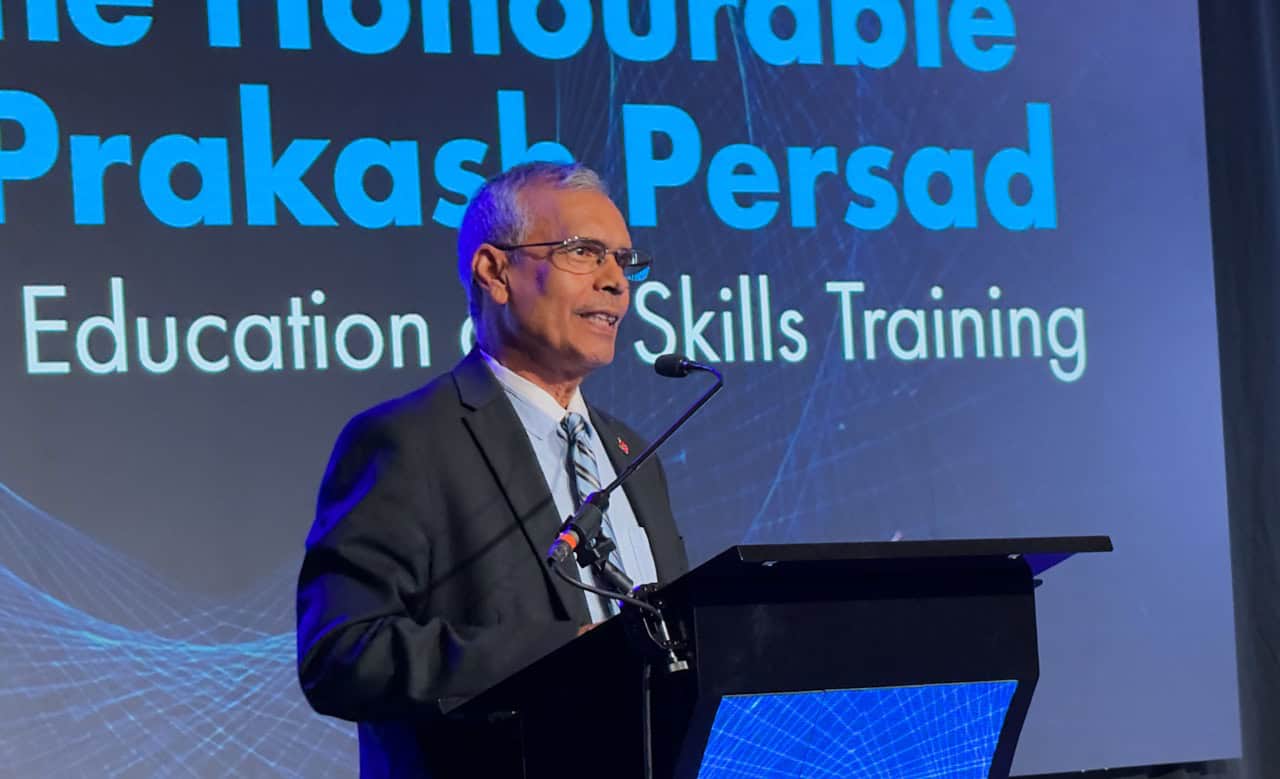
VerifyTT has already been implemented as a solution for higher education certification, with working arrangements in place for graduates and continuing education students at UTT, UWI and the Public Administration Ministry’s LearnTT initiative.
Tertiary Education Minister Prakash Persad explained how the system will work for those students.
“People want to do studies, their certificates, in short time periods [they] no longer to wait for three years for a degree. They have micro credentials stackable over time and this year is when this is going to become very important.”
“Once we have these micro-credentials, you build your degree block by block. Instead of a continuous three-year period, you can study a bit, work, study a bit, work, and that credential must be there, easily accessible. From the point of view of tertiary education, we look forward to digitalizing the entire tertiary education sector for better articulation for the benefit of our students and our country.”
Demonstrating the process with certification from the LearnTT portal, iGovTT Head of Software Irwin Williams offered a breathtakingly concise explanation of how VerifyTT works.
In this use case, the student can access a learner record, a listing of activities undertaken successfully and generate a secure QR code that enables a prospective employer to view that record. That record can be viewed by scanning the QR code, but in the instance that a PDF is generated, it can be set to be viewed a limited or unlimited number of times.
VerifyTT credentials can also be used on iGovTT’s EmployTT platform.
For now, it appears that accessing a particular institution on the VerifyTT platform is governed by an email issued by the tertiary institution, but if the system will cover degrees issued in the past, that’s likely to prove untenable, pointing to the need for the VerifyTT credentials system to be underwritten by a national authentication system that creates a larger funnel to capture more documents created by and required by other ministries.

That process appears to be underway, since the two-hour long launch was brought to an abrupt stop to haul two tables with little TT flags on them for the signing of two Memoranda of Understanding with Minister Saddam Hosein and a representative of the TT Police Service.
This mysterious, unexplained staging conformed to the best practices of theatre, hauling props on stage, placing people strategically and explaining nothing at all, leaving it to the audience to deduce what’s actually going on.
It’s likely that the mysterious documents being signed have something to do with new QR codes on land documents, which are under Minister Hosein’s purview, and the police signing was probably about making Certificates of Good Character available on the VerifyTT system, but who knows?
Minister Saddam Hosein, who probably won’t be charmed to be described as ‘the UNCs Minister of Everything and the inheritor of the hardest working man in Cabinet title from Stuart Young, lots of Cabinet ground, including, apparently, the realm of birth and death certificates.
In the year 2025, he announced, the number of birth certificates ordered online was 77,527 certificates. The in-person system served 8,100 people. In 2024, there were about 90,000 certificates issued. In 2023, we had about 130,000 birth certificates issued from the civil registry.
These polymer certificates are apparently very expensive, with every refill order costing US$1 million.
On New Year’s Day, Minister Hosein said, the SWRHA launched bedside registration, where officers at the medical facility register births, making the promise of instant birth certificates a possibility. Is a follow-up slab-side initiative for the instant registration of deaths on the cards?
What happens next?
VerifyTT points to a foundational start to the ongoing promise of digital identity in Trinidad and Tobago, something that’s been discussed with disturbing regularity over the last fifteen years.
The audience at the launch of the project was regularly prompted to applaud whenever someone mentioned “first in the Caribbean,” and while it might not be politic to say this, this country was first in the Caribbean when it began talking about digital governance with the turn of the century Fast Forward project, only to fall flat on its face through institutional inertia and inter-ministry infighting.
The Minister of Legal Affairs spoke at the event, but never addressed the question of legislation and regulatory oversight.
TTCSIRT might have been part of the development process and no doubt provided valuable feedback on cybersecurity, but it is neither a legislative nor a regulatory body.
If the government creates a digital credentials management system that works for its own verification needs, there is no question that it represents an advance on the current position, but plugging the private sector into the equation raises the question of legal liability to their shareholders that should lead such discussions.
Is the government ready to address those concerns?
Interoperability is no doubt high on the agenda of the CDPI, but effectively interacting with other nations using this digital credentials system is likely to involve more than just open and accessible APIs, interoperability will also demand legislative compatibility with other countries.
The consultants advising the government may now be from Latin America and not Estonia, but the advice has been consistent and clear. It’s the listening and taking required action that has always been the problem.
This isn’t the first time that iGovTT mangled the launch of a product. Read about the disastrous September 2007 launch of TTConnect here.


















 Urgency, awareness needed to combat sextortion
August 24, 2026
Urgency, awareness needed to combat sextortion
August 24, 2026
 The silent, growing danger of ransomware
August 17, 2026
The silent, growing danger of ransomware
August 17, 2026
 How should a newsroom of the...
August 10, 2026
How should a newsroom of the...
August 10, 2026
 FNP’s halting stumble to dubious relevance
August 3, 2026
FNP’s halting stumble to dubious relevance
August 3, 2026
 Samsung’s big bet on AI
July 27, 2026
Samsung’s big bet on AI
July 27, 2026
 The data centre dilemma
July 20, 2026
The data centre dilemma
July 20, 2026
 How should business and government embrace...
July 13, 2026
How should business and government embrace...
July 13, 2026
 How influencer marketing works in the...
July 5, 2026
How influencer marketing works in the...
July 5, 2026
 Yes, a website is work. Yes,...
June 29, 2026
Yes, a website is work. Yes,...
June 29, 2026
 No more fire in these wires
June 22, 2026
No more fire in these wires
June 22, 2026
 What the heck is chip binning?
June 14, 2026
What the heck is chip binning?
June 14, 2026
 Solving the region’s journalism problem
June 8, 2026
Solving the region’s journalism problem
June 8, 2026
 Tambini to journalists: “Keep doing what...
May 31, 2026
Tambini to journalists: “Keep doing what...
May 31, 2026
 How do we unfetter journalism from...
May 25, 2026
How do we unfetter journalism from...
May 25, 2026
 What the Canvas hack tells us...
May 15, 2026
What the Canvas hack tells us...
May 15, 2026
 Ghost women in AI? Hardly!
May 10, 2026
Ghost women in AI? Hardly!
May 10, 2026
 IShowSpeed: Here and gone
May 4, 2026
IShowSpeed: Here and gone
May 4, 2026
 How TT journalists can turn modern...
April 26, 2026
How TT journalists can turn modern...
April 26, 2026
 Reuters report on young news readers...
April 20, 2026
Reuters report on young news readers...
April 20, 2026
 The state of ransomware in the...
April 12, 2026
The state of ransomware in the...
April 12, 2026