
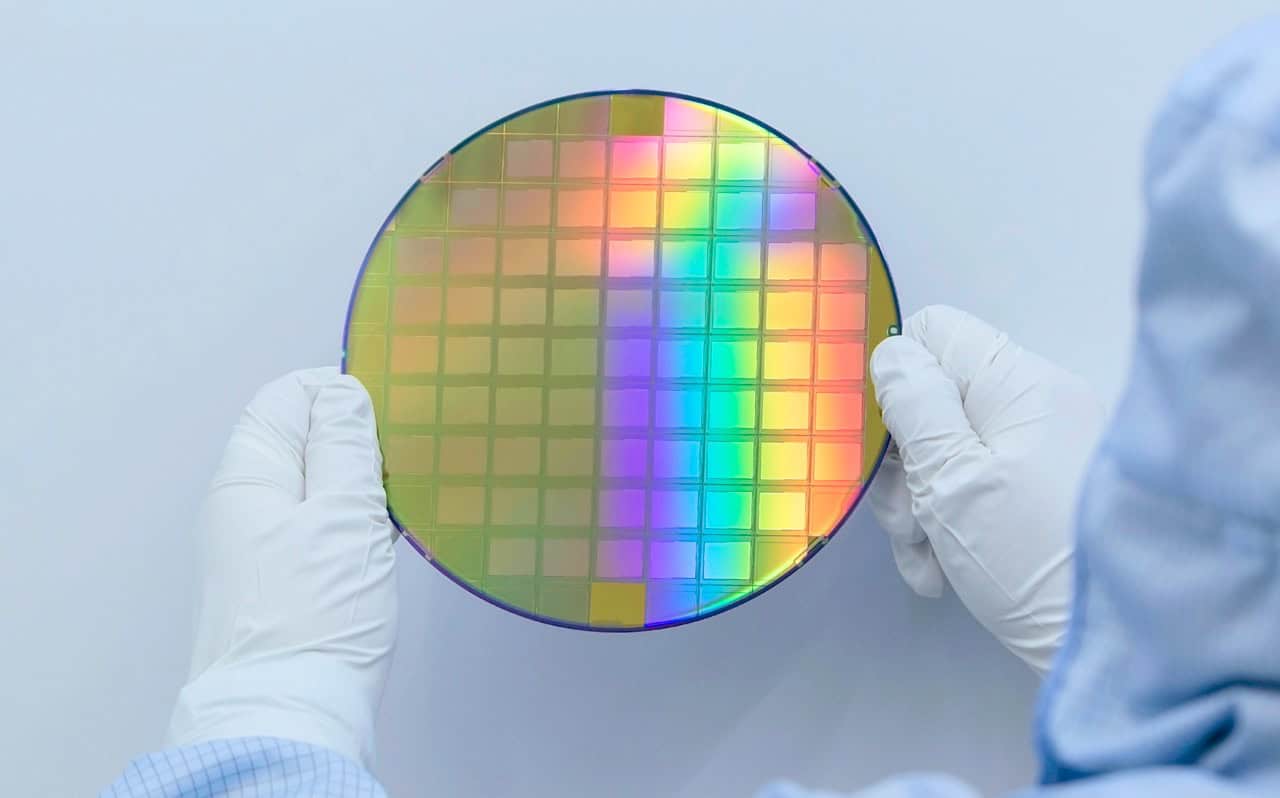

Above: Silicon wafer. Photo by sto-noname/DepositPhotos
BitDepth 1567 for June 15, 2026
Leave it to Apple to turn a routine technology practice into a story point, in this case, for the company’s new budget laptop, the MacBook Neo.
We can add this issue to the company’s controversial previous decisions to dump prevalent computer ports like SCSI and Serial in favour of newfangled USB, or its choice to drop the floppy disk across its entire line of computers in favour of some new data-CD thing.
Except that this time, it’s all about a procedure that computer processor manufacturers have been doing ever since those chips began adding additional processing cores on their manufacturing dies.
The TL:DR. The MacBook Neo is powered by one of Apple’s recent iPhone chips, the A18 Pro processor instead of the popular M series computer grade processors its been using, currently in their fifth generation.
The A18 Pro shipped in iPhones with six cores, individual processors on the chip that provide the engine of their computing prowess.
In a well-optimised system, the workload on a computer is either split across multiple cores or processed in parallel, speeding up demanding tasks.
The A18 Pro chip normally has six cores, but the ones used in the Neo are binned units, processors in which one of the cores has been deemed unreliable.
These chips would probably have been recycled, but most processors in modern computers undergo market-targeted binning as a part of the production process.
Instead of manufacturing multiple versions of a processor with different numbers of active cores, manufacturers create one master processor and then test the yields, selling those that pass testing at the highest level in the top tier, locking out defective or unreliable cores on those that don’t meet manufacturing tolerances and selling them at a cheaper price under different series branding, such as i9, i7 and i5.

Everybody does this. When there is great demand for a cheaper chip, faster chips will be deliberately binned and sold at a lower price even when they pass testing with flying colours.
Nobody wants a back stock of really fast processor chips on the loading bay waiting for customers willing to settle for a cheaper processor with fewer cores.
The principle behind the practice goes all the way back to agricultural production, when a harvest of tomatoes; for example, is sorted into perfect product, sold for the highest price in top stores, an edible but not particularly attractive product sold in the bargain bin and unsellable tomatoes that are processed into animal feed or are ploughed back into the soil.
The MacBook Neo, released in March, turned out to be a hit for Apple and it isn’t just because it reused a chip that would have been trashed.
The computer is a marvel of strategic decision-making. Forgoing nice-to-have features in favour of must-haves that won the device outsized attention among computers in the sub-US$700 price range.
The trackpad is an unimpressive mechanical surface that harkens back to much earlier versions. The computer is built into an injection-moulded aluminum frame, not the plastic generally used in its competitors.
It has just two ports; one of which is an unforgivably slow USB-C port that runs at ancient USB 2 speeds, while the other is a more capable USB 3.2 port thats begging for a US$30 hub. No budget for a Thunderbolt chip in this machine.
But the positives are significant and demand has pushed the ship time of all models, including the more useful US$699, 512GB model to two weeks.
Apple is a company that, under Tim Cook, has created an elegant supply chain architecture, so that kind of wait for an in-demand product is unusual for the company.
Scuttlebutt has it that the supply of binned A18 Pro chips is running low and it seems that the company has made the surprising choice to ask its chip manufacturers to spin up production on more of the A18 Pro chips, a line that ended with the introduction of the iPhone 17, which used the more advanced A19 Pro chip.
If that’s the case, Apple will be deliberately binning chips capable of using all six production cores to meet the stated specifications of the MacBook Neo. Or it may not. That remains to be seen.

Why not do a production run upgrade to the A19 Pro chip on the device, which would also include an on-chip RAM upgrade from 8GB to 12GB?
There are several factors at play here.
For one, Apple Silicon leverages its new chip architecture by building all its processing power, CPU, GPU, Neural Processing and RAM onto a single chip.
Switching chips is likely to require more than just soldering a new processor to the existing motherboard. A redesign is expensive and never done on a model in production.
Then there is AI, or to be more accurate, the tremendous demand for the most powerful chips to power computers installed in both existing and planned data-centers that will deliver the considerable compute power required by artificial intelligence.
Three companies dominate the memory market. Micron Technology has closed its consumer facing brand Crucial entirely. SK Hynix and Samsung are reducing last generation DDR4 memory production to produce higher-end memory for data centers.
Because people are still buying computers and upgrading them, SK Hynix and Samsung are signalling a restart of production of earlier versions of DDR4 RAM, but are unlikely to recreate manufacturing dies to produce more sophisticated versions of those chips.
That won’t affect most business and home users, but gamers, whose rigs are based on cutting edge technology performance seem set to lose in this supply-demand tug-of-war.
RAM manufacturers will always favour the largest possible market for their product, not the most demanding. Apple does this too, quietly axing its premium MacPro computer entirely from its offerings.
Apple is said to be paying as much as US$70 for the A19 Pro chip, which uses a newer manufacturing process with lower usable yields in this superheated market, compared to around US$45 for the A18 Pro.
At some point, the company will probably have enough binned A19 Pro chips to do an upgrade to the MacBook Neo, but not before it’s exhausted the computer’s market potential at the current price point.
So thank Apple and its new budget laptop for prying open a view into both the practices of producers of computer hardware manufacturers and bringing into sharper focus the issues facing consumer-level computer users in a marketplace that’s increasingly not terribly interested in your personal hardware needs.

















 Declaring independence from mobile roaming
August 31, 2026
Declaring independence from mobile roaming
August 31, 2026
 Urgency, awareness needed to combat sextortion
August 24, 2026
Urgency, awareness needed to combat sextortion
August 24, 2026
 The silent, growing danger of ransomware
August 17, 2026
The silent, growing danger of ransomware
August 17, 2026
 How should a newsroom of the...
August 10, 2026
How should a newsroom of the...
August 10, 2026
 FNP’s halting stumble to dubious relevance
August 3, 2026
FNP’s halting stumble to dubious relevance
August 3, 2026
 Samsung’s big bet on AI
July 27, 2026
Samsung’s big bet on AI
July 27, 2026
 The data centre dilemma
July 20, 2026
The data centre dilemma
July 20, 2026
 How should business and government embrace...
July 13, 2026
How should business and government embrace...
July 13, 2026
 How influencer marketing works in the...
July 5, 2026
How influencer marketing works in the...
July 5, 2026
 Yes, a website is work. Yes,...
June 29, 2026
Yes, a website is work. Yes,...
June 29, 2026
 No more fire in these wires
June 22, 2026
No more fire in these wires
June 22, 2026
 What the heck is chip binning?
June 14, 2026
What the heck is chip binning?
June 14, 2026
 Solving the region’s journalism problem
June 8, 2026
Solving the region’s journalism problem
June 8, 2026
 Tambini to journalists: “Keep doing what...
May 31, 2026
Tambini to journalists: “Keep doing what...
May 31, 2026
 How do we unfetter journalism from...
May 25, 2026
How do we unfetter journalism from...
May 25, 2026
 What the Canvas hack tells us...
May 15, 2026
What the Canvas hack tells us...
May 15, 2026
 Ghost women in AI? Hardly!
May 10, 2026
Ghost women in AI? Hardly!
May 10, 2026
 IShowSpeed: Here and gone
May 4, 2026
IShowSpeed: Here and gone
May 4, 2026
 How TT journalists can turn modern...
April 26, 2026
How TT journalists can turn modern...
April 26, 2026
 Reuters report on young news readers...
April 20, 2026
Reuters report on young news readers...
April 20, 2026