
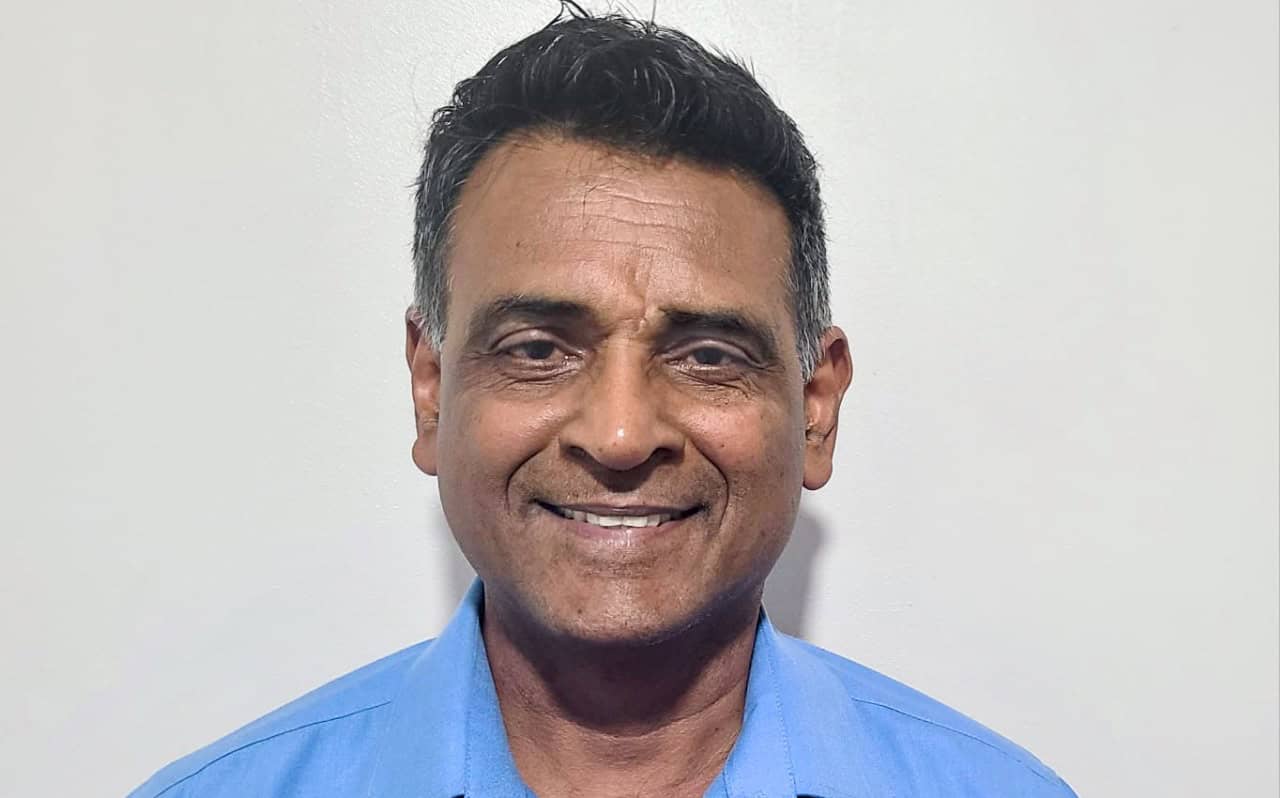

Above: RSC director Raj Ramdass. Photos courtesy RSC.
BitDepth#1497 for February 10, 2025
The morning session of the TT Internet Governance Forum (TTIGF) on January 31 was supposed to be an online discussion of cyberbullying among connected students, but it turned into something else entirely.
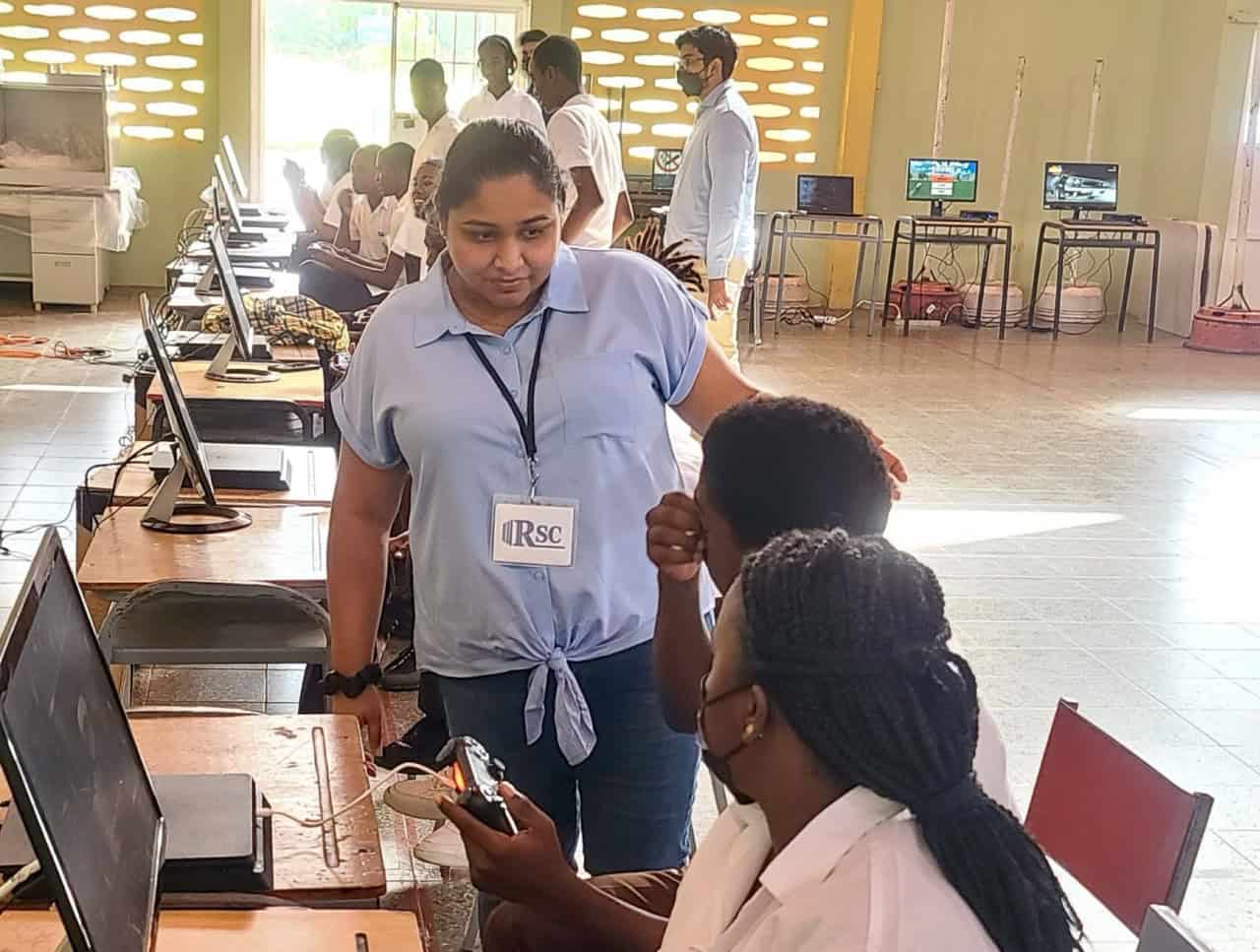
According to Raj Ramdass, director of Restore a Sense of I Can (RSC), a Penal-based technology learning initiative, “The original setup involved multiple moderators and student panelists from different schools engaging in discussions with the AI avatar on cyberbullying, making it more of a dialogue than just a Q&A session. After the discussions, students were supposed to move into breakout rooms for a more in-depth Q&A.”
Sketchy school internet forced an adaptation of that plan and a single moderator, UWI student Danara Sahadeo hosted the session, which quickly became a proof of concept of an app developed by RSC students, led by Inshan Bhattan, a former tech club member who now coaches development teams.
The custom AI tool is driven by a locally trained large language model and was demonstrated using a web-based 3D avatar to humanise the interface.
The technology is also being used to develop customised, regionally relevant AI tutors.
RSC has already released one that is teaching CSEC Mathematics Paper II and includes videos describing math procedures. Ramdass explained that in its earliest form, users can expect 90 per cent accuracy in its responses to questions.
Responding to questions I posed to him while he was in Guyana, where he was evangelising tech clubs last week, Ramdass explained that the humanoid model was initially created in 2021 for the Caribbean Association of Principals of Secondary Schools conference as part of an immersive virtual environment to assist teaching during Covid-19 lockdowns.
“Since then, we have been expanding that concept into AI-powered avatars. The avatar’s appearance, background, and personality vary based on the specific application, though for all beta versions so far, we have primarily used just two core models.”
One of those, a vaguely Asian, determinedly non-threatening female figure with a propensity for looking at her virtual hands, presented answers to questions about cyberbullying posed by students during the TTIGF online session.
Behind the scenes of the cyberbullying awareness app are several technologies, including speech recognition and synthesis, lip-sync animations, spatial awareness, a database, and multiple LLMs.
“The model configuration depends on factors like internet connectivity, device capabilities, confidentiality requirements, and the specific application,” Ramdass said.
“If the avatar is acting as a panelist on stage, we use a quantized LLM to ensure low-latency responses. If it’s functioning as a math tutor, we integrate a fine-tuned LLM trained specifically for that subject.”
“In cases where internet connectivity is limited or unavailable, we configure the avatar to utilize offline models for speech recognition, synthesis, and viseme generation (lip-sync animations).”
The cyberbullying resource is available to teachers who request it. RSC offers both a mobile app and a desktop version and there’s a web version of the Q&A model that’s accessible to RSC tech club members.
When access is opened more broadly, RSC plans to release a beta version of the app to school principals to allow educators and students to use the cyberbullying awareness tool in a structured and meaningful way, said Ramdass.
The use of LLMs that target the education system is part of a wider agenda by RSC to deliver educational tools throughout the Caribbean.
“The [curriculum] content is largely the same across the region, since all students sit the CXC exams. When we develop educational tools, our focus is on benefiting the entire Caribbean education system instead of just one country. Currently, we are actively engaging students through our tech clubs in 10 countries.”
“Our vision is to expand this initiative into a broader learning-based LLM system covering multiple subjects in the medium term. Alongside this, we aim to develop a parallel information management system that will provide educators—teachers and principals—with relevant analytics to enhance student learning and academic outcomes.”
“RSC’s mission is ‘effecting change through education and technology,’ and this project aligns perfectly with our ongoing efforts to support the regional education system.”
“This initiative is a natural extension of our work, not a shift in direction, leveraging evolving technology to enhance learning experiences. Our primary focus remains on supporting our 50,000 plus student members, but these AI-powered services are designed to be accessible to all.”
“As technology advances, we will continue to adapt and innovate to meet the needs of students and educators across the Caribbean. So we will continue refurbishing old computers in collaboration with TTCS, while also expanding our training and advocacy efforts within the education system.”
“Our commitment to climate and gender projects remains a core part of our mission, ensuring that technology-driven solutions support broader social impact.”


















 How AI is changing film making
September 14, 2026
How AI is changing film making
September 14, 2026
 In a US university film lab,...
September 7, 2026
In a US university film lab,...
September 7, 2026
 Declaring independence from mobile roaming
August 31, 2026
Declaring independence from mobile roaming
August 31, 2026
 Urgency, awareness needed to combat sextortion
August 24, 2026
Urgency, awareness needed to combat sextortion
August 24, 2026
 The silent, growing danger of ransomware
August 17, 2026
The silent, growing danger of ransomware
August 17, 2026
 How should a newsroom of the...
August 10, 2026
How should a newsroom of the...
August 10, 2026
 FNP’s halting stumble to dubious relevance
August 3, 2026
FNP’s halting stumble to dubious relevance
August 3, 2026
 Samsung’s big bet on AI
July 27, 2026
Samsung’s big bet on AI
July 27, 2026
 The data centre dilemma
July 20, 2026
The data centre dilemma
July 20, 2026
 How should business and government embrace...
July 13, 2026
How should business and government embrace...
July 13, 2026
 How influencer marketing works in the...
July 5, 2026
How influencer marketing works in the...
July 5, 2026
 Yes, a website is work. Yes,...
June 29, 2026
Yes, a website is work. Yes,...
June 29, 2026
 No more fire in these wires
June 22, 2026
No more fire in these wires
June 22, 2026
 What the heck is chip binning?
June 14, 2026
What the heck is chip binning?
June 14, 2026
 Solving the region’s journalism problem
June 8, 2026
Solving the region’s journalism problem
June 8, 2026
 Tambini to journalists: “Keep doing what...
May 31, 2026
Tambini to journalists: “Keep doing what...
May 31, 2026
 How do we unfetter journalism from...
May 25, 2026
How do we unfetter journalism from...
May 25, 2026
 What the Canvas hack tells us...
May 15, 2026
What the Canvas hack tells us...
May 15, 2026
 Ghost women in AI? Hardly!
May 10, 2026
Ghost women in AI? Hardly!
May 10, 2026
 IShowSpeed: Here and gone
May 4, 2026
IShowSpeed: Here and gone
May 4, 2026