
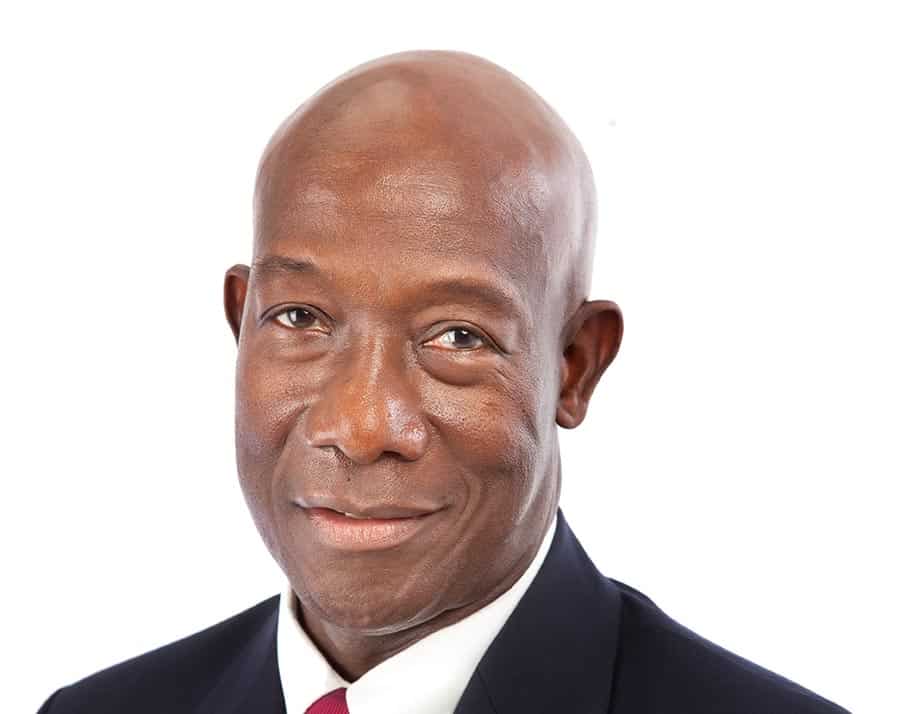

Above: Prime Minister Dr Keith Rowley
BitDepth#1472 for August 19, 2024
On June 30, the Prime Minister gave a commencement speech to more than 400 graduates at the University of the Southern Caribbean.
In his speech, Dr Rowley, looking appropriately professorial in cap and gown, challenged graduates to put their knowledge to work in the fight against crime.
It might have slipped the PM’s speechwriters that in this case, the sermon was being quite determinedly directed to the choir, a group of successful tertiary scholars who with the support of the Seventh-Day Adventist Church, had successfully completed almost two decades of study in the local school system.
Tens of thousands of children were not in that room, and most will live their lives with no knowledge of its existence.
They are the vulnerable heel of our education system and 2,600 of them will enter secondary schools in September.
The SEA exam gets its bad reputation for the way it is executed, acting as a gating mechanism between the desired denominational, government-assisted schools and the sometimes problematic government-run school system.
Many will be placed at the 16 schools that the Education Ministry designated in 2022 as “high-risk” after they assigned a heightened police presence to them.
Children entering these high-risk government schools will have scored 50 per cent or less in the SEA exam.
Students scoring less than 30 per cent doubled from 8.3 per cent in 2020 to 18.7 percent in 2022, but dropped to 14.39 out of 18,177 in 2024.
Compounding this is a globally acknowledged, locally denied problem of negative socialisation that’s the most pervasive legacy of covid restrictions.
There is no perfect school in Trinidad and Tobago and there may not be one anywhere in the world, but there are local schools that aspire to continuous improvement and others that struggle to make it through a working day without bloodshed.
The SEA system, which should be part of a process of continuous assessment and guiding children to realise their best capabilities, is educational brinksmanship.
How to teach the first form curriculum when many in an at-risk classrooms have a poor understanding of the fifth standard curriculum?
How to keep these classes in sync with the CXC curriculum when you are starting from behind?
Most of these children will not be taught geography or history in first and second form.
They enter secondary school existentially lost, then aren’t taught where they came from or where they are.
How can we realistically expect them to know where they are going?
Nobody in governance today has any idea what is happening with children in schools. Nobody. Everything you remember about your days at school, good and bad, is irrelevant.
Managing as if it were is not only ineffective, it is dangerous, particularly in our at-risk schools.
Puberty arrives earlier, lasts longer and is even less well understood today than when anyone reading this was in their teens.
The generations of children sandwiched between those entering and leaving secondary school this year are more fluently connected, more globally aware of fads, more easily misled by false information and less dependent on personal social interactions than any before them.
If they can’t see or understand a connection between their text books and any realistic life they might live, their attention wanders, often never to return.
Fretting about drug use, sexual activity, absenteeism and indiscipline in schools is pointless if there aren’t clear strategies for addressing them.
If the education ministry’s reporting systems are geared to encourage positive reporting of school issues, then by design, the state will have no idea what is going on either.
The ministry also doesn’t reveal much about what happens five years later at CXC, particularly relevant for at-risk schools, preferring instead to celebrate exemplary success in the school system generally.
In a September 2023 release on the country’s CSEC results, the Education Minister noted that 51.51 per cent of students got five subjects including math and English, widely regarded as the minimum required for employability.
The ministry does not explicitly note how many students left after five years at school with neither math nor English, a cohort of children who are effectively unemployable, nor does it have a clearly stated strategy of next steps for these educationally disadvantaged young adults.
A National Child Policy green paper covering 2020-2030 was published, but it’s largely a formal statement of the government’s policy response to the UN’s Sustainable Development Goals
A “no child left behind” policy was announced in 2020 to address access shortfalls resulting from covid lockdowns and along with other digital initiatives from that era, was largely retired after masks dropped.
In March 2023, the ministry published its Education Policy for 2023-2027, but so far all that seems to have resulted from that is a tussle with the TT Homeschool Association.
Key focus points in that document are plans to, “Implement the monitoring and evaluation systems and associated intervention strategies to ensure the success of each student within the education system” and “To facilitate the seamless transition of learners through all levels of the education system, and to promote purposeful career choices.”
These are sensible, though long overdue goals, but it should be clear to everyone that committing to leaving no child behind isn’t the same as ensuring that they have a fulfilling journey to meaningful employment.














 How AI is changing film making
September 14, 2026
How AI is changing film making
September 14, 2026
 In a US university film lab,...
September 7, 2026
In a US university film lab,...
September 7, 2026
 Declaring independence from mobile roaming
August 31, 2026
Declaring independence from mobile roaming
August 31, 2026
 Urgency, awareness needed to combat sextortion
August 24, 2026
Urgency, awareness needed to combat sextortion
August 24, 2026
 The silent, growing danger of ransomware
August 17, 2026
The silent, growing danger of ransomware
August 17, 2026
 How should a newsroom of the...
August 10, 2026
How should a newsroom of the...
August 10, 2026
 FNP’s halting stumble to dubious relevance
August 3, 2026
FNP’s halting stumble to dubious relevance
August 3, 2026
 Samsung’s big bet on AI
July 27, 2026
Samsung’s big bet on AI
July 27, 2026
 The data centre dilemma
July 20, 2026
The data centre dilemma
July 20, 2026
 How should business and government embrace...
July 13, 2026
How should business and government embrace...
July 13, 2026
 How influencer marketing works in the...
July 5, 2026
How influencer marketing works in the...
July 5, 2026
 Yes, a website is work. Yes,...
June 29, 2026
Yes, a website is work. Yes,...
June 29, 2026
 No more fire in these wires
June 22, 2026
No more fire in these wires
June 22, 2026
 What the heck is chip binning?
June 14, 2026
What the heck is chip binning?
June 14, 2026
 Solving the region’s journalism problem
June 8, 2026
Solving the region’s journalism problem
June 8, 2026
 Tambini to journalists: “Keep doing what...
May 31, 2026
Tambini to journalists: “Keep doing what...
May 31, 2026
 How do we unfetter journalism from...
May 25, 2026
How do we unfetter journalism from...
May 25, 2026
 What the Canvas hack tells us...
May 15, 2026
What the Canvas hack tells us...
May 15, 2026
 Ghost women in AI? Hardly!
May 10, 2026
Ghost women in AI? Hardly!
May 10, 2026
 IShowSpeed: Here and gone
May 4, 2026
IShowSpeed: Here and gone
May 4, 2026



The thing that bothers me about the education system, is no one, not the ones who excel, nor the ones who fail, leave ready to face life outside the education system.
Nobody comes out with an understanding of the REAL history of Trinidad, because for some unknown reason, despite the fact that the Father of the Nation, Dr Eric Williams, was a historian and wrote a book on the history of the West Indies, nobody is taught that, not even an abridged version.
Years, no decades, after I left school, I learned about the Cedula de Poblacion, the agreement that allowed mainly French colonists to live in Trinidad on exceedingly favourable terms, based on the size of their households, meaning how many slaves they owned. They were just given land for free, with minimal taxation.
This gave them a tremendous advantage over all the other colonists who arrived later. Nobody ever mentions that.
And we were never educated in how the political system works either. No mention of our rights/responsibilities under the constitution, or why we are using the Westminister model of government, which is a thing that a citizen might want to know.
Never any discussion of the various acts governing employment or welfare, nothing. It’s as though education exists in a different, totally artifical world to the real world.
As far as I can tell, there is no idea of using the time children spend in the education system, to diagnose any potential mental health issues they may be suffering from. No, children are not treated as individuals, with unique personalities/requirements/needs at all. It’s insane when you sit and think about it for a bit.
The way I see it, our education system really just provides a guaranteed income for teachers and administrators. It serves as political leverage over religious dominations and the voting public in general, which is EXACTLY what it was designed to do.
Actual education of our children or any real benefit to them, is seen as a side-effect.
I have yet to be convinced that digital transformation of our education system will provide any real benefit to the children of our nation.
The primary school in my village has a full computer lab which has NEVER been used EVER, because none of the teachers in that school have any understanding of computer technology.
This lab includes air-conditioning, and required so much electricity that an additional transformer had to be installed in the street outside. It’s been unused for YEARS!
“Add computer and stir” does NOT produce digitally capable citizens but it does provide income for computer salespeople!
Thanks for commenting sir.
[…] a commencement speech to more than 400 graduates at the University of the Southern Caribbean… more […]