
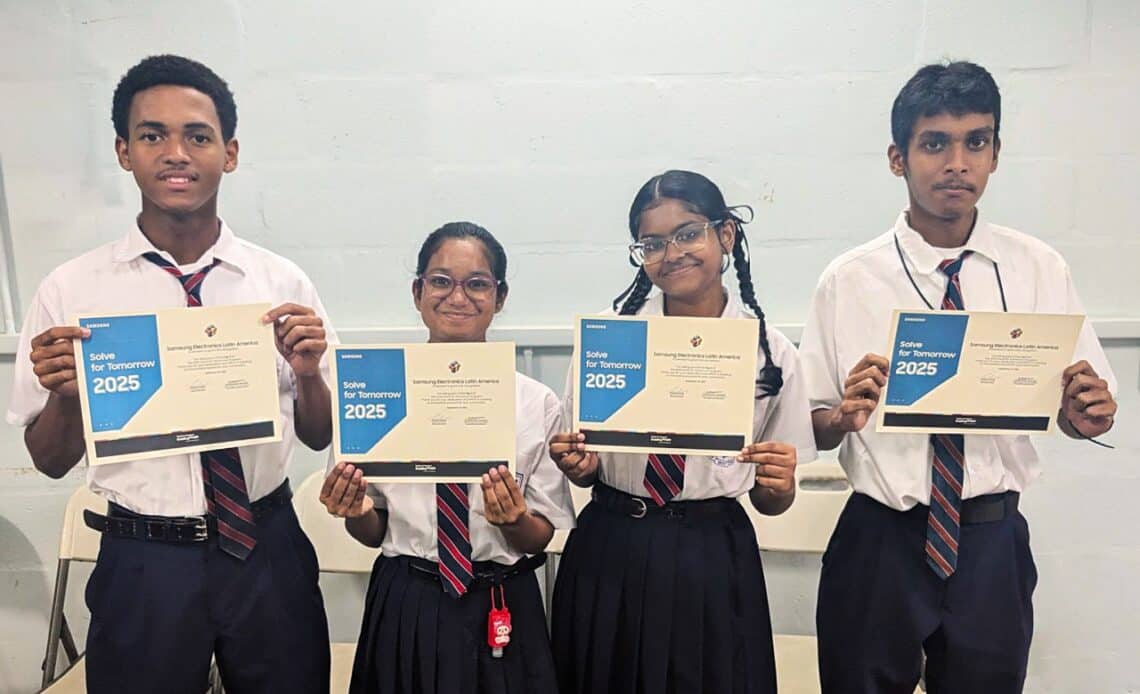
Above: Students from Marabella North Secondary with their Samsung certificates. Photo courtesy Samsung.
Teams from three schools in Trinidad and Tobago qualified to be in the final of the Solve for Tomorrow 2025, with projects that testify to their commitments to defending the environment and promoting sustainability.
The common denominator of the three teams is to contribute with their proposals to meet the requirements of local communities whose solutions result in the quality of their inhabitants. This educational initiative promoted by Samsung Electronics around the world, completed the semifinalist selection phase of the regional edition that brought together 13 countries from Central America, the Caribbean and part of South America.
Students from Marabella North Secondary presented the proposal “Don’t Get Wet – Alerts to Stay Dry and Stay Safe”, which addresses the critical problem of flooding in Trinidad and Tobago, exacerbated by climate change, inadequate drainage infrastructure and unplanned urbanization. The project proposes a solar-powered flood early warning system, using low-cost, autonomous monitoring stations.
St. Joseph’s Convent, San Fernando is in this final defending the benefits of “Keep Wild T&T”. The students who make up the team aim to address the threat posed by invasive species to the native and endemic species of Trinidad and Tobago, by designing an app that facilitates ecologically conscious reforestation, allowing users to identify native or non-native plant species by comparing photos with an extensive database.
The third team to qualify is Bishops’ High School, Tobago. The project “Tobago’s Greencycle Hub – Turning waste into energy, compost and community value”, aims to address the problems of waste management and access to clean energy in Tobago, especially in Scarborough. It proposes a hybrid community recycling center, powered by solar energy and biogas, which will process plastic, glass and organic waste to convert it into reusable materials, compost and biogas. The hub is designed to be operated by youth and volunteers from the community.
Young talent with social commitment
The evaluation committee learned in detail about the best projects presented by teams of students from Belize, Costa Rica, El Salvador, Guatemala, Honduras, Nicaragua, Dominican Republic, Panama, Paraguay, Trinidad and Tobago, Uruguay, and Venezuela. After fulfilling the crucial task of evaluating them, they selected the top three proposals. Now the qualified teams are preparing for the final, with innovative projects that seek to solve problems in their communities.
The participants proposed initiatives focused on collective needs that affect their communities following the guidelines of the program. “The Solve for Tomorrow programme challenges young people to devise and develop creative solutions to real problems that impact their communities. In this edition, the students demonstrated their ingenuity by linking their projects directly to the needs of their environments, proposing solutions that promise lasting benefits,” explained Maria Fernanda Hernández, Samsung’s Corporate Citizenship Manager for this region.
In terms of thematic areas, 40 percent of the 39 semi-finalist projects focused on Environment and Sustainability, evidencing the growing interest of young people in global ecological issues. Other areas highlighted include Education and Learning at 15 percent, and Equity and Inclusion (10 percent), Civic Engagement and Justice (10 percent), and Health and Wellbeing (10 percent).
Excitement and expectation continue to grow among the semifinalist teams, who are now preparing their proposals for the final to be held later this year. To this end, they will receive tools of different kinds – technology, programming, management, formulation and feasibility of projects and teamwork, among others – through special courses that are part of the benefits of SFT. Thus, they work on the maturation and optimization of their projects.