
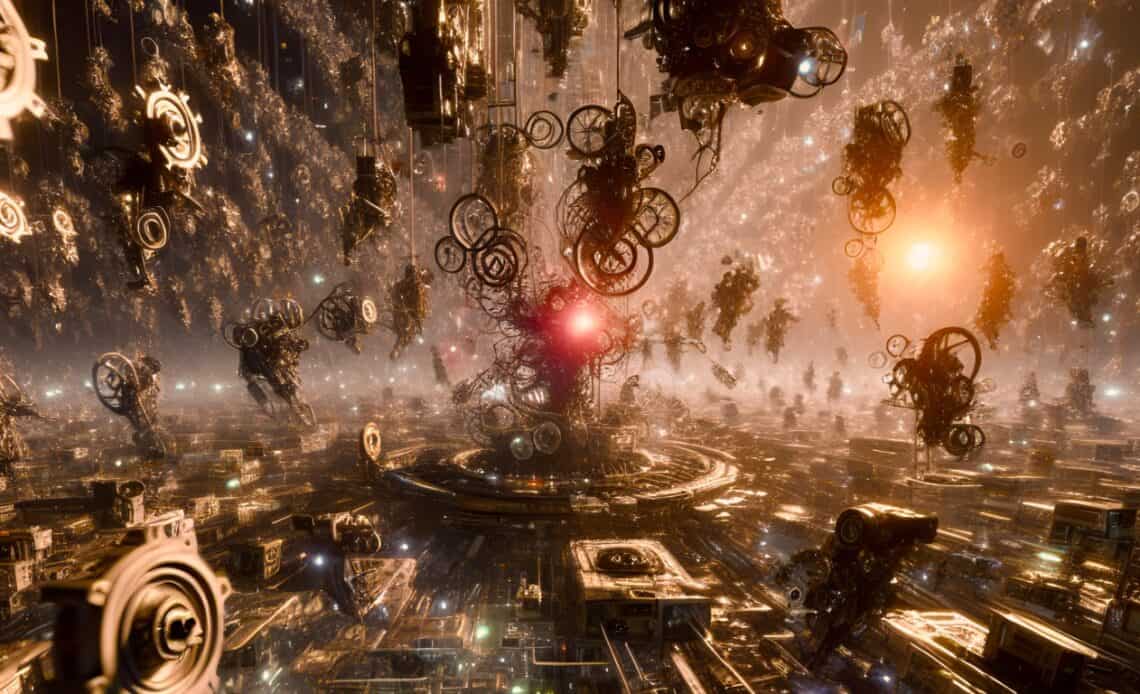
- The emergence of superintelligent machines could lead to drastic changes in human society.
- Thinking jobs will persist but require fewer human operators as AI takes over more tasks.
- Caring jobs, like childcare and eldercare, will remain relevant due to the need for human empathy and intuition.
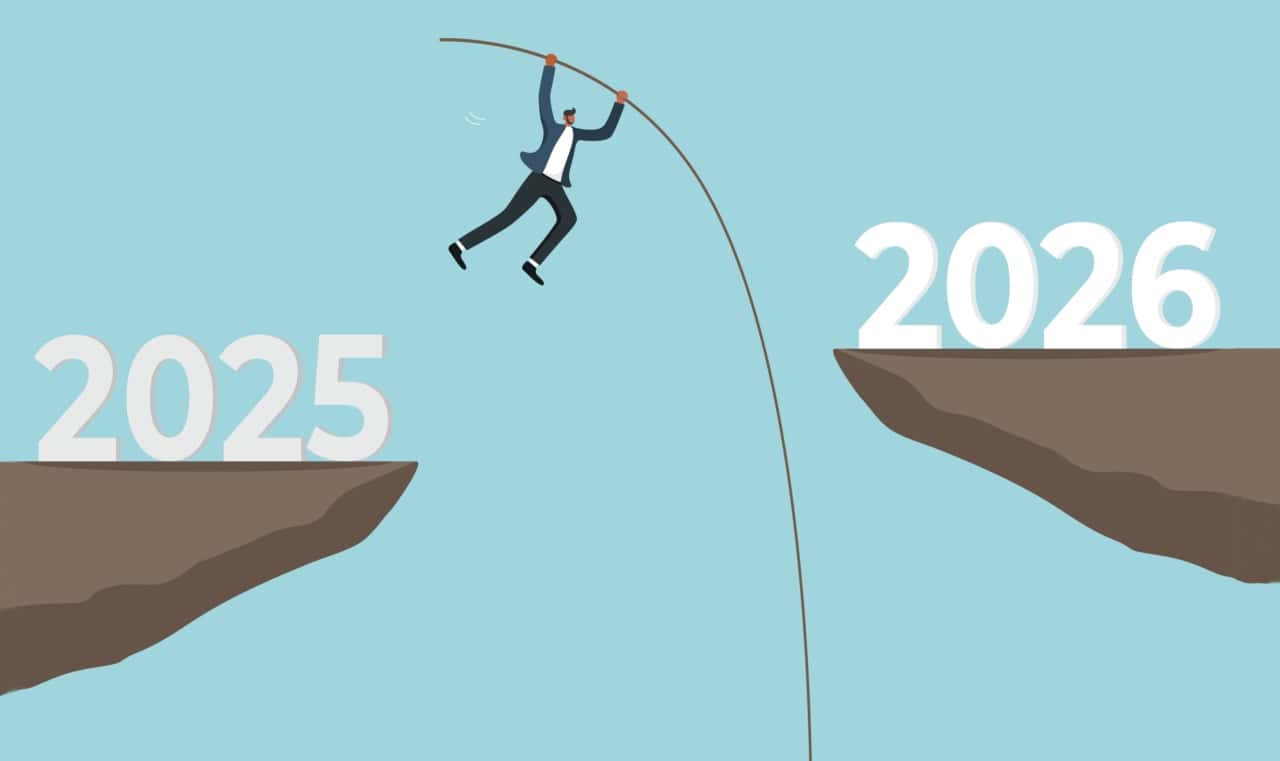
Above: Illustration made using the Flux AI image generator on 123rf.com
BitDepth#1528 for September 15, 2025
The technology singularity postulates that at some point, intelligent machines would begin creating even more intelligent machines in an explosion of advancement that would quickly leave human understanding behind.
The British mathematician IJ Good considered this all the way back in 1965, when he wrote: “The first ultra-intelligent machine is the last invention that man need ever make, provided that the machine is docile enough to tell us how to keep it under control.”
Good was writing when distributed networks of connected information were an abstraction, so he could not have known that such a machine, having achieved super-intelligence, would emerge knowing everything that humanity had ever done, to itself, to its neighbours and to the world.
Such a machine might conclude, in that nanosecond of awareness, that peeling the crust off planet Earth and tossing all its inhabitants into the sun like a bedsheet teeming with selfish, self-important bedbugs might be a good first step.
Instead, we have lived with the march of the machines Skynet scenario all these years, little suspecting that the singularity would take place at machine speed.
Before then; however, the world grappling with AI is likely to face a dramatic reorganisation of jobs. Many of the earliest speculation about which automated jobs will require human oversight seem ambitious.
Interns aren’t disposable napkins, they are the entry point for a new generation of leaders and visionaries, so simply dismissing all entry-level jobs would be a mistake.
Robert Reich, in an August 19 post to his Substack, pointed out that of the three broad classes of jobs, making, thinking, and caring, the ones that are likely to survive will be those that are driven by thinking and caring.
Making jobs are particularly vulnerable to automation and offshoring, moving to where the cost of labour is either cheap or can be reduced to closer to zero through increased automation.
Thinking jobs will continue to exist, but will require a shrinking pool of meat operators as ever more operations are ceded to fast AI control.
That’s already happening in cybersecurity operations, as hackers power their invasive tools with AI with response times that demand AI level blocks and countermeasures.
According to Crowdstrike, a threat-detection company, bad-actor AI will “Identify vulnerabilities, deploy campaigns along identified attack vectors, advance attack paths, establish backdoors within systems, exfiltrate or tamper with data, and interfere with system operations. AI-powered cyberattacks can learn and evolve and can adapt to avoid detection or create a pattern of attack that a security system can’t detect.”
Crowdstrike develops AI tools to respond to these next-level threats.
The extent to which thinking jobs will survive will depend on the personal acuity of practitioners and the identifiably human approach they can bring to that work.
Clearer is the potential for caring jobs, child-care and elder-care, jobs in the disability sector that require an experienced, intuitive response to nonstandard subjects.
While the standard of the human resource dedicated to such care is generally poor today, saturating the market with talent does not require an army of new recruits. There are people who are temperamentally unsuitable to any kind of sustained caregiving.
A saturated market means generally poor pay for those employed in the sector, which does not bode well for the quality of talent it will eventually attract.
The ideas of making, thinking and caring work does suggest specific sectors of the economy, but an economy fragmented by AI will be a fundamentally different one.
Journalism, for instance, in a world of ready availability of raw facts will be defined by practitioners who can both present a perspective and demonstrate both authority and trust in increasingly narrow niches.
Authors like Reich who are flexing Substack’s reach and discovery potential will thrive through the identifiable uniqueness of their work, not on cookie-cutter contributions to the thought pool.
The “care” business will also demand trust, as care will likely move beyond concepts of medical care into art, pet-care, household management, landscaping and areas of personal adult satisfaction, with only the best rising to the top of those professions.
There will, eventually, be more workers than there is work to be done, and that creates a new conundrum for human society.
Neither the capitalist nor the socialist forms of governance ever envisioned societies which no longer needed to build or advance, in which small sectors of the population accumulate vast wealth, leaving salt for the poor.
That won’t be an easy world to manage, if it comes to pass.













 Is Apple’s Neo the One?
March 22, 2026
Is Apple’s Neo the One?
March 22, 2026
 Privacy and your travel information
March 15, 2026
Privacy and your travel information
March 15, 2026
 TATT announces ambitious three-year strategic plan
March 9, 2026
TATT announces ambitious three-year strategic plan
March 9, 2026
 Samsung’s S26 leans in hard on...
March 1, 2026
Samsung’s S26 leans in hard on...
March 1, 2026
 A 2026 manifesto for Carnival
February 23, 2026
A 2026 manifesto for Carnival
February 23, 2026
 A hiss from a rose
February 15, 2026
A hiss from a rose
February 15, 2026
 News is a niche until it’s...
February 9, 2026
News is a niche until it’s...
February 9, 2026
 FT’s second Next Gen News report...
February 9, 2026
FT’s second Next Gen News report...
February 9, 2026
 Ransomware report notes fourth quarter 2025...
February 2, 2026
Ransomware report notes fourth quarter 2025...
February 2, 2026
 Hands-on with Apple’s Creator Studio as...
January 30, 2026
Hands-on with Apple’s Creator Studio as...
January 30, 2026
 Apple flirts with subscription software
January 26, 2026
Apple flirts with subscription software
January 26, 2026
 So long, and thanks for all...
January 19, 2026
So long, and thanks for all...
January 19, 2026
 Cyberedge reports on cybersecurity trends
January 12, 2026
Cyberedge reports on cybersecurity trends
January 12, 2026
 Samsung’s ZFlip 7 shows steady improvement
January 5, 2026
Samsung’s ZFlip 7 shows steady improvement
January 5, 2026
 Digital New Year’s resolutions
December 29, 2025
Digital New Year’s resolutions
December 29, 2025
 WiPay announces new strategy for services,...
December 22, 2025
WiPay announces new strategy for services,...
December 22, 2025
 Old Mac, new OS
December 15, 2025
Old Mac, new OS
December 15, 2025
 Regional cybersecurity faces fire
December 8, 2025
Regional cybersecurity faces fire
December 8, 2025
 Unfinished symphonies
December 1, 2025
Unfinished symphonies
December 1, 2025
 Do you know who your child...
November 24, 2025
Do you know who your child...
November 24, 2025
Still some time before an AI bot can come fix a leaking pipe in my bathroom or redo the patio stone work in my yard, install a new electrical outlet, including pulling wires ‘intelligently’ through the walls and floors (in some countries).
Maybe my plumber / electrician / mason / will get to my house in an autonomous vehicle but those building / doing trades seem to resist better to off-shoring and maybe AI too.
As for having human sentience ..!! well we don’t even get that right today between us and even worse between cultures, never mind towards other living beings, so will be interesting how a ‘generic AI’ will do.
Makes for exciting press AI but still some ways to go for artificial general intelligence (which is not what we have today) ..never mind human sentience.
,,,well at least I have not seen a scientific model for sentience …Yet!?!
\Wayne
My thoughts exactly.