

- Trinidad and Tobago has over 80% internet penetration, lower than Jamaica (85%) but higher than Barbados (76%).
- All three islands have poor “upstream diversity” and rely heavily on global internet connections.
- Trinidad and Tobago (62%), Jamaica (43%), and Barbados (37%) register varying levels of digital economy adaptation.
Above: Illustration by eamesBot/DepositPhotos
BitDepth#1504 for March 31, 2024
The Internet Society (ISOC) updates its Pulse rankings of countries across a range of connectivity benchmarks.
ISOC is an advocacy body that supports and promotes “The development of the internet as a global technical infrastructure, a resource to enrich people’s lives and a force for good in society.”
In the 2024 country report, formally released in February, the region’s statistics reveal areas of concern.
ISOC gathers its data from a combination of trusted data partners, third-party data sources and measurements it performs itself.
To establish TTs progress relative to the region, a direct comparison with the country reports of Jamaica and Barbados might offer some perspective.
Internet penetration.
More than 80 per cent of TT’s population is connected to the internet. Jamaica, with double TT’s population, has connected 85 per cent of its citizens while Barbados, with a fifth of TT’s numbers, reports 76 per cent internet penetration.
Regionally, connecting a small population in a geographically homogeneous island should be relatively simple, but few islands fit that profile. Antigua and Barbuda has a 91 per cent connection rate.
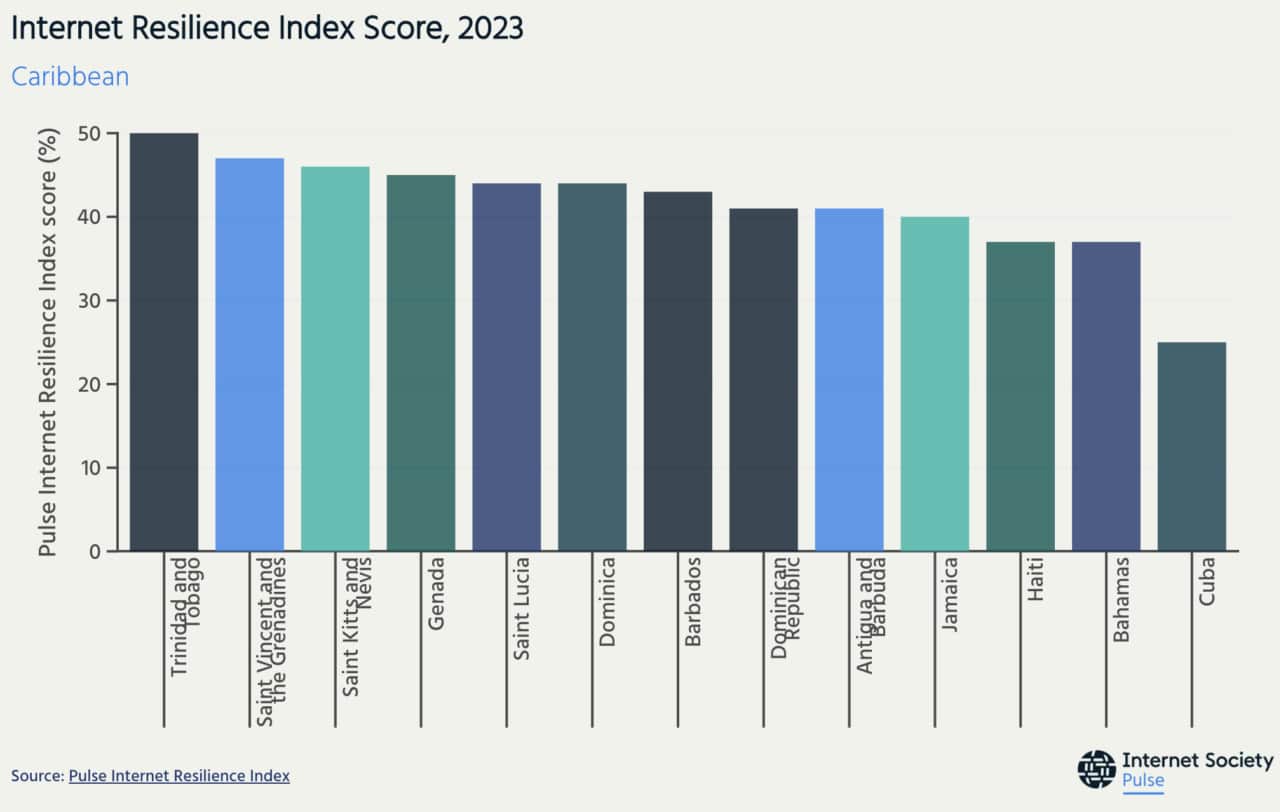
Internet resilience.
The average for the Americas region is 75 per cent.
The Internet Resilience Index tracks several factors relevant to an open internet, including infrastructure, performance, security and market readiness, the extent to which each local internet market is diverse, competitive and capable of effectively regulating itself.
TT has an overall internet resilience score of 50 per cent, the highest for the region. ISOC describes this as a medium capacity to withstand unexpected faults in the normal operation of its telecommunications data network.
Jamaica’s score on this metric is 40 per cent. Barbados has a 43 per cent score. Caribbean average: 41 per cent.
The resilience ranking also estimates the cost of a one-day shutdown of internet access to the country’s Gross Domestic Product. For TT, that number is US$607,307, for Jamaica, US$405,936, and for Barbados, US$66,827.
All three islands are ranked as poor in terms of their “upstream diversity,” the number of discrete connection routes to the global internet.
Another factor in internet resilience is the extent to which a country depends on a global internet connection for day to day operations.
Internet Exchange Points (IXPs), which enable strictly local internet connectivity and allow access to cached information can reduce this reliance, enabling continuity for internal connections if the tether to the global internet fails.
ISOC measures how many of the top 1,000 visited websites in each country is accessible via a local server (ISOC recommends a target of 50 per cent).
For TT, with two IXPs, that number is 28 per cent, with just 59 per cent of 17 registered local networks connecting or peering through this service. Jamaica caches 29 per cent of this data locally and for Barbados, with one IXP (BARIX), it’s 24 per cent.
Mobile internet uptake
TT has 95 per cent coverage for mobile 4G, defined as a person with at least one device connected to the mobile internet. For both Jamaica and Barbados, that number rises to 99 per cent.
The average mobile download speed for TT is 30.8 megabits per second, for Jamaica, 28.49 Mbps, and for Barbados, it’s 90.89 Mbps.
IPv6 adoption
The adoption of the IPv6 protocol, underway for more than a decade, has an adoption rate of 22 per cent in TT, 13 per cent in Jamaica and 15 per cent in Barbados. Compare with an average of 23 per cent for the Americas.
e-Government readiness.
ISOC’s measurement of how well a country is adapting to a digital economy. TT – 62 per cent. Jamaica – 43 per cent. Barbados – 37 per cent
Cybersecurity and DNSSEC
DNSSEC (Domain Name System Security Extensions) are a fairly recent suite of protocols to authenticate responses to domain name lookups.
Introduced in the 1990’s, more emphasis has been placed on adherence to the protocols in the face of cybersecurity breaches and faked domains.
The average for adoption of DNSSEC in the Americas region is 47 per cent, and TT has 43 per cent coverage, Jamaica, 63 per cent and Barbados, 94 per cent.
The ITU’s Global Cybersecurity Index, which measures a country’s commitment to cybersecurity measures across five pillars, is measured out of 100.
TT – 22. Jamaica – 33. Barbados – 17.
Generally, the three selected Caribbean nation track closely in score and don’t deviate much from the average from the Americas region.
But the internet is also increasingly a level playing field for threat actors. Caribbean countries sit in the lowest three tiers of cybersecurity development in the index (TT and Jamaica are in tier 3).
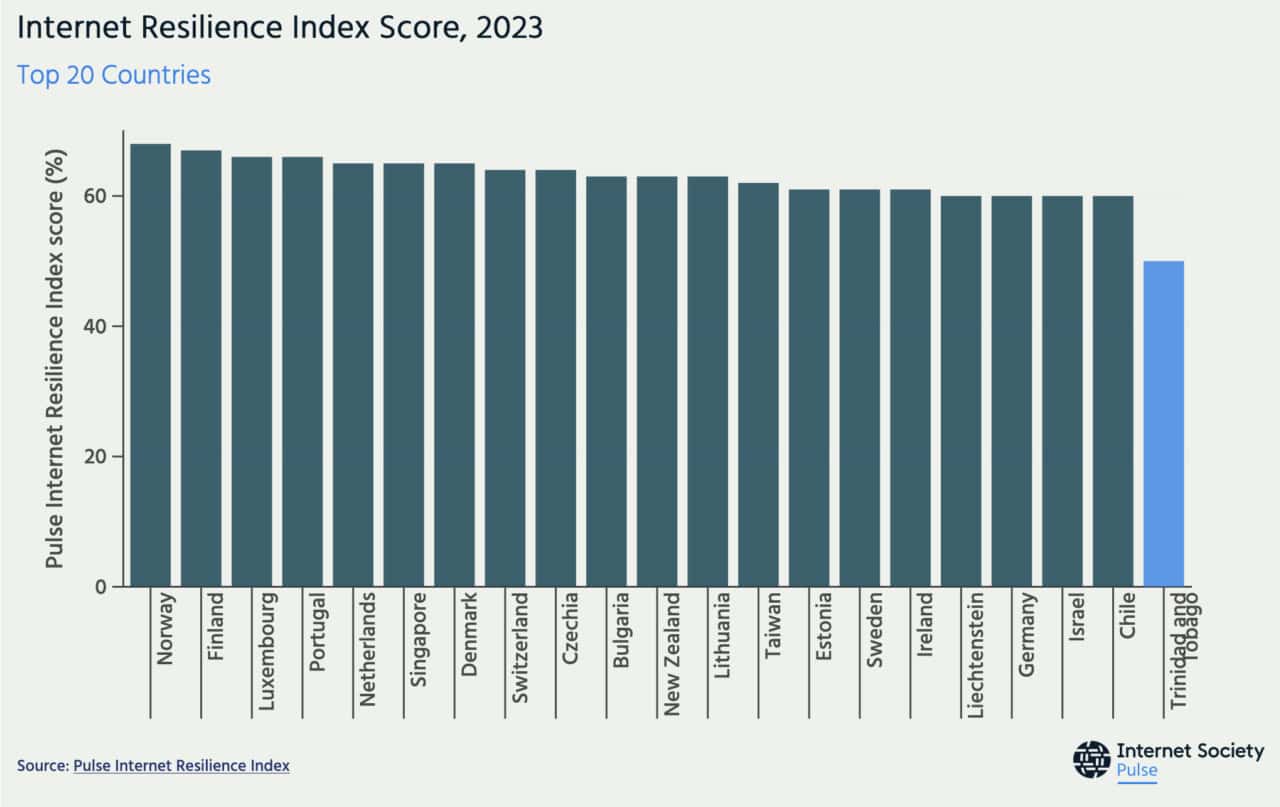
How do the measurements for the top digitally developed nations compare?
Denmark scores 93 on cybersecurity readiness with a resilience score of 65 per cent. Seventy per cent of commonly used websites are locally cached across eight active IXPs.
Japan scores 98 on cybersecurity, has a resilience score of 56 per cent and caches 92 percent of content across 21 IXPs.
There are no ready conclusions to be had. These rankings are meant to measure global internet development and to offer comparison statistics within a region. That’s the only sensible way to read them.
A regional comparison of metrics (Bermuda, St Martin and Ste Maarten are underreported and therefore unlisted. Montserrat is included as a guidepost for the experience of a sparsely populated Caribbean island.)
| Pop. | Resilience % | Internet Use % | e-Government % | Cybersecurity /100 | Caching % | |
| Antigua & Barbuda | 93,316 | 41 | 91 | 59 | 16 | 10 |
| Barbados | 282,336 | 43 | 76 | 71 | 17 | 24 |
| Cuba | 11,019,931 | 25 | 73 | 46 | 59 | 9 |
| Grenada | 11,7081 | 45 | 80 | 72 | 9 | 50 |
| Dominican Rep. | 11,331,265 | 41 | 84 | 46 | 75 | 46 |
| Guyana | 826, 353 | 43 | 85 | 69 | 28 | 13 |
| Haiti | 11,637, 398 | 37 | 39 | 18 | 6.4 | 10 |
| Jamaica | 2,839,786 | 40 | 85 | 43 | 57 | 29 |
| Montserrat | 4,367 | – | 55 | – | – | 1 |
| St Kitts & Nevis | 46,758 | 46 | 76 | 67 | 12 | 0 |
| St Lucia | 179,285 | 44 | 74 | 46 | 11 | 27 |
| St Vincent | 101,323 | 47 | 78 | 52 | 12 | 8 |
| Trinidad Tobago | 1,267,510 | 50 | 80 | 63 | 22 | 28 |
| Venezuela | 28,300,854 | 45 | 62 | 58 | 47 | 27 |


















 Is Apple’s Neo the One?
March 22, 2026
Is Apple’s Neo the One?
March 22, 2026
 Privacy and your travel information
March 15, 2026
Privacy and your travel information
March 15, 2026
 TATT announces ambitious three-year strategic plan
March 9, 2026
TATT announces ambitious three-year strategic plan
March 9, 2026
 Samsung’s S26 leans in hard on...
March 1, 2026
Samsung’s S26 leans in hard on...
March 1, 2026
 A 2026 manifesto for Carnival
February 23, 2026
A 2026 manifesto for Carnival
February 23, 2026
 A hiss from a rose
February 15, 2026
A hiss from a rose
February 15, 2026
 News is a niche until it’s...
February 9, 2026
News is a niche until it’s...
February 9, 2026
 FT’s second Next Gen News report...
February 9, 2026
FT’s second Next Gen News report...
February 9, 2026
 Ransomware report notes fourth quarter 2025...
February 2, 2026
Ransomware report notes fourth quarter 2025...
February 2, 2026
 Hands-on with Apple’s Creator Studio as...
January 30, 2026
Hands-on with Apple’s Creator Studio as...
January 30, 2026
 Apple flirts with subscription software
January 26, 2026
Apple flirts with subscription software
January 26, 2026
 So long, and thanks for all...
January 19, 2026
So long, and thanks for all...
January 19, 2026
 Cyberedge reports on cybersecurity trends
January 12, 2026
Cyberedge reports on cybersecurity trends
January 12, 2026
 Samsung’s ZFlip 7 shows steady improvement
January 5, 2026
Samsung’s ZFlip 7 shows steady improvement
January 5, 2026
 Digital New Year’s resolutions
December 29, 2025
Digital New Year’s resolutions
December 29, 2025
 WiPay announces new strategy for services,...
December 22, 2025
WiPay announces new strategy for services,...
December 22, 2025
 Old Mac, new OS
December 15, 2025
Old Mac, new OS
December 15, 2025
 Regional cybersecurity faces fire
December 8, 2025
Regional cybersecurity faces fire
December 8, 2025
 Unfinished symphonies
December 1, 2025
Unfinished symphonies
December 1, 2025
 Do you know who your child...
November 24, 2025
Do you know who your child...
November 24, 2025