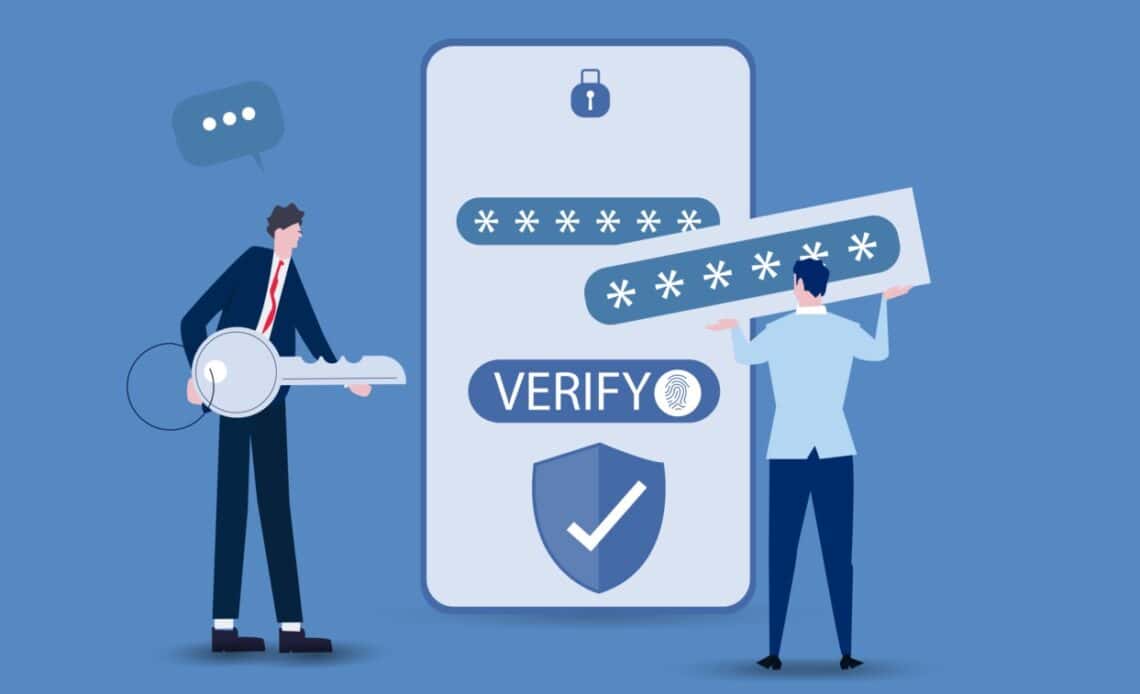
Above: Illustration by fuazmee/DepositPhotos
Every day, billions of digital interactions, from online purchases to cross-border contracts, depend on a simple question: can we trust the identities and data involved? As cyber threats grow and business moves further into the cloud, traditional methods of verification face new challenges.
New frameworks and technologies promise to redefine how organizations build and maintain trust online. In this article, you will discover:
- The historical milestones that shaped today’s digital trust landscape
- Core components behind modern verification technologies, from PKI and self-sovereign identity to decentralized identifiers
- How interoperability and regulations like eIDAS drive seamless cross-border transactions
- Strategies for safeguarding data sovereignty, including quantum-resistant cryptography and zero-trust architectures
- Real-world use cases in finance, healthcare, supply chains and e-government
- Future trends at the intersection of AI governance, IoT security, and quantum-resilient models
Whether you manage security for a global enterprise or you are simply curious about the next wave of trust solutions, this guide offers clear insights and practical takeaways. Let us begin by tracing the evolution of digital trust infrastructure and see how past innovations set the stage for tomorrow’s breakthroughs.
The evolution of digital trust infrastructure
Digital trust infrastructure traces back to the introduction of X.509 public key certificates in the late 1980s. Early browser support for SSL in the mid-1990s established certification authority hierarchies as the backbone of secure web sessions. Growing cyber threats and expanding e-commerce drove improvements in certificate lifecycle management, making automated issuance and revocation standard by the 2000s.
Regulatory Milestones: eIDAS
In 2014, the European Union rolled out the eIDAS regulation to harmonize electronic identification and trust services across member states. Qualified electronic signatures and seals under eIDAS ensured legal validity and mutual recognition for cross-border digital transactions.
Shift to Decentralized Models
Blockchain-based identity frameworks emerged to address central points of failure. W3C Decentralized Identifiers (DIDs) and networks like Sovrin enable verifiable credentials without relying on a single trusted authority. These next-generation models lay the groundwork for resilient, data-driven trust systems in the decade ahead.
Core components of modern verification technologies
Modern verification technologies combine cryptography, distributed systems, and self-sovereign identity standards. These core components provide the foundation for secure, interoperable trust across digital interactions.
Public Key Infrastructure & Qualified e-Signatures
Public Key Infrastructure (PKI) underpins most digital signature workflows. A mathematical algorithm generates public/private key pairs. Signers use the private key to encrypt a hash of the document. Verifiers decrypt that hash with the public key to confirm signer identity and document integrity.
Digital Signatures via PKI
Digital signatures rely on X.509 certificates issued by trusted authorities. They meet advanced electronic signature (AdES) criteria: unique linkage to the signer, signatory control, and tamper detection.
Qualified Electronic Signatures
Qualified electronic signatures (QES) build on AdES by using a qualified certificate and a secure signature creation device. Under EU regulation, QES carry the highest legal weight and are mutually recognized across member states.
Blockchain & Distributed Ledger Technology
Distributed ledger technology (DLT) offers a decentralized audit trail. Blockchains record transactions in linked blocks, each secured by consensus.
Consensus Mechanisms
- Proof of Work (PoW): high security and decentralization with significant energy use
- Proof of Stake (PoS): energy efficient; validators stake tokens to secure the network
- Proof of Authority (PoA) and Proof of Capacity (PoC): lower energy consumption for permissioned environments
Decentralized identifiers (DIDs) and verifiable credentials
Decentralized Identifiers are URIs that enable entities to control their own identifiers without a central registry. A DID document is a JSON-LD structure containing cryptographic keys and service endpoints.
DID Documents
Controllers prove ownership via associated verification methods in a DID document. Resolution protocols retrieve DID documents from distributed networks.
Verifiable Credentials
Verifiable Credentials complement DIDs by encoding claims in a tamper-evident format. Holders present cryptographic proofs to verifiers, enabling selective disclosure of identity attributes.
Enabling interoperability and cross-border transactions
Digital services require trust frameworks that work across jurisdictions. eIDAS and its successor lay the foundation for seamless, legally binding interactions.
eIDAS & eIDAS 2 frameworks
eIDAS created a predictable regulatory environment for electronic identification and trust services. It set technology-neutral standards for qualified electronic signatures, seals, time-stamps, and registered delivery. Once a national eID meets specified assurance levels and is notified to the Commission, all member states must accept it. The 2021 proposal for eIDAS 2 adds a European Digital Identity Wallet, electronic archiving, and remote signature management.
Mutual recognition mechanisms
eIDAS mandates that notified eIDs and qualified trust services are valid across member states. This mutual recognition supports real use cases:
- Cross-border tax submissions
- Foreign university enrollment
- Remote business registration
- Online tender bidding
Mutual recognition reduces friction and cuts compliance costs for organizations operating in multiple countries.
Global adoption beyond the EU
Several non-EU governments are piloting trust frameworks aligned with key eIDAS principles. Bilateral agreements in the Asia-Pacific and the Americas aim to extend mutual recognition of digital identities. International bodies like the OECD and the UN are exploring trust frameworks that mirror eIDAS. Trade blocs are also discussing rules to streamline digital trade and identity recognition. These initiatives pave the way for a global market of legally binding digital transactions.

Safeguarding data sovereignty and security
Protecting digital identity assets and cryptographic keys underpins strategic autonomy in trust services. Relying on non-EU providers introduces structural risks, as outside laws or conflicting disclosure rules can undermine data protection and legal certainty.
Qualified trust service providers operate exclusively under European law and meet strict cybersecurity and audit requirements. By keeping critical trust functions under European jurisdiction and aligned with eIDAS, organizations guarantee confidentiality, integrity, and cross-border interoperability.
Key management and custodial models
Effective key management relies on hardware security modules (HSMs), secure key lifecycle controls, and clear custodial policies.
Hardware security modules
HSMs provide tamper-resistant storage and cryptographic operations under strict access controls.
Custodial vs self-sovereign approaches
Organizations must balance centralized custodianship for ease of audit with self-sovereign key control to maximize data sovereignty and identity privacy.
Quantum-resistant algorithms
Post-quantum cryptography addresses future threats from quantum computing. Lattice-based and hash-based schemes offer resistance to quantum attacks today. Deploying hybrid algorithms that combine classical RSA or ECC with quantum-safe primitives allows a smooth transition toward fully quantum-secure infrastructures.
Zero-trust architectures
Zero-trust removes implicit trust in network perimeters by enforcing continuous verification:
- Microsegmentation limits lateral movement
- Strict authentication and authorization ensure least-privilege access
- Encryption of data in transit and at rest upholds integrity
- Client-side protections, like an ad blocker, block malicious scripts
Adopting zero-trust complements key management and quantum-safe measures, creating layered defenses that safeguard data sovereignty and secure critical trust functions.
Industry use cases impacted by trust infrastructure
Financial services and digital assets
Trust infrastructure enables identity-backed interactions to cryptographically link each payment to a verified legal identity. Financial institutions report up to 70% reduction in fraud losses and faster settlement cycles. Support for digital asset custody and tokenized securities also opens new revenue streams and real-time compliance checks, boosting ROI with lower audit overhead.
Healthcare records and telemedicine
Verifiable credentials validate patient consent and safeguard electronic health records. Telemedicine sessions gain end-to-end integrity, reducing compliance risks and improving patient trust with secure, tamper-evident data exchanges.
Interoperable health records cut manual reconciliation errors and audit costs by up to 50%, driving operational efficiency. Patients can also access digital therapeutics and remote monitoring tools, like those from Tactile Medical, to reduce swelling.
Supply chain traceability
End-to-end verifiability of certificates of origin and shipment records delivers:
- Shorter negotiation cycles and faster onboarding
- Reduced operating costs through automated verification
- Enhanced risk control by detecting anomalies early
Manufacturers and exporters benefit from transparent trade processes and lower dispute resolution expenses.
e-Government and digital odentity
Public administrations use qualified electronic signatures to prevent benefits fraud and identity theft. Cross-border digital identity frameworks streamline citizen services, cut processing times, and remove legal barriers under harmonized eGovernment regulations. Agencies also gain stronger data sovereignty by relying on trusted EU providers.
Future outlook: AI, IoT, and the quantum era
AI governance and trust
As AI systems power critical services, emerging frameworks embed reliability and transparency. The NIST AI Risk Management Framework and the U.S. National AI Initiative drive standards for secure model development. Key elements include:
- Clear accountability and audit trails
- Certification schemes for AI in healthcare and infrastructure
- Ongoing risk assessment and bias monitoring
These efforts will inform regulatory roadmaps through 2030.
Securing IoT ecosystems
Over 75 billion IoT devices will connect by 2030, creating vast attack surfaces. Robust device identity schemes and zero-trust architectures are essential. Best practices include:
- Hardware roots of trust and blockchain-based PKI
- Software bills of materials to track firmware integrity
- AI-driven threat detection at the network edge
High-speed, low-latency 5G networks will amplify data flows, requiring integrated trust across devices and analytics platforms.
Quantum-resilient models
Quantum computing threatens public-key systems like RSA and ECC. NIST’s selection of post-quantum algorithms marks a key milestone in migration planning. Organizations should:
- Adopt hybrid cryptography combining classical and quantum-safe algorithms
- Follow guidance from the National Quantum Initiative Act on research and workforce
- Integrate quantum resistance into long-term trust strategies
Preparing now ensures the trust infrastructure remains secure as quantum and AI technologies converge.
Conclusion
As digital interactions span borders and technologies evolve, a robust digital trust infrastructure is no longer optional. Verification technologies, from public key systems to decentralized identifiers, will define how organizations secure identities, protect data, and comply with emerging regulations.
Key takeaways:
- Evolution of trust: X.509 certificates, SSL, and the shift toward decentralized identity frameworks
- Core components: PKI, qualified e-signatures, DLT, DIDs, and verifiable credentials
- Regulatory drivers: eIDAS, eIDAS 2, and global mutual-recognition efforts
- Data sovereignty & security: hardware security modules, zero-trust architectures, and quantum-resistant cryptography
- Industry impact: finance, healthcare, supply chains, and e-government use cases
- Future trends: AI governance frameworks, IoT device identity, and quantum-resilient models
Armed with these insights and best practices, security leaders and technology teams can design a trust foundation that scales across cloud services, connected devices, and next-generation applications. The next decade will reward organizations that invest in verification technologies today and build systems for transparency, interoperability, and resilience. Set your digital trust strategy in motion now and lead the way to a more secure and connected future.

Ellie Williams
Ellie Williams studied at Miami State University and majored in Marketing with a minor in creative writing. She enjoys doing freelance writing on general business, wellness, and lifestyle tips. During her free time, she enjoys catching up with friends and family or attending local events.














 Digital döstädning
April 5, 2026
Digital döstädning
April 5, 2026
 The garbage infesting my in-box
March 30, 2026
The garbage infesting my in-box
March 30, 2026
 TSTT’s payments problem
March 30, 2026
TSTT’s payments problem
March 30, 2026
 Is Apple’s Neo the One?
March 22, 2026
Is Apple’s Neo the One?
March 22, 2026
 Privacy and your travel information
March 15, 2026
Privacy and your travel information
March 15, 2026
 TATT announces ambitious three-year strategic plan
March 9, 2026
TATT announces ambitious three-year strategic plan
March 9, 2026
 Samsung’s S26 leans in hard on...
March 1, 2026
Samsung’s S26 leans in hard on...
March 1, 2026
 A 2026 manifesto for Carnival
February 23, 2026
A 2026 manifesto for Carnival
February 23, 2026
 A hiss from a rose
February 15, 2026
A hiss from a rose
February 15, 2026
 News is a niche until it’s...
February 9, 2026
News is a niche until it’s...
February 9, 2026
 FT’s second Next Gen News report...
February 9, 2026
FT’s second Next Gen News report...
February 9, 2026
 Ransomware report notes fourth quarter 2025...
February 2, 2026
Ransomware report notes fourth quarter 2025...
February 2, 2026
 Hands-on with Apple’s Creator Studio as...
January 30, 2026
Hands-on with Apple’s Creator Studio as...
January 30, 2026
 Apple flirts with subscription software
January 26, 2026
Apple flirts with subscription software
January 26, 2026
 So long, and thanks for all...
January 19, 2026
So long, and thanks for all...
January 19, 2026
 Cyberedge reports on cybersecurity trends
January 12, 2026
Cyberedge reports on cybersecurity trends
January 12, 2026
 Samsung’s ZFlip 7 shows steady improvement
January 5, 2026
Samsung’s ZFlip 7 shows steady improvement
January 5, 2026
 Digital New Year’s resolutions
December 29, 2025
Digital New Year’s resolutions
December 29, 2025
 WiPay announces new strategy for services,...
December 22, 2025
WiPay announces new strategy for services,...
December 22, 2025
 Old Mac, new OS
December 15, 2025
Old Mac, new OS
December 15, 2025