
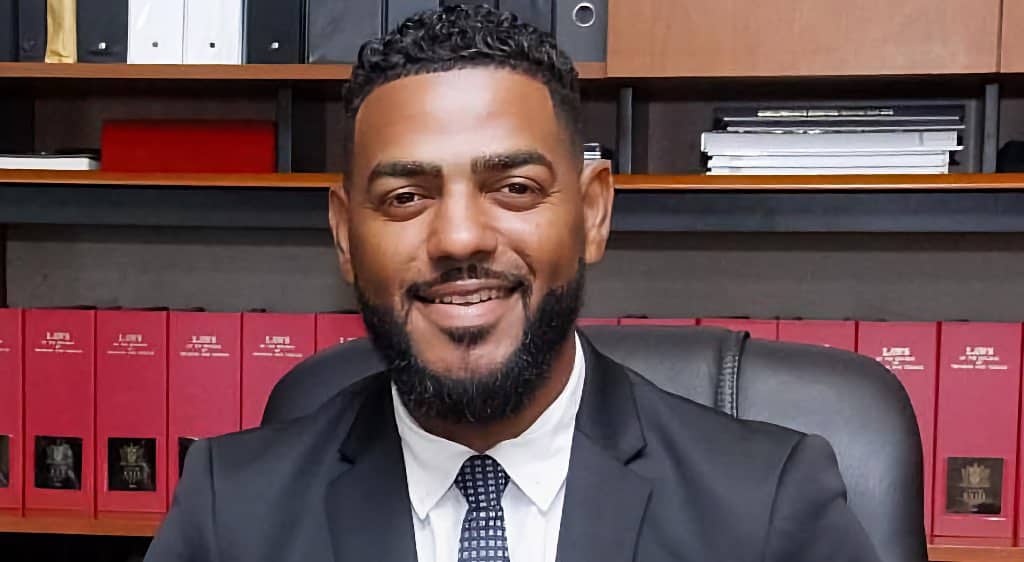
Above: Minister of Public Administration and AI, Dominic Smith.
This speech given by Dominic Smith at the second annual Caribbean Spectrum Management Conference on May 13, 2025, is the first public statement by the new minister on his plans for the newly reintegrated public administration and digital ministries. It has been edited only to remove public speech related protocols.
Today marks a significant step toward shaping the future of our digital landscape — a future defined by innovation, connectivity, and inclusive growth.
In a world increasingly driven by artificial intelligence, digital media, and rapid technological change, spectrum is more than just a resource of progress. Recognising this, the government has articulated a vision that emphasises the importance of Public Administration and Artificial Intelligence (AI), as vital components of national development.
This, 2nd Caribbean Spectrum Management Conference, being held in Trinidad and Tobago is both significant and important to the achievement of this government’s vision for a Trinidad and Tobago that embraces artificial intelligence (AI), digital technology to create meaningful job opportunities, and a modernised public service, that positions Trinidad and Tobago as a foremost destination for doing business.
Your conference, today and tomorrow, is therefore provident.
The discussions at this conference aim to spark local and regional initiatives to capitalise on the benefits of connectivity and harness the full potential of the digital economy to enhance productivity.
Although this conference discusses spectrum management, its opportunities and its use, we’re here to effectively speak about connectivity, particularly leveraging wireless technologies, including mobile, satellite, and broadcast technologies.
Connectivity is crucial to achieving my Ministry’s AI agenda and ICT-enabled development across all government ministries and society as a whole.
Effective spectrum management is crucial to leveraging these technologies to benefit our society. Whether it’s expanding broadband access to underserved communities, supporting innovative AI applications in healthcare and education, or ensuring our digital platforms foster social cohesion and economic opportunities.
This conference represents a vital step forward—an opportunity for policymakers, regulators, operators, industry leaders, academia, and civil society to collaborate, share insights, and chart a progressive path for spectrum management at a regional level.
As a region, we face critical opportunities:
- To modernise and adapt our regulatory frameworks in line with international best practice.
- To embrace emerging technologies such as fifth generation or 5G networks, AI, and the Internet of Things (IOT), ensuring Trinidad and Tobago and the rest of the region become leaders in economic growth through digital adoption
- To revolutionise the experiences for our free-to-air viewers, education recipients and disaster relief agencies through the adoption of Digital Terrestrial Television using ATSC 3.0 technology. and
- To foster inclusive connectivity, bridging social and geographical divides, aligning with our national goals to become digital societies.
However, these opportunities come with challenges:
- Addressing scarcity and congestion.
- Ensuring robust safety and security in our digital communications.
- Managing interference within our island geography.
- Building technical capacity for monitoring and enforcement.
- Disaster resilience in the face of global warming and the threats presented to our Caribbean countries.
- Resource constraints due to economic conditions
It is digital evolution and emerging technologies that improve our adoption. In 2021, Trinidad and Tobago’s ICT Development Index (IDI) score was 7.86, according to the Telecommunications Authority of Trinidad and Tobago (TATT). The IDI, a composite index, is used to measure the level of development in the ICT sector by the International Telecommunication Union (ITU). We aim to improve this.
In our pursuit of digital sovereignty and resilience, regional and international cooperation becomes essential. We must work with our Caribbean neighbours and global partners to promote harmonised policies, innovative spectrum sharing mechanisms, and capacity-building initiatives that empower our countries and citizens.
As you gather to shape the future of our region’s telecommunications landscape in an era characterised by rapid technological advancements and unprecedented connectivity, spectrum has emerged as an important resource.
Firstly, let’s address regional harmonisation. As a region of diverse nations, unique geographical challenges, and shared ambitions, the Caribbean stands to gain immensely from a unified approach to spectrum management. The discussions in Session One: “Towards a Unified Spectrum Strategy” are particularly relevant.
Harmonisation is not merely about aligning frequencies; it’s about creating a seamless environment for cross-border communication, attracting investment, and enabling economies of scale for our operators. It reduces interference, ensures efficient resource use, and fosters a more integrated telecommunications market.
Real economic benefits can be realised for all of us —from improved mobile coverage to enhanced disaster preparedness and resilience. But harmonisation requires collaboration, compromise, and a willingness to look beyond national borders for the greater good. I urge all of us to engage in constructive dialogue, share best practices, and work together to forge a consensus on the path forward.
We must accelerate these efforts, addressing obstacles that have delayed progress.
Secondly, we must focus on future-proofing our policies. Our policies must be agile, flexible, and forward-thinking in a rapidly evolving technological landscape. This conference aligns our frameworks with emerging trends in terrestrial and non-terrestrial networks, consider the ITU World Radiocommunication Conference 2023 (WRC-23) outcomes, and tailor our approaches to key vertical industries.
The discussions in Session 10: Future-Proofing Spectrum Policy are crucial in this regard. We must ask ourselves, are allocating spectrum optimally?
Addressing these questions will require a blend of innovation, collaboration, and strategic planning. It will also require an ongoing commitment to knowledge-sharing, both within the region and with our international partners.
As we embark on this journey, I urge all participants to approach these discussions with an open mind, a spirit of partnership, and a shared commitment to national progress.
This week holds significance for the region, as it includes hosting the Caribbean Telecommunications Union (CTU) Caricom Regulators Forum, held yesterday, and the CTU Spectrum Management Task Force Meeting, scheduled for May 15th – 16th, 2025, all at this venue.
The CTU’s Regulators Forum serves as a vital platform for telecommunications/ICT regulators across the Caribbean region to convene, share insights, and collaborate on key issues shaping the telecommunications landscape.
By the end of the week, participants will have collaborated. They will advance work towards a regionally harmonised ICT regulatory framework supporting the CARICOM Single ICT Space, addressing other significant current developments, and facilitating inter-regional policy exchanges.
As the Minister of Government responsible for telecommunications, digital adoption and AI in Trinidad and Tobago, I recognise that efficient spectrum use is foundational to our aspirations for a modern, inclusive, and resilient Trinidad and Tobago and the Caribbean.
As we look beyond 2025, I urge us all to be visionaries, embracing digital evolution as a catalyst for social inclusion, economic growth, and sustainable development. Our commitment is to create an enabling environment where every regional citizen benefits from the promise of technology, supported by transparent, efficient, and forward-looking spectrum policies.
The Government of Trinidad and Tobago is dedicated to working towards an AI empowered region that empowers all of our citizens across the region, stimulates investment, and positions all of our countries as leaders in the Caribbean and beyond.
In closing, I reaffirm our government’s dedication to this vision. We are committed to building a digital future grounded in equitable access, groundbreaking innovation, and responsible stewardship of our precious spectrum resource.

[…] Trinidad and Tobago – This speech given by Dominic Smith at the second annual Caribbean Spectrum Management Conference on May 13, 2025, is the first public statement by the new minister on his plans for the newly reintegrated public administration and digital ministries. It has been edited only to remove public speech related protocols… more […]