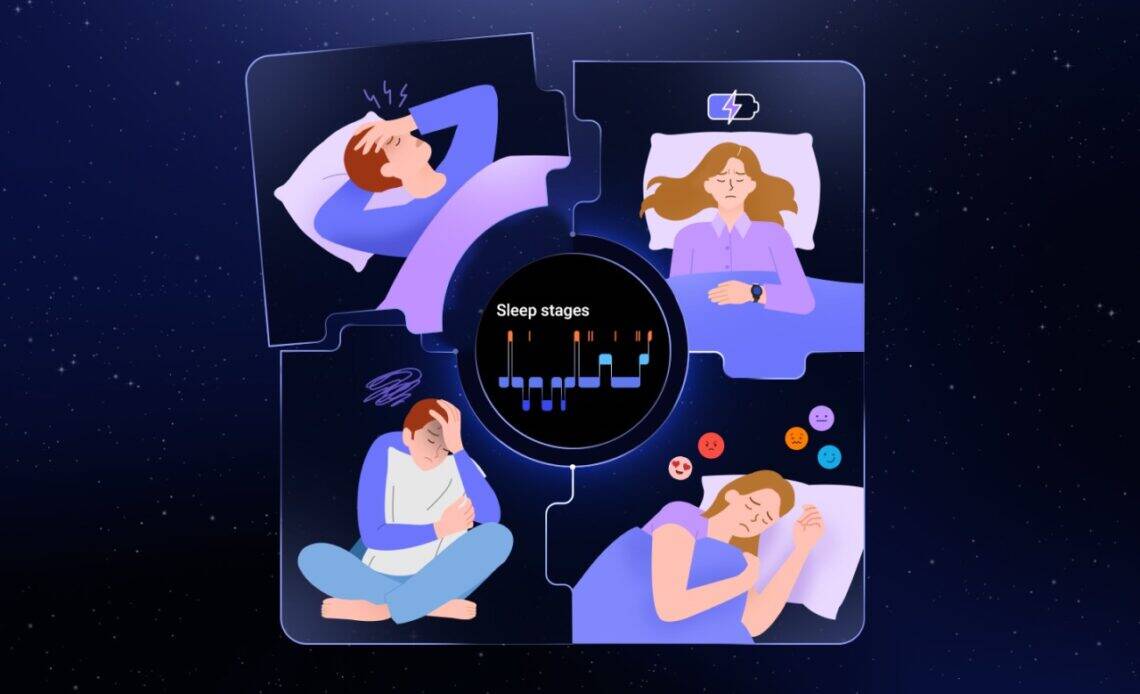
Above: Illustration courtesy Samsung
Millions worldwide suffer from sleep apnea, but 80 per cent of sufferers don’t even know they have it. This serious condition causes people to pause breathing while asleep, potentially disrupting oxygen supply, lowering sleep quality, and leading to health complications including hypertension and stroke. Despite these risks, the disorder largely goes unnoticed because getting a diagnosis usually requires time-consuming and costly in-lab sleep studies.
World Sleep Day took place on March 13, coinciding with a global study of Samsung Health users which sheds new light on the true extent of the condition and the disruptive impact it has on sleep.
How does apnea impact affect sleep?
The report found that 23 per cent of study participants are at risk of sleep apnea.
“The microarousals and awakenings that follow breathing pauses fragment your sleep,” explains behavioral sleep scientist Dr. Vanessa Hill. “Those occurrences can prevent the brain from staying in the REM and deep sleep stages necessary for cognitive and physical restoration.”
The report shows these constant disruptions take a direct toll on sleep duration and quality, leading to:
Reduced REM sleep: Participants with moderate to severe sleep apnea indicators detected by their Galaxy Watch got around four minutes less rapid eye movement (REM) sleep, the phase where our brains process emotions, consolidate memories and cement learning. Without enough of it, people can experience mood instability and memory problems, impacting performance at work and overall well-being.
Less deep sleep: Sleep apnea also robs sufferers of deep sleep, approximately eight minutes less per night, on average. This is the body’s critical physical restoration phase, where growth hormone is released, muscles are repaired, and your immune system is activated. Losing out on deep sleep is why you may feel physically exhausted, have slower recovery times, and get sick more often.
Frequent nightly awakenings: Study participants with signs of sleep apnea also woke up regularly during the night and stayed awake around four minutes longer. These interruptions derail the sleep cycle, locking you into lighter, less restorative stages and making next-day exhaustion inevitable, no matter how long you slept.
Shorter sleep duration: Overall, people with a higher likelihood of sleep apnea averaged around 12 minutes less sleep. While this loss may seem minor, it can have a significant impact on overall sleep quality as your sleep cycle gets fragmented throughout the night.
Why it matters
“Even a small loss in sleep duration is compounded by a larger loss of sleep quality,” said Dr. Hill. “This can be the difference between simply being ‘in bed’ and getting restorative rest, which could be why people feel so tired the next day.”
Dr. Hill also advocates a multidimensional approach to sleep health. “Sleep apnea affects many dimensions of sleep — duration, quality, sleep efficiency and even daytime fatigue,” she stated. “They together help determine our health and functioning.”
With sleep apnea shown to impact all aspects of sleep and lead to other health complications, detection is an essential first step in the fight against the condition.
How do Samsung devices detect moderate to severe sleep apnea?
For years, sleep apnea has been difficult to detect due to the need for inconvenient hospital tests. However, Samsung offers Sleep Apnea feature on your Galaxy Watch.
The technology: Leveraging the Galaxy Watch’s BioActive Sensor, the feature tracks blood oxygen levels to determine when the user stops breathing (apnea) or is not breathing enough (hypopnea). Based on this data, the feature estimates the user’s Apnea-Hypopnea Index (AHI), which indicates the severity of obstructive sleep apnea(OSA).
From awareness to action: By detecting signs of sleep apnea early, the feature provides the data needed for an informed consultation with a medical professional. “For years, the inconvenience of an in-lab clinical sleep study has been a barrier to diagnosing sleep apnea,” added Dr. Hill. “Wearable technology is a breakthrough because it democratizes that first step. It allows people to gather meaningful data from their own beds, providing a starting point for a conversation with a healthcare professional.”











 Digital döstädning
April 5, 2026
Digital döstädning
April 5, 2026
 The garbage infesting my in-box
March 30, 2026
The garbage infesting my in-box
March 30, 2026
 TSTT’s payments problem
March 30, 2026
TSTT’s payments problem
March 30, 2026
 Is Apple’s Neo the One?
March 22, 2026
Is Apple’s Neo the One?
March 22, 2026
 Privacy and your travel information
March 15, 2026
Privacy and your travel information
March 15, 2026
 TATT announces ambitious three-year strategic plan
March 9, 2026
TATT announces ambitious three-year strategic plan
March 9, 2026
 Samsung’s S26 leans in hard on...
March 1, 2026
Samsung’s S26 leans in hard on...
March 1, 2026
 A 2026 manifesto for Carnival
February 23, 2026
A 2026 manifesto for Carnival
February 23, 2026
 A hiss from a rose
February 15, 2026
A hiss from a rose
February 15, 2026
 News is a niche until it’s...
February 9, 2026
News is a niche until it’s...
February 9, 2026
 FT’s second Next Gen News report...
February 9, 2026
FT’s second Next Gen News report...
February 9, 2026
 Ransomware report notes fourth quarter 2025...
February 2, 2026
Ransomware report notes fourth quarter 2025...
February 2, 2026
 Hands-on with Apple’s Creator Studio as...
January 30, 2026
Hands-on with Apple’s Creator Studio as...
January 30, 2026
 Apple flirts with subscription software
January 26, 2026
Apple flirts with subscription software
January 26, 2026
 So long, and thanks for all...
January 19, 2026
So long, and thanks for all...
January 19, 2026
 Cyberedge reports on cybersecurity trends
January 12, 2026
Cyberedge reports on cybersecurity trends
January 12, 2026
 Samsung’s ZFlip 7 shows steady improvement
January 5, 2026
Samsung’s ZFlip 7 shows steady improvement
January 5, 2026
 Digital New Year’s resolutions
December 29, 2025
Digital New Year’s resolutions
December 29, 2025
 WiPay announces new strategy for services,...
December 22, 2025
WiPay announces new strategy for services,...
December 22, 2025
 Old Mac, new OS
December 15, 2025
Old Mac, new OS
December 15, 2025