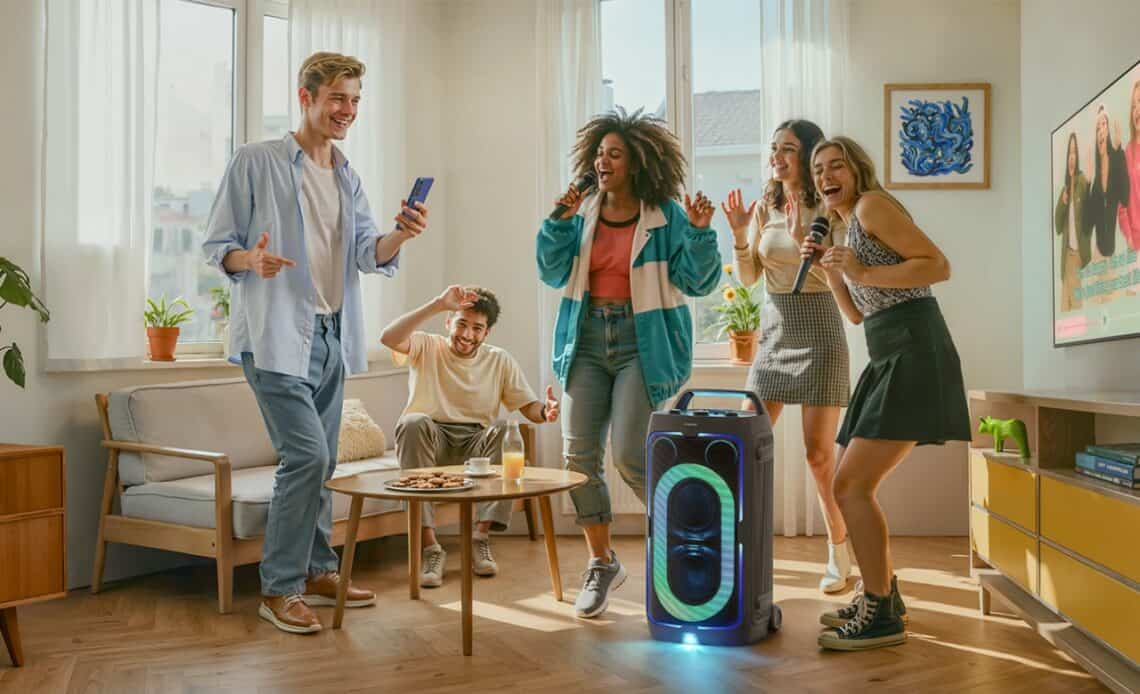
Above: Samsung’s Sound Tower. Photo courtesy Samsung.
Every December, Spotify Wrapped turns our social feeds into a global parade of musical biographies. In 2025, the phenomenon exploded once again: more than 3.5 billion views in 48 hours and a new viral metric —“musical age”— that analyses your habits to tell you whether your year sounded like that of a 12-, 30-, or 60-year-old.
Streaming dominates global consumption (67 per cent, according to IFPI 2025), and artificial intelligence has become the main engine of music discovery for 62 per cent of listeners, especially in Latin America. We no longer search for songs; algorithms learn our patterns and predict what we need to hear based on the time, mood, or activity. Wrapped is simply the most visible version of that continuous personalisation.
The connected home: The new concert hall
The music experience has also migrated into an ecosystem of devices. Forty-seven percent of listeners use their smartphone as their main source, and “ambient” listening through TVs and smart homes continues to grow. As a producer of these home systems, Samsung has accelerated this evolution through:
AI-powered TVs that optimise sound based on the room. Built-in intelligence adjusts picture and audio according to the environment, and offers immersive
Dolby Atmos with object tracking sound.
Samsung soundbars that incorporate advanced AI algorithms that analyse content in real time. This analytical capability dynamically adjusts audio settings to deliver optimal sound quality.
Seamless integration across mobile devices, wearables, and screens, allowing music to “jump” from one device to another without interruption. The Galaxy ecosystem ensures a smooth, frictionless connection without needing commands or switching apps.
AI as an emotional DJ
A Stanford study shows that current algorithms can detect mood with 86 per cent accuracy based solely on listening patterns. This boosts adaptive playlists, dynamic mixes, and contextual suggestions.
The virality of “musical age” reflects a deeper pattern: algorithms have blurred generational boundaries. It no longer matters what decade you were born in, but rather which emotions, rhythms, and moments defined your year. Wrapped turned that into data, memes, and cultural conversation.
The future: Hyper-personalization
Everything suggests that 2026 will be the most personalised music year in history…
- Multimodal AI that combines audio, habits, and routines.
- Greater integration between mobile devices and screens for immersive at-home experiences.
- Context-based recommendations: weather, energy levels, work, rest.
- Music created or mixed by AI in real time.
Wrapped went viral again because music today is identity, emotion, and information. And brands like Samsung—together with streaming platforms and AI—are building an environment where technology fades into the background, leaving only what matters: the intimate connection with the songs that shaped the year.