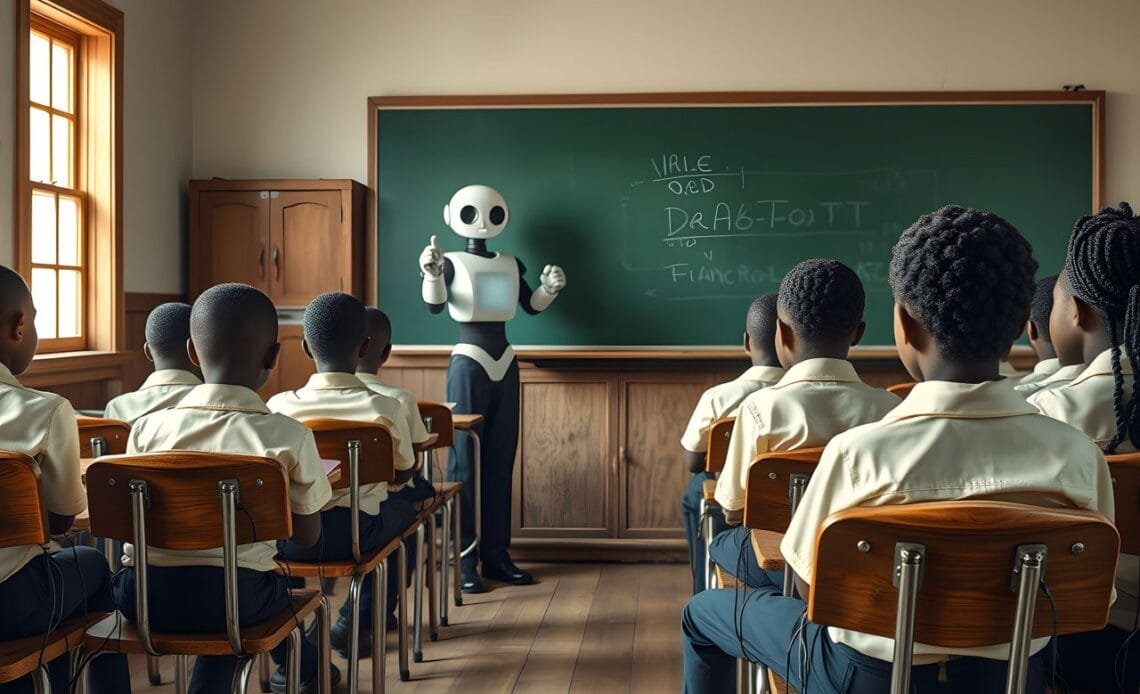
Above: AI image generated by Flux using 123RF.com
By Chukwuemeka Cameron
Mr Cameron posted this opinion to his profile on LinkedIn on April 22, 2025. He kindly gave permission for it to be reproduced on TechNewsTT.
One click for education. One giant leap for Big Tech’s reach into childhood.
A New Era in Jamaican Education
In 2020, the Jamaican Ministry of Education launched a digital transformation initiative. Google Workspace for Education became the first step. By 2023, Microsoft 365 had joined the toolkit.
The promise? A new kind of learning—flexible, collaborative, and future-ready.
But while online classrooms opened doors, they also opened backdoors.
Thousands of student accounts were created. Personal data started flowing into foreign data centres. And still—very few parents, teachers, or school administrators knew to ask:
Who owns this data? Who’s using it? Is it protected? Is it even legal?
Digital Gold Mines: Children’s Data in the Crosshairs
Let’s be clear: children aren’t just learners. In the world of data, they are high-value targets.
Every login, every quiz, every emotional response captured during virtual learning feeds into a profile. Together, these insights form a detailed blueprint of identity.
And we’re not alone in this. Take Espoo, Finland—a city that introduced Google Workspace and quickly found itself in a legal firestorm. The country’s Data Protection Authority (DPA) ruled that the programme violated GDPR due to unjustified, excessive data processing.
It wasn’t just about the tool. It was about what the tool could do without proper safeguards.
Sound familiar?
The Espoo Case: What Finland Fought, Jamaica May Be Ignoring
The Finnish DPA made three key points:
- There was no real oversight of Google’s data use
- The data collected went far beyond what was necessary
- The city couldn’t prove it had lawful grounds to collect student data at that scale
Eventually, Finland’s highest administrative court overturned the ruling—but not because the platform was safe. It only ruled that their education laws implied a duty to use digital tools. The surveillance concerns were never resolved. Just postponed.
Now compare that to Jamaica:
- No public record of Data Protection Impact Assessments (DPIAs)
- No transparency on legal basis for deploying Big Tech in classrooms
- No disclosures around how children’s data is stored, shared, or protected
We’ve adopted the same tools. Without any of the public scrutiny.
The Jamaican Parallel: Same Tools, Same Risks, Same Silence
Under Jamaica’s Data Protection Act, 2020, children’s data must be treated with the highest level of protection.
But right now, that’s not happening.
- There’s no evidence DPIAs were conducted before rolling out these tools
- Schools and ministries have not demonstrated a clear legal basis for their data practices
- Most stakeholders are unaware of the risks, or don’t have the capacity to question the terms they’ve accepted
Worse, these platforms are standardised and non-negotiable. So even if schools had concerns, they couldn’t easily act on them.
What Finland debated publicly, Jamaica may be sleepwalking through.
The Watchdog That’s Yet to Bark
The Information Commissioner—Jamaica’s designated data protection authority—is supposed to ensure our privacy laws are enforced.
They should be:
- Requesting DPIAs from the Ministry of Education
- Investigating whether valid parental consent has been obtained
- Demanding clarity on what data is collected and why
But here’s the truth: the Commissioner is not yet legally operational.
It’s like announcing a national fire service—without trucks, hoses, or firefighters.
In an even more troubling twist, the Commissioner’s office has advised data controllers to deprioritize DPIAs. Yes, the very risk assessments that are mandatory under the Act.
Instead of leading the charge, our privacy watchdog appears to be whispering: “Let’s not rock the boat.”
Meanwhile, children are logging into classrooms governed by policies their guardians never reviewed—while their data moves across borders, potentially forever.
The real question isn’t about schools anymore
We’ve moved past:
“Are schools doing enough?”
We’re now asking:
“Where is the regulator—and why are they silent?”
Conclusion: A wake-up call for Jamaican education
Technology in the classroom is here to stay. And it should be. But privacy is not a luxury. It’s a legal and ethical requirement—especially for our children.
The Finnish experience proves that even progressive systems can stumble into surveillance. The difference is: they noticed.
Jamaica has:
- A strong legal framework
- A visionary privacy mandate
- A clear duty to protect children
What we lack is execution and enforcement.
Let’s not digitize neglect. Let’s not look back in five years and realize we traded access for exposure.
Because if privacy is the price of progress, we must ask:
Who profits—and who pays?

Chukwuemeka Cameron
About the author
Chukwuemeka Cameron, founder of Design Privacy empowers Data Controllers & DPOs with SaaS solutions to manage privacy risks and compliance. He believes that data privacy should be embedded in everyday systems—especially in public education. He is the host of Data Protection Matters.













 Is Apple’s Neo the One?
March 22, 2026
Is Apple’s Neo the One?
March 22, 2026
 Privacy and your travel information
March 15, 2026
Privacy and your travel information
March 15, 2026
 TATT announces ambitious three-year strategic plan
March 9, 2026
TATT announces ambitious three-year strategic plan
March 9, 2026
 Samsung’s S26 leans in hard on...
March 1, 2026
Samsung’s S26 leans in hard on...
March 1, 2026
 A 2026 manifesto for Carnival
February 23, 2026
A 2026 manifesto for Carnival
February 23, 2026
 A hiss from a rose
February 15, 2026
A hiss from a rose
February 15, 2026
 News is a niche until it’s...
February 9, 2026
News is a niche until it’s...
February 9, 2026
 FT’s second Next Gen News report...
February 9, 2026
FT’s second Next Gen News report...
February 9, 2026
 Ransomware report notes fourth quarter 2025...
February 2, 2026
Ransomware report notes fourth quarter 2025...
February 2, 2026
 Hands-on with Apple’s Creator Studio as...
January 30, 2026
Hands-on with Apple’s Creator Studio as...
January 30, 2026
 Apple flirts with subscription software
January 26, 2026
Apple flirts with subscription software
January 26, 2026
 So long, and thanks for all...
January 19, 2026
So long, and thanks for all...
January 19, 2026
 Cyberedge reports on cybersecurity trends
January 12, 2026
Cyberedge reports on cybersecurity trends
January 12, 2026
 Samsung’s ZFlip 7 shows steady improvement
January 5, 2026
Samsung’s ZFlip 7 shows steady improvement
January 5, 2026
 Digital New Year’s resolutions
December 29, 2025
Digital New Year’s resolutions
December 29, 2025
 WiPay announces new strategy for services,...
December 22, 2025
WiPay announces new strategy for services,...
December 22, 2025
 Old Mac, new OS
December 15, 2025
Old Mac, new OS
December 15, 2025
 Regional cybersecurity faces fire
December 8, 2025
Regional cybersecurity faces fire
December 8, 2025
 Unfinished symphonies
December 1, 2025
Unfinished symphonies
December 1, 2025
 Do you know who your child...
November 24, 2025
Do you know who your child...
November 24, 2025