
- • Apple's new Macbook Neo launched with a starting price of US$600
- • The Neo uses Apple’s A18 Pro chip, originally designed for the iPhone 16 Pro and Pro Max
- • Neo is notably more repairable than recent Apple computers, according to iFixit
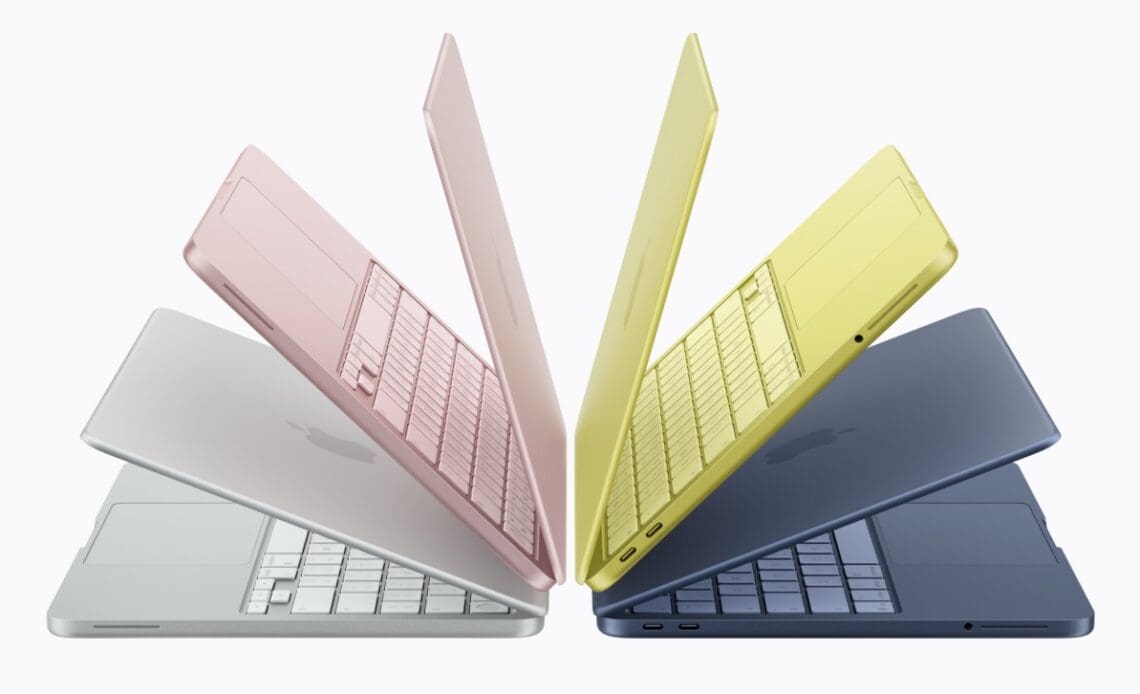
Above: Apple’s stylish new colours for the Neo notebook. Photo courtesy Apple.
BitDepth 1555 for March 23, 32026
The early buzz on Apple’s new Macbook Neo positions it as a potential success, a Chromebook killer, according to many pundits.
It’s the company’s boldest attempt to place a computing product in the price sensitive market, a space where it has had no success.
The proliferation of Performas between 1992 and 1997 was the company’s most notable effort at going downmarket and it was a bust.
The underpowered, baseline specified machines were offered in such an array of configurations that nobody could figure out which one offered the best value for their use case.
All that united them was an effort to dumb down the straightforward Mac OS UI and lame hardware performance, hardly selling points.
The company had already decided to trim this avalanche of bargain basement model SKUs, then Steve Jobs returned to the company, trimming the line even further before replacing all the consumer facing products with two options, the iMac and the iBook, which came in a range of colours.
Consumers then faced only two choices, laptop or desktop and which colour went well with the curtains.
In the last ten years, Apple’s cost-conscious devices have largely been found on mobile, with the iPhone SE and AppleWatch SE offered as reduced cost options with one to two year old specifications, but still able to keep pace with current iOS revisions while dropping support for new, cutting edge features.
For most users who choose those devices, the trade-offs are inconsequential.
That seems to be the gamble that Apple is making with the Neo. Give customers most of what they want and see how the market accepts it.
Leading the attractions is the price point. This is the first laptop that Apple has ever offered that decisively breaks the US$1,000 entry point, shattering that price floor with a starting price of US$600.
To do that, there are compromises, as you might expect. This is the first Apple laptop to be built around a chip designed for use in an iPhone.
Apple’s journey to this point began in 2010 first with the iPad then with the iPhone 4, the company’s first migration away from third-party processors, when it replaced the Samsung processor in the iPhone with the first of its A-series Apple silicon chips.

Photo courtesy Apple.
The Neo uses Apple’s A18 Pro chip, previously deployed in the iPhone 16 Pro and Pro Max models.
Apple’s current laptop series use its M series chips, but the architecture of both chips is conceptually equivalent, with the A series maintaining a core focus on heat management and battery consumption, as befits a device you hold in your hand and store in your pocket.
iPads, which largely operate outside of such restrictions, have largely moved to the M series chips, with equivalent jumps in performance that are supported by their larger batteries.
So the Neo, with space for a large battery and deploying an iPhone scale chip, should deliver remarkable performance per watt. It probably does, but it doesn’t compare well in testing to the new MacBook Air M5, which runs significantly longer on battery.
The Air M5 has a much larger 53.8 w/hr battery, compared to the Neo’s 36.5 w/hr battery. But the Air M5 costs US$500 more and is hardware operating at another level.
While Neo copes well with daily computing tasks, specialised software demands the raw horsepower of the M series chip.
The Neo exists in a space that is so far outside of my requirements that I’d barely noticed the launch, but then folks started asking about it.
So I earn a determined zero for my anticipation of the potential market impact of Apple’s new computer, but if you’re looking for advice, here it is.
You can’t get a Neo with more than 8GB of RAM, not because Apple is being tone deaf or parsimonious, but because the A18 Pro chip, originally designed for a smartphone, is manufactured with exactly that.
Since Apple is making use of existing manufacturing capacity, even a modest bump to 12GB would require a redesign and retooling, increasing the cost of the computer dramatically.
That said, 8GB on Apple Silicon is nothing like 8GB on an Intel chip in a Macbook. The chip is heavily optimised for mobile use, sipping power and emitting little heat in normal use.

I set up an 8GB M3 Macbook for a friend who was going to do graphics work with the device and I quietly despaired that his family had chosen poorly. I was wrong.
The Macbook slapped the work around casually and I had to take the recriminations out of my mouth.
Don’t expect to have a rewarding experience with complex DaVinci Resolve projects or dozens of tracks on Logic Pro, but really, even if you commit the idle tab sin in a browser to the extent that I do (yes, dozens, for months on end), you shouldn’t have any issues with the Neo.
Apple also cut corners on the ports. There’s no Thunderbolt port and only one of the ports, the one closer to the hinge, supports USB 3.2 with throughput of 10Gbps.
That’s the port you will want to plug an dongle or an external monitor into. The port closer to the front of the machine is old-school USB2 (480Mbps), suitable only for charging.
Since this is a limitation of the A18Pro itself and its original assignment as an iPhone chip, future Neo versions may benefit from more on-chip RAM and more port capacity.
The new A19 Pro chip in the iPhone 17 Pro and 17 Pro Max has 12GB of on-die RAM.
As it is, the Neo’s motherboard is a marvel of shrinkage.
The entire computer fits into a space roughly the same size as a six-inch school ruler. The skinny kind.
iFixit’s teardown of the device suggests that it is the most repairable computer that Apple has made in a decade and a half.
Its primary market target is Chromebooks, lightweight, underpowered computers designed to run Google’s ChromeOS with a focus on using cloud-based and Android apps in the Chrome browser that are marketed heavily in the US school system.

Ease of repair puts a firm hand on the scale in favour of the Neo for parents looking for a laptop suitable for use in education.
I’ve been using an iPhone for the last two years that runs the A17 Pro chip and it hasn’t balked at anything I’ve tossed at it.
I’ve shot hundreds of photos intended for publication, written thousands of words and managed this website with it. Should I have bought a model with more storage? In retrospect, yes.
Have I needed more RAM or had performance stalls? Not a one.
Would have I preferred to do all that work with a device that had a bigger screen and the same battery life?
Most of the time no, because walking around with a computer isn’t the same as walking around with a phone and a folding pocketable keyboard.
But apart from that, the practical experience would likely have been the same.
We spend a lot of time in pursuit of more performance, but the embarrassing thing is that for an alarming amount of the time they are active, our computers, and certainly Apple Silicon in my experience, just sits there waiting for a challenge.
Their efficiency processors tackle our lame efforts at work while the more powerful performance processors sit idle, hoping for their turn at wicket.
The starting price point of US$600 for the MacBook Neo is unquestionably tempting, but I’d suggest spending a bit more for the version with 512GB of storage and a TouchID sensor.
At US$699 it’s still within the realm of a price-sensitive purchase but it’s one with a backlit keyboard and just a bit more storage headroom. Reality check. Once you get started, that drive is going to fill right up.
The Macbook Neo went on sale on March 11 in four colours, blush, indigo, silver, and citrus.














 The state of ransomware in the...
April 12, 2026
The state of ransomware in the...
April 12, 2026
 Digital döstädning
April 5, 2026
Digital döstädning
April 5, 2026
 The garbage infesting my in-box
March 30, 2026
The garbage infesting my in-box
March 30, 2026
 TSTT’s payments problem (updated)
March 30, 2026
TSTT’s payments problem (updated)
March 30, 2026
 Is Apple’s Neo the One?
March 22, 2026
Is Apple’s Neo the One?
March 22, 2026
 Privacy and your travel information
March 15, 2026
Privacy and your travel information
March 15, 2026
 TATT announces ambitious three-year strategic plan
March 9, 2026
TATT announces ambitious three-year strategic plan
March 9, 2026
 Samsung’s S26 leans in hard on...
March 1, 2026
Samsung’s S26 leans in hard on...
March 1, 2026
 A 2026 manifesto for Carnival
February 23, 2026
A 2026 manifesto for Carnival
February 23, 2026
 A hiss from a rose
February 15, 2026
A hiss from a rose
February 15, 2026
 News is a niche until it’s...
February 9, 2026
News is a niche until it’s...
February 9, 2026
 FT’s second Next Gen News report...
February 9, 2026
FT’s second Next Gen News report...
February 9, 2026
 Ransomware report notes fourth quarter 2025...
February 2, 2026
Ransomware report notes fourth quarter 2025...
February 2, 2026
 Hands-on with Apple’s Creator Studio as...
January 30, 2026
Hands-on with Apple’s Creator Studio as...
January 30, 2026
 Apple flirts with subscription software
January 26, 2026
Apple flirts with subscription software
January 26, 2026
 So long, and thanks for all...
January 19, 2026
So long, and thanks for all...
January 19, 2026
 Cyberedge reports on cybersecurity trends
January 12, 2026
Cyberedge reports on cybersecurity trends
January 12, 2026
 Samsung’s ZFlip 7 shows steady improvement
January 5, 2026
Samsung’s ZFlip 7 shows steady improvement
January 5, 2026
 Digital New Year’s resolutions
December 29, 2025
Digital New Year’s resolutions
December 29, 2025
 WiPay announces new strategy for services,...
December 22, 2025
WiPay announces new strategy for services,...
December 22, 2025