
- • The public record of Carnival is evaporating, media houses are careless with their archives
- • Only a few artists and bands are financially successful, while most struggle to make a living
- • Despite losing their dominance on the road, steelbands remain culturally significant
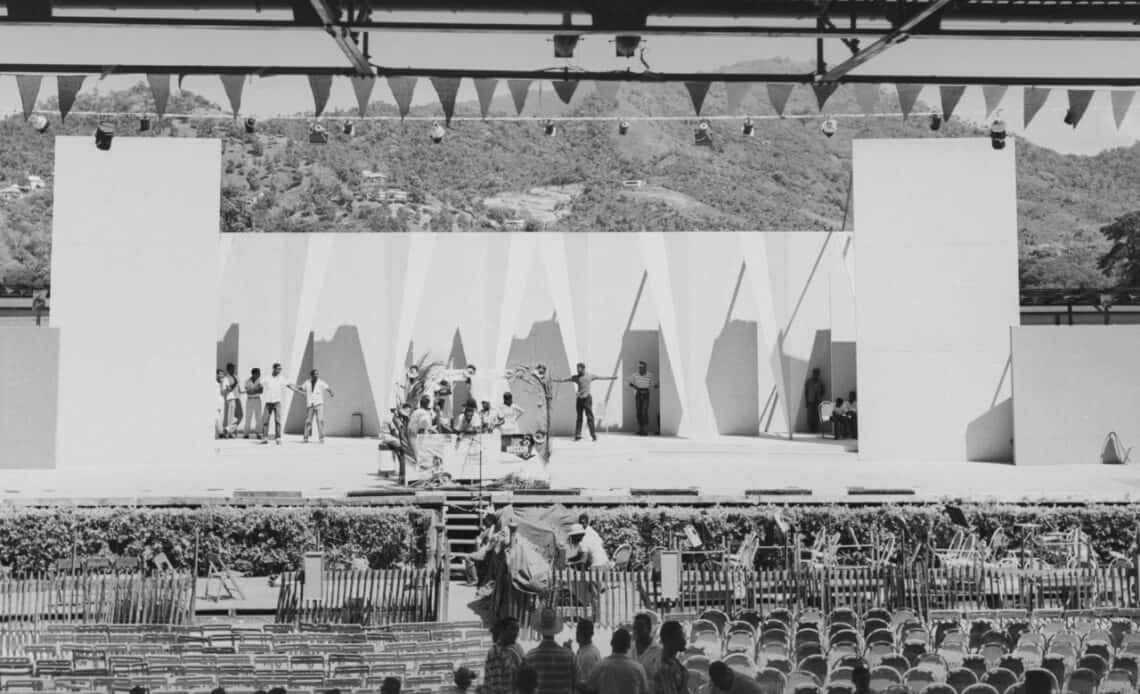
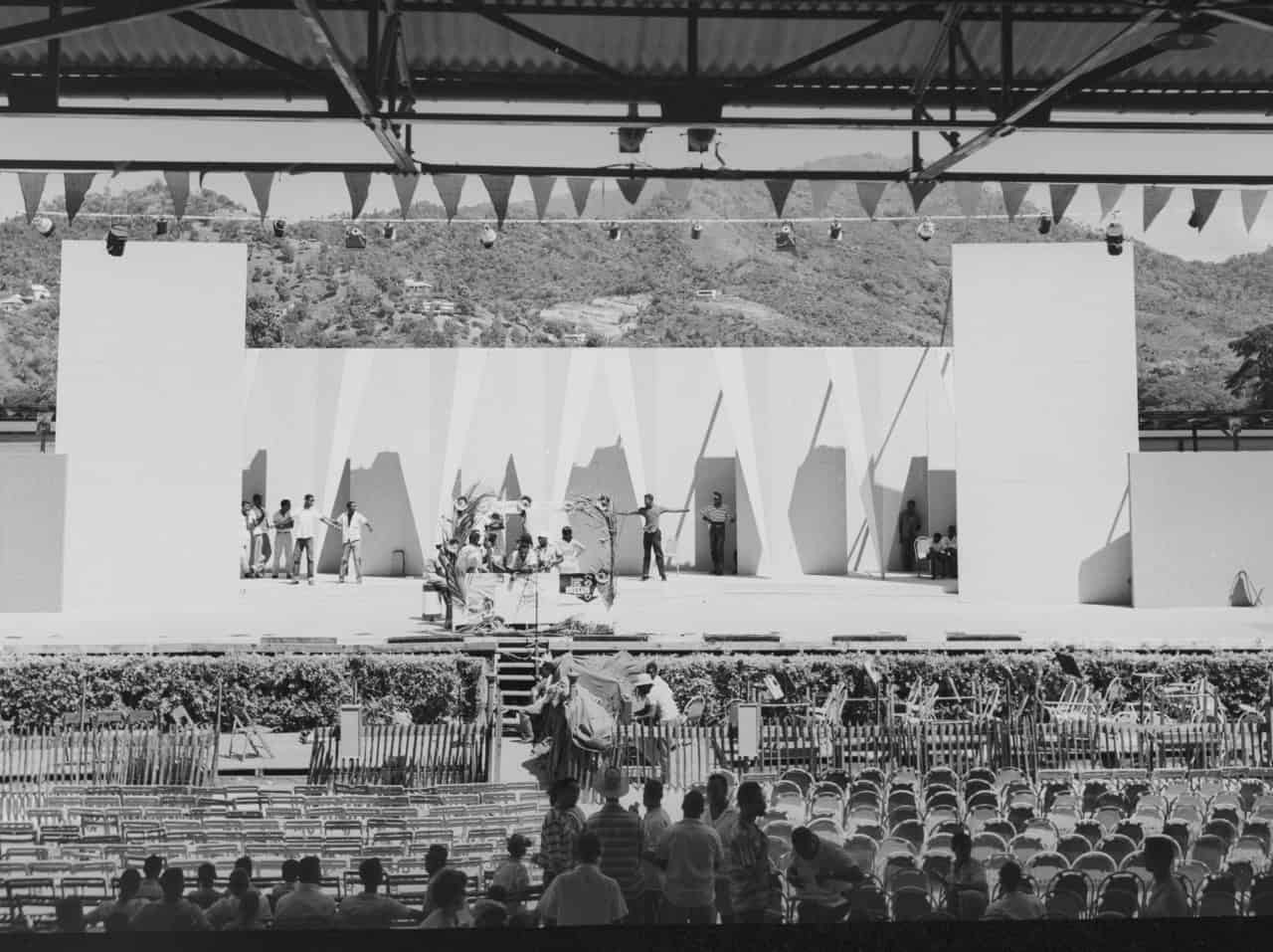
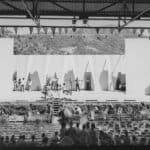
Above: Near the end of the fifth decade of the 20th century, my father took this photograph of the stage being prepared for a presentation that was likely to be Dimanche Gras. Not much has changed since then. Photograph by Kingsley Lyndersay/Lyndersay Digital.
BitDepth 1551 for February 23, 2026
For an event that seizes this country in an unshakeable, if sensuous grip from Boxing Day onward, there is little consensus on what Carnival actually is.
For some, the event is a street parade, an opportunity for everyone, from the highest to the lowest, to meet on communal asphalt to play a mas, sublimating their day-to-day identities to a higher calling of costumed reinvention.
Formally, there are four recognised stakeholders in Carnival’s planning and execution, the National Carnival Commission (NCC), which represents the investment of the state in the festival, the National Carnival Bandleaders Association (NCBA) representing the leadership of costumed bands, Pan Trinbago, the collective voice of the steelband movement and the Trinbago Unified Calypsonians Organisation (TUCO).
Unseen and largely unheard in this mix are other stakeholders, the media who report on the festival, the audience for whom they report and the paying punters whose support, though sorely tested, remains strong for its events.
When I first stumbled up the grassy path (no asphalt then) to the stage for the first time, around 1976 or so, the boundaries of the stage were demarcated by brown wooden picket fencing held together by wire, a separation of respect, not stout resistance.
My first sight of a band leaving that stage was of Firemen, the sailor mas stokers who staged an elaborate dance involving steel rods, modeled after the slice-bar used to stir coal in shipboard furnaces.
We don’t see Firemen anymore. They are a part of what has disappeared from Carnival, along with a night of pun-itive Old Mas, Brassorama and Midnight Mas in PoS. J’Ouvert as a forum for Old Mas hovers on the edge of extinction.
I had no idea what I was looking at when I saw those men in their colourful, glittering costumes jumping artfully over those long steel rods. Those pokers would become sticks in modern sailor mas, but the dance is largely lost.
When I look at Carnival today, I feel the same way, the sense of a common understanding that proceeds every year, constantly evolving, mostly unexamined, despite being widely photographed and recorded.
Take Flava. It was a bold idea, dropped early in the Carnival, receiving a shaky welcome. Yes, it was a reimagining of something that already existed, the unruly and ramshackle vendor’s row that bracketed the south entrance to the Grandstand track.
But it did two things in one fell swoop. It removed a disorderly collection of individual survival spaces from a congested access point and replaced it with a planned arrangement of stalls where sellers could, with significantly improved dignity, ply their trade to what became an almost constant flow of customers.
Many people will claim laurels for its execution, but I know who did it and how it got done; quietly, almost on the sly, planning for forgiveness in the absence of explicit permission.
That’s how some of the most powerful movements in Carnival engineer meaningful change.
The most effective levers are moved by a small group or even just one influential person gathering support for an idea they believe in, even if nobody else understands it.
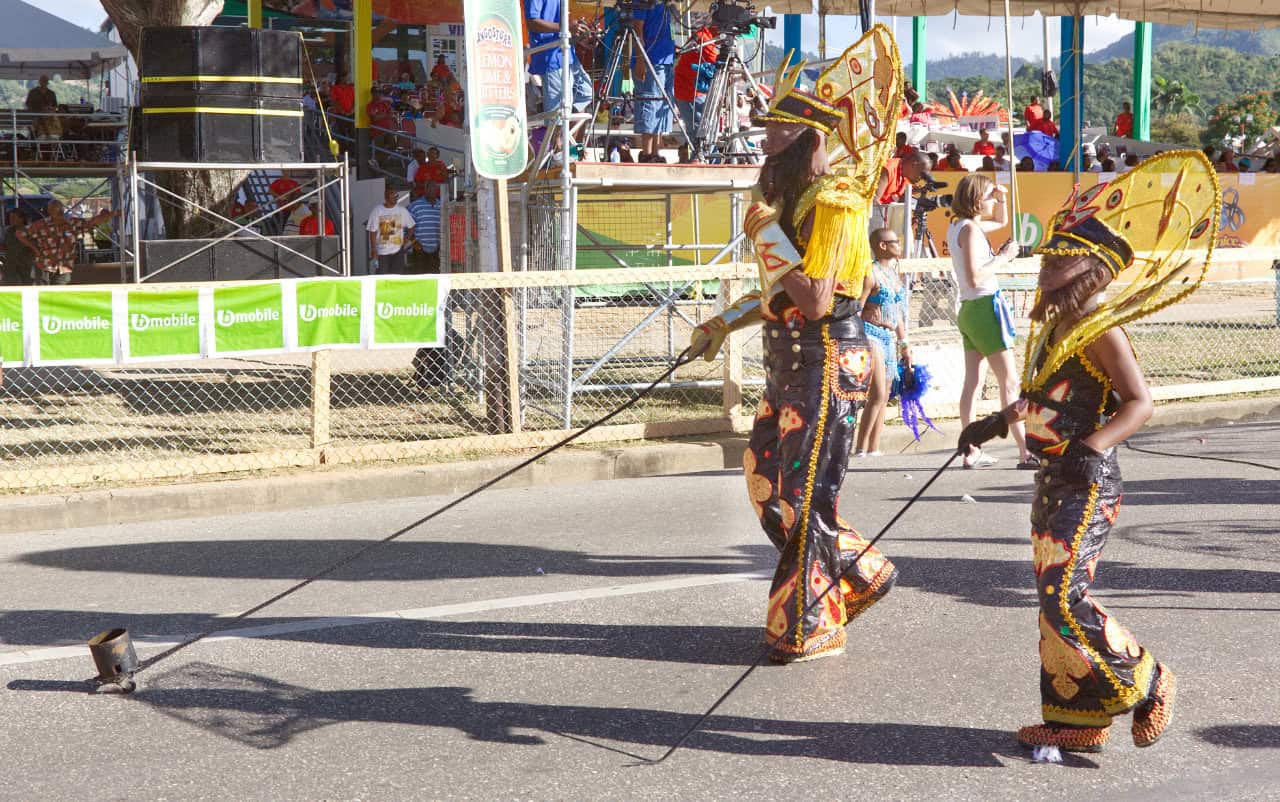
Photo by Mark Lyndersay.
The Carnival that was
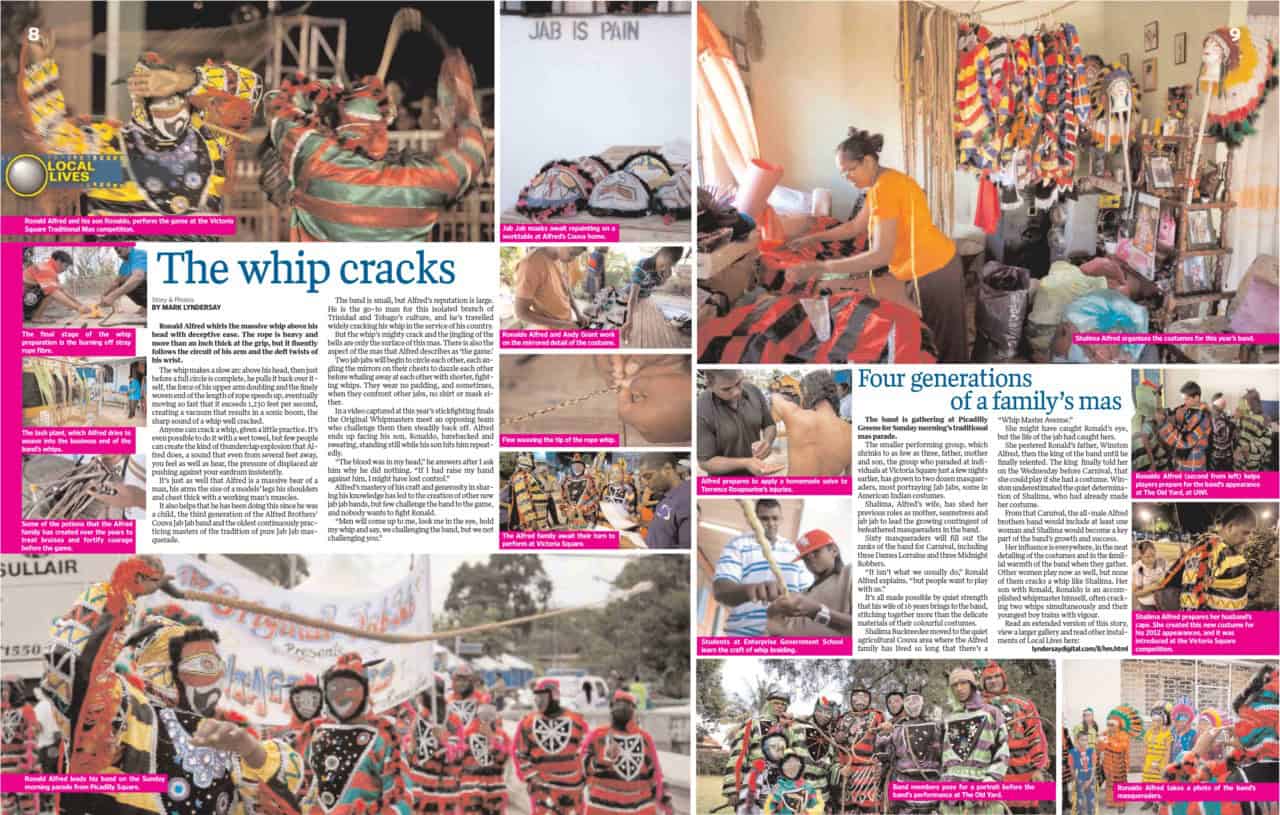
Between April 2005 and February 2018, I produced 31 photo essays about life in Trinidad and Tobago, all but one of them published in the TT Guardian, and 20 of them explored some aspect of Carnival. Most were stories about small groups or individuals whose work I found interesting.
When I started doing those, I was still in the habit of throwing myself into the meat grinder that is Carnival coverage, pursuing the demonstrably lunatic notion of trying to take pictures of everything, which as the event has fragmented and branched, became more clearly impossible.
I’d reliably lose my voice before Carnival Monday; the result of eating dust blown across the stage into my face at each night’s events.
I once took a camera in for repair at Marty Forscher’s in New York and they asked whether I had been deployed to the desert. Fine grit had infiltrated every gear in the locked up equipment.
Covering Carnival became even worse in the mid-90’s, when bandleaders discovered copyright and began wielding it like a blunt instrument.
The idea of a pass to cover Carnival, reasonably priced and offered at no cost to anyone representing any kind of media outlet was replaced by fractioned access. A pass issued by bandleaders wasn’t recognised by Pan Trinbago or TUCO.
As the very idea of what constituted media became even more tenebrous, access became even more difficult.
Traditional media houses, who should have stood on the only hill available to them, the public’s right to know, simply caved and paid extortionate fees to publish Carnival magazines increasing costs while sales diminished as copious online galleries flourished.
Big bandleaders began to publish their own glossy magazines and eventually dumped hundreds of photos taken by their contracted photographers onto DVDs.
A business model was based on providing the public with provocative photos of scantily clad masqueraders was doomed to failure.
This steady devolution of magazine length contemplation of Carnival is particularly notable for the impact it had on our understanding of the festival.
Between 1973 and 1987, for roughly a decade and a half, the gold standard for Carnival documentation was Key Caribbean’s Trinidad Carnival magazine, a full-colour, glossy magazine that appeared months after Carnival was over (read editor Pat Ganase’s recollection).
That kind of thoughtful consideration of the festival was already in decline before the copyright cash grab, challenged by a flurry of poorly printed newsprint Carnival souvenirs, some of which I was responsible for.
With the arrival of desktop publishing, the window of opportunity for sales shrank by the middle of the 1990s, to Ash Wednesday.
For one madcap Guardian publication, publisher Alwyn Chow famously promised to take a grocery trolley stacked with the souvenirs up and down the line of passengers waiting to board departing flights early that holy Wednesday morning.
When his strategy seemed to be faltering on the glitchy reality of early digital pre-press production and human frailty, he arrived in the newsroom late on Carnival Tuesday, glowing with drinks, to declare that the souvenir would be out on time.
“I am not accepting excuses,” he thundered, “I am accepting resignations.”
Patrick Ifill, a subeditor prone to occasional stuttering, answered him clearly and resolutely, “Yes sir.”
After the insistence on copyright payments in advance slammed into place uncontested, the shift in souvenir coverage was abrupt and universal.
If payments had to be made for costumed masqueraders, then their photos would be used everywhere. A casual reader would have had no way of understanding that other things happened during Carnival.
Those “copyright payments” were supposed to be distributed among bandleaders on a model that was supposed to mirror licensing arrangements used for music by COTT for its artistes.
No bandleader that I asked about the fees ever saw any of that money.
“I didn’t understand then,” he told me softly, “but I understand now.” I still have all the feels.
The maladministration of Carnival
Which brings us to the other influence that pervaded the production of Carnival since 1980, the slow-dawning realisation that stakeholder representatives receiving multi-million dollar payouts from the government each year were overseeing a kleptocracy on an unimaginable scale.
This was a reallocation of resources, defiantly underlined by an almost universal unwillingness to provide financial accountability for public money allocated to the festival that dwarfed, on a per capita basis, the sloshing at the trough of the government’s make-work programmes, DEWD, URP and Cepep.
Those programmes required some general financial reporting and so trickled some money down, even if it went to ghost gangs.
Accountability and audit have always been mortal oversights in the Carnival system.
Millions are spent, but an exact analysis of returns has never been tabulated; only vague calculations based on flights and hotel bookings, as if ah friend couch had never been pressed into service for the bacchanal.
Do we even know how much never even comes to the country through AirBNB rentals?
Perhaps the saddest thing about Carnival is our determination to toss the whole enterprise to the roadside for City Council to collect on Ash Wednesday. We have been even more efficient at saying an unsentimental goodbye to months of creative enterprise than we are at saying farewell to the flesh.
The evaporated public record of Carnival
As a person who does not fete, wine, drink or masquerade, my focus on the festival has, ever since the first afternoon that I wandered stage left at the QPS, – with mounted officers pacing the grounds, and manure everywhere – been on taking a picture, shaping a descriptive word, trying to turn cold record to revelatory understanding.
My northstar for this approach was the late Noel Norton, who alongside his wife Mary, amassed the most comprehensive collection of costumed Carnival photography in this country.
Of course, there were other photographers and videographers, notably in the media, capturing images of the festival across all the years he worked, but as with physical wealth, it doesn’t matter what you gather, the riches are in what you keep, and local media houses have been criminally careless with the media archive of Carnival.
Make no mistake, it costs serious money to maintain an archive, and on the balance sheets of media houses, even when cash was readily available, “library” was not an business sector winning budgetary emphasis. Even when such resources existed, they proved to be permeable.
For an event as photographed as Carnival, the public record of the works it produced is criminally sparse. The work of generations of second and third tier calypsonians have disappeared. Hundreds of songs produced by committed talent each year have gone unheard or forgotten for a century.
Eighteen songs were entered as competitive works for the Road March competition this year. Twelve registered no plays whatsoever. No artiste would spend $500 to get such a resounding snub if their music wasn’t being played with enough presence to suggest that an entry made sense.
The work that rises to the top is the work that’s buoyed less by public demand than it is by a strategic infiltration of broadcast networks and the cussedness of calypsonians too stubborn to accept “no.”
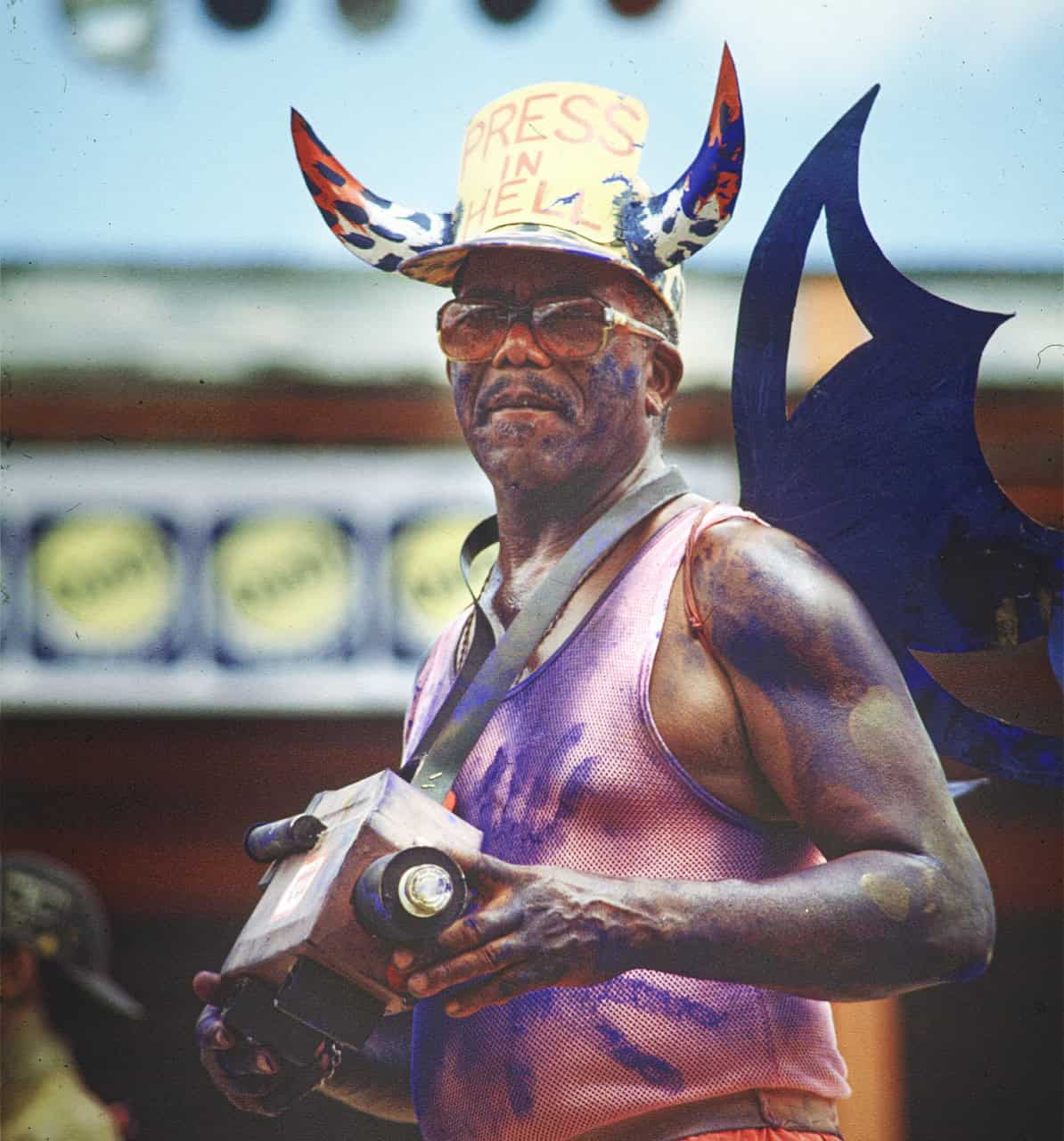
Photo by Mark Lyndersay.
What’s to be done about Carnival?
It’s pointless to go down the road of specific fixes. Nothing like that ever gets done anyway. The Carnival we have is not the one that anyone wants, unless you are well-to-do and anxious to party in all the best places.
Today’s Carnival is the nexus of what’s been positioned as most desirable one; toned bodies sheathed in a light sheen of glamorously exercised sweat, calypso reduced to beat and shouted refrain, individual mas hidebound to a limited and vague concept of tradition instead of its long history of continuous invention and imagination.
The idea of Carnival, the spark of the individual, rebellious, expressed as boldly inventive creation still catches fire, but it’s so easily smothered by what’s come to be expected, that we believe it’s the way things have always been done, except they haven’t, not really.
We don’t know any different because we haven’t committed to documenting and telling the whole story of the festival and so many who knew the details of its component parts are gone.
With the imbalances in Carnival so wildly out of whack, it’s time to take a serious look at what we actually want Carnival to be.
A few fete promoters have a reliable lock on an audience. Big bandleaders are doing phenomenally well. A handful of soca artists and one lucky calypsonian make it through the season with enough to get by for another year.
The big five steelbands have a cultural momentum commensurate with their massed tonnage of heavy metal chromatics despite having yielded road supremacy to monolithic speaker systems.
But everybody else? Not so good. Armfuls of sketchy trophies and appearance fees are not a career. They are certainly not a living.
What’s needed is a referendum, not one of those long-winded talk-shops that go on forever, serve terrible finger-food in frigid air conditioning and never produce anything resembling an actionable plan.
Community level listening. Action lists. Commitments to measured but relevant and specific change. A national declaration of what the celebration of Carnival must become, not just a stale parroting of old claims to being the greatest show on Earth.
We pass that stage. We just didn’t realise it before now. It’s time to figure out where we intend to go.
















 Digital döstädning
April 5, 2026
Digital döstädning
April 5, 2026
 The garbage infesting my in-box
March 30, 2026
The garbage infesting my in-box
March 30, 2026
 TSTT’s payments problem
March 30, 2026
TSTT’s payments problem
March 30, 2026
 Is Apple’s Neo the One?
March 22, 2026
Is Apple’s Neo the One?
March 22, 2026
 Privacy and your travel information
March 15, 2026
Privacy and your travel information
March 15, 2026
 TATT announces ambitious three-year strategic plan
March 9, 2026
TATT announces ambitious three-year strategic plan
March 9, 2026
 Samsung’s S26 leans in hard on...
March 1, 2026
Samsung’s S26 leans in hard on...
March 1, 2026
 A 2026 manifesto for Carnival
February 23, 2026
A 2026 manifesto for Carnival
February 23, 2026
 A hiss from a rose
February 15, 2026
A hiss from a rose
February 15, 2026
 News is a niche until it’s...
February 9, 2026
News is a niche until it’s...
February 9, 2026
 FT’s second Next Gen News report...
February 9, 2026
FT’s second Next Gen News report...
February 9, 2026
 Ransomware report notes fourth quarter 2025...
February 2, 2026
Ransomware report notes fourth quarter 2025...
February 2, 2026
 Hands-on with Apple’s Creator Studio as...
January 30, 2026
Hands-on with Apple’s Creator Studio as...
January 30, 2026
 Apple flirts with subscription software
January 26, 2026
Apple flirts with subscription software
January 26, 2026
 So long, and thanks for all...
January 19, 2026
So long, and thanks for all...
January 19, 2026
 Cyberedge reports on cybersecurity trends
January 12, 2026
Cyberedge reports on cybersecurity trends
January 12, 2026
 Samsung’s ZFlip 7 shows steady improvement
January 5, 2026
Samsung’s ZFlip 7 shows steady improvement
January 5, 2026
 Digital New Year’s resolutions
December 29, 2025
Digital New Year’s resolutions
December 29, 2025
 WiPay announces new strategy for services,...
December 22, 2025
WiPay announces new strategy for services,...
December 22, 2025
 Old Mac, new OS
December 15, 2025
Old Mac, new OS
December 15, 2025