
- • Reversing the inverted pyramid structure, adapting to online mediums, and prioritizing audience engagement
- • Success requires understanding the nuances of each platform and tailoring content accordingly
- • Transparency about intent, biases, and consistent honesty are crucial for building trust with next-generation news consumers
Above: Illustration by mast3r/DepositPhotos
BitDepth 1549 for February 09, 2026
The first next generation news audience and delivery report produced by FT Strategies and Northwestern University’s Knight Lab explored the landscape of news consumption by users who had come of age entirely within the internet era.
The findings were depressingly realistic, underlining the gaps between traditional news-gathering and modern news consumption into which audience numbers and revenue had plummeted.
The second edition of that report goes deeper, probing for deeper insights among the target audience, represented by 5,000 respondents aged 18 and up (with 84 respondents between the ages of 18 and 28).
The respondents represented news consumers in Brazil, India, Nigeria, the UK and US.
Added to the mix are analyses of the work and perspectives of 19 next generation news producers, representing work being done in Brazil, Denmark, India, Germany, the Netherlands, Nigeria, Singapore, the United Kingdom and the United States.
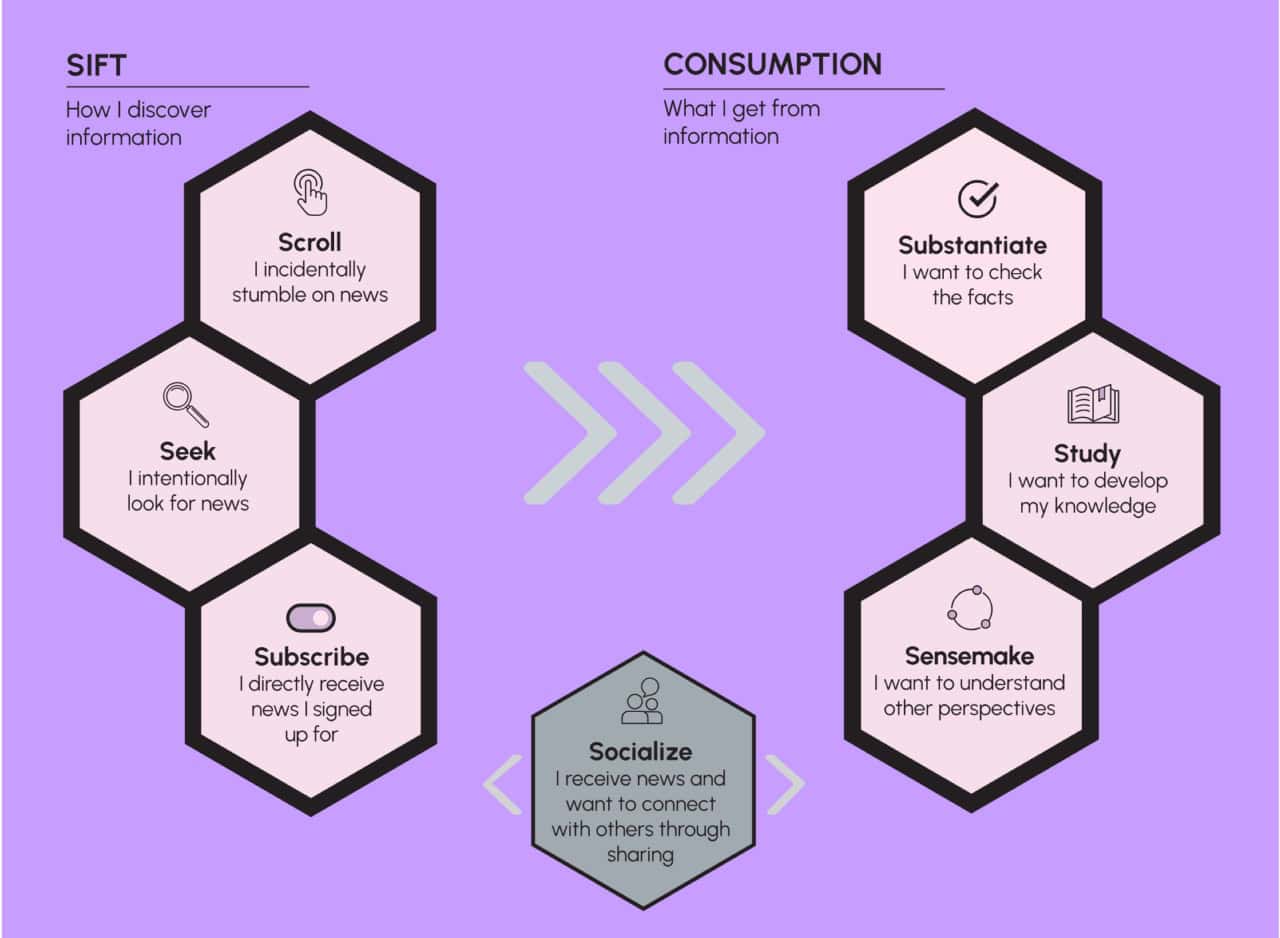
Based on their responses, the new report has distilled the modern news consumption process into two distinct categories and one bridging mode.
Discovery is broadly divided among the following methods, Scroll, Seek and Subscribe.
Consumption is separated into three modes, Substantiate, Study and Sensemake (unwieldy, that one).
Bridging those processes is Socialise, which the report describes as news being shared and found between peers and within communities.
News producers must prepare to rethink the very definition of news, since next generation audiences consider a news menu to consist of relevant civic information, broad interest to their community, to have personal relevance and to be entertaining as nonfiction.
In response, successful producers are reversing the journalism process, dismantling the inverted pyramid of news structure, which top loads stories with important information first, replacing it with structures and approaches adapted to take advantage of the online mediums into which the information flows.
“Through constant testing and iterating, they discover that success is highly contextual,” the report notes.
“What sparks engagement on YouTube might fall flat on TikTok, what drives conversation on Reddit rarely thrives on Instagram, and what works in a two-person interview podcast might not translate to a Q&A-style text article. This trial-and-error process allows them to design stories that feel native to each environment rather than being retrofitted afterward.”
Mastery of each medium becomes a very channel-specific skill set.
That approach is critical, because with the right engagement, more than 65% of respondents said that they would prefer an in-depth story to a summary, driving traffic back to source stories.
Artificial Intelligence is being used by this generation to summarise a flood of news from multiple sources and to provide reference background on topics of interest.
Traditional media sources, flattened on mobile device screens to an avatar, an image and a few lines of text, offer little that distinguishes them from the AI slop that flows into the news feed of their potential audience.
They face a double bind in engaging with this new user.
“Young consumers also do not have a strong affinity for traditional news producers,” the report notes.
“They struggle to relate to their formal, depersonalized tone. This is not always a bad thing; that same tone is the foundation for traditional news producers’ reputation for credibility.”
For more than a century, news-gathering has followed a near universal workflow: Idea → Research → Writing → Editing → Publication → Distribution.
Successful distribution of next generation news is represented by a new workflow: Distribution → Idea → Testing → Editing → Publication → Community Engagement.
Add to this mix multiple rounds of A/B testing to find effective delivery formats for each chosen distribution platform and the challenge of building teams fluent in the native language and style of each platform.
A traditional media house is faced with a robust challenge to adapt and grow their presence online.
“The traditional approach for news – arranging facts in descending order of importance – lacks creativity and flexibility,” notes Shirish Kulkarni.
“What’s more, the research says this style alienates younger audiences that crave a ‘more thoughtful, considered and purposeful approach’ to online news. They want it to reflect the reality of their lives, rather than industry norms.”
Kulkarni advocates a new structure, “the narrative accordion,” as a more flexible way to adapt stories to modern consumption (https://digitalcontentnext.org/blog/2021/06/14/abandon-the-inverted-pyramid-its-time-to-rebuild-the-news/).
What gets compulsive scrollers to pause? What builds news brand loyalty and an inclination to visit? How to win subscribers in an environment that is happy to hop between free services or just good enough sources?
You have two seconds to seize attention. That’s when a decision to stop and investigate either happens or it doesn’t.
The news delivery model is irretrievably broken, but young people still want information, and they are cheerfully skipping along, making their way across the shattered bits that remain above the red ink waterline.
Having a recognizable brand and style is a first step. Consistent and predictable posts that establish authority and reward click-through are baseline requirements.
Successful news producers emphasise individualistic identity over corporate authority. A company logo commands less attention than an identifiable face or style of delivery that resonates empathically with its intended audience.
Next generation news consumers don’t just want information; they want to know who is gathering it, who is producing it and who is delivering it.
Upfront declarations of intent, biases in approach, and consistent honesty with the audience count for more than protestations of neutrality.
Knowing “where you’re coming from” doesn’t automatically disengage a next generation audience if they are interested in having presumptions and conventional wisdom challenged, no matter how strongly they may hold dissenting beliefs if they find that their perspective is respectfully represented.
There’s much more available for consideration in the report, which is here, along with the first report.
















 The state of ransomware in the...
April 12, 2026
The state of ransomware in the...
April 12, 2026
 Digital döstädning
April 5, 2026
Digital döstädning
April 5, 2026
 The garbage infesting my in-box
March 30, 2026
The garbage infesting my in-box
March 30, 2026
 TSTT’s payments problem (updated)
March 30, 2026
TSTT’s payments problem (updated)
March 30, 2026
 Is Apple’s Neo the One?
March 22, 2026
Is Apple’s Neo the One?
March 22, 2026
 Privacy and your travel information
March 15, 2026
Privacy and your travel information
March 15, 2026
 TATT announces ambitious three-year strategic plan
March 9, 2026
TATT announces ambitious three-year strategic plan
March 9, 2026
 Samsung’s S26 leans in hard on...
March 1, 2026
Samsung’s S26 leans in hard on...
March 1, 2026
 A 2026 manifesto for Carnival
February 23, 2026
A 2026 manifesto for Carnival
February 23, 2026
 A hiss from a rose
February 15, 2026
A hiss from a rose
February 15, 2026
 News is a niche until it’s...
February 9, 2026
News is a niche until it’s...
February 9, 2026
 FT’s second Next Gen News report...
February 9, 2026
FT’s second Next Gen News report...
February 9, 2026
 Ransomware report notes fourth quarter 2025...
February 2, 2026
Ransomware report notes fourth quarter 2025...
February 2, 2026
 Hands-on with Apple’s Creator Studio as...
January 30, 2026
Hands-on with Apple’s Creator Studio as...
January 30, 2026
 Apple flirts with subscription software
January 26, 2026
Apple flirts with subscription software
January 26, 2026
 So long, and thanks for all...
January 19, 2026
So long, and thanks for all...
January 19, 2026
 Cyberedge reports on cybersecurity trends
January 12, 2026
Cyberedge reports on cybersecurity trends
January 12, 2026
 Samsung’s ZFlip 7 shows steady improvement
January 5, 2026
Samsung’s ZFlip 7 shows steady improvement
January 5, 2026
 Digital New Year’s resolutions
December 29, 2025
Digital New Year’s resolutions
December 29, 2025
 WiPay announces new strategy for services,...
December 22, 2025
WiPay announces new strategy for services,...
December 22, 2025