

- Online news faces challenges despite lower costs
- Balancing revenue protection with the need for new income streams is difficult, especially in challenging financial situations
- Reinventing local journalism is complex, and financial success can discourage bold changes
Above: Photograph by Alex Stemmer/DepositPhotos. “So long and thanks for all the fish” is the name of the fifth book in Douglas Adams’ Hitchiker’s Guide to the Galaxy trilogy. For all kinds of reasons, all of them personal, it was the obvious, if absurdly obscure headline with which to close this fourth era of BitDepth at Newday. Really, team, thanks.
BitDepth 1546 for January 19, 2026
This is the last BitDepth to appear in Newsday. It’s been a remarkable experience and one for which I remain grateful.
From December 2017 until, well, today, I’ve had an opportunity to shape and redefine the column and its relation to its audience to the benefit of both.
I got to work with BC Pires on Trini to the Bone for four years, ending the run of that feature with his death in October 2023.
Do I wish that I’d been able to do something more to shape the paper’s direction? Sure, but I am also mindful that its editorial management chose to keep me on during covid lockdowns, providing a real world lifeline when revenue streams began to dry up.
When those restrictions hit, I’d been planning to do a series of exclusive posts on this website, the website amplification of my technology coverage, so I donated them to the paper during those trying times instead.
At a meeting with then EIC Judy Raymond and Camille Moreno I remember their visible relief as I went on about “feeding the golden goose,” in an extended and ham-handed metaphor.
The streets outside the office that day were empty, an unsettling quiet embalming the city at midweek.
Both women were uncommonly and quietly supportive during my eight years and demonstrated admirable patience with my constant trickle of suggestions.
No idea I offered was a magic bean that would have helped Newsday to sprout to the skies again, and the hard reality is that a pivot to digital only would have sunk the paper almost immediately.
I can say this with some confidence because for 11 years I’ve been fighting to make TechNewsTT an independent revenue source. Very little has worked, resulting in very little from a financial perspective.
The limitations of a super-niche news website are balanced by the fact that I can, realistically, do nearly everything myself. Even so, unburdened by the boat anchor costs of a physical press and newsprint, online news struggles.
Loop, underwritten by Digicel, folded abruptly when the company refocused on core business. It’s entire archive of stories was removed almost immediately.
Wired868 produces considered, authoritative sports reporting but enjoyed its greatest success with bacchanal laced with biting satire under the Mr LiveWire byline, an elegant reinvention of the Bomb’s Madame Petticoat.
A general news website operates at a dramatically larger scale and consumes human resources like a raging fire.
Since the announcement of the intent to wind up Newsday, there has been a flood of posts commenting on the paper’s failure and the apparent inability of its management to take advantage of its internet presence and audience.

Most of the commentary is fair and thoughtful. One in six of the 600+ columns I wrote and archived on TechNewsTT considered the challenges of modern journalism.
But, media momentum has its own power.
When Google bought YouTube in 2006 for US$1.65 billion, there was significant head scratching in the broadcast industry.
That year, the phenomenon of lonelygirl15, a series of video clips purporting to be an introspective diary of a teenage girl was unmasked as a staged production. Views of the videos increased.
Consider that. A documentary was revealed to be a fraud. On a new platform that nobody fully understood. All the rules had changed, but we wouldn’t realise that for years.
At its peak in 2008, MySpace had 300 million registered users, of which 115 million were described as active. Facebook was a contender, but it had a very different idea of what users meant to the business.
Again the rules had changed. MySpace offered users a space to share their music and later, to build community. Facebook created an engine that turned users into fuel.
In 2005, Flickr was the bomb for photographers. An app that was crafted to surface photography in a way that made sense for the profession.
After Yahoo bought it in 2005, it clearly had no idea what to do with it. It slid slowly but inexorably into irrelevance, but it was a good idea and SmugMug bought it in 2018 to reinvent it for a new generation of photographers.
Before I joined the Newsday editorial team in 2017, I’d spent almost a month studying the paper, at the request of then Express Editor-in-Chief Lennox Grant in 1997, when it was experiencing robust success, pushing hard to become the top-selling newspaper.
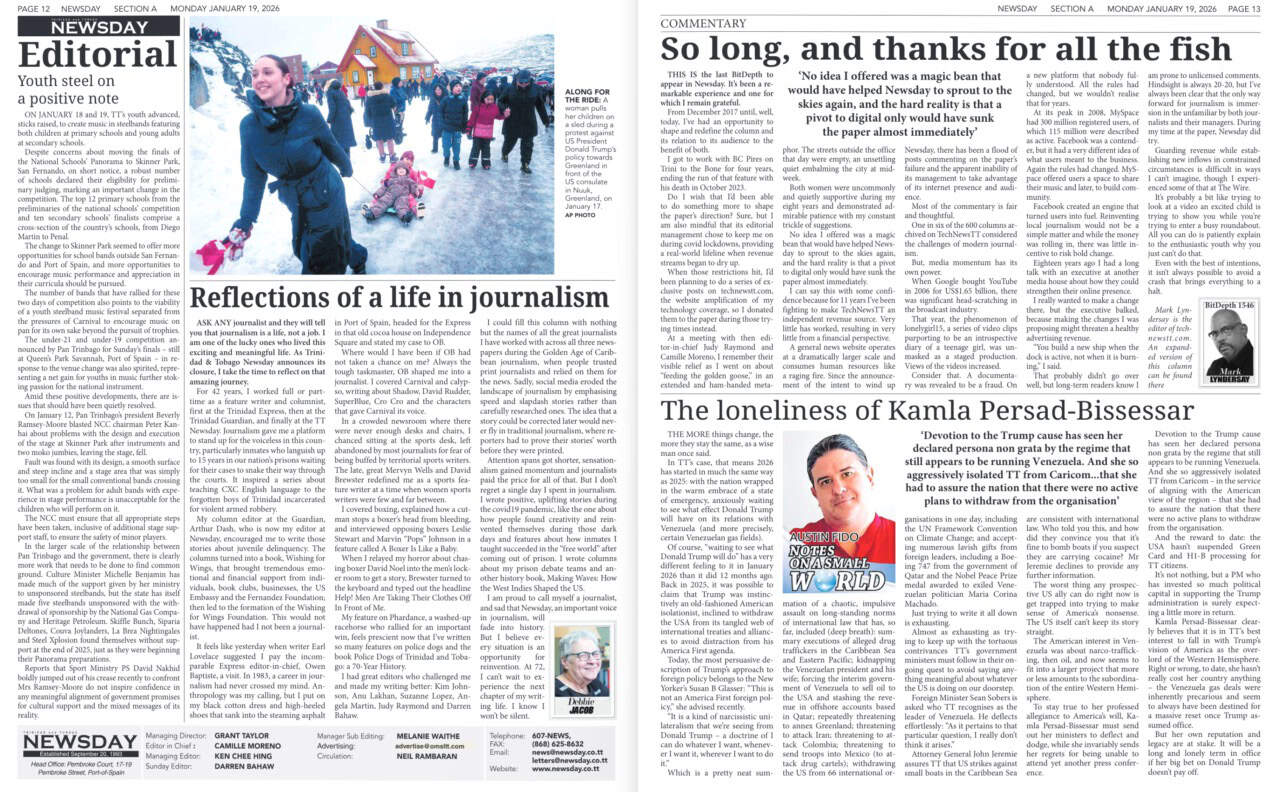
Newsday had abandoned its effort to be a good news paper, swinging fiercely in the opposite direction, and it was tempting to believe that the fierce front pages were the key to its success.
That dramatic opener got the punters through the door, but it wasn’t the only thing the paper was doing. Text was subtly larger than its competitors, around a point and a half bigger, not much when you write it down, but huge in the way it impacted the design colour of the pages.
Stories compared across all three papers were shorter in Newsday then, so more stories were packed into each page, giving the impression of more coverage.
Photos weren’t necessarily hung off a news hook. There were lots of photos of community events, people being Trinis, what international photojournalists called “wild art,” photos that were about themselves and not any related story.
These photos showed citizens themselves and their lives and were another good reason to win the catbird seat of the dashboard in front of a maxi-taxi driver.
Reinventing local journalism was never going to be a simple matter and while the money was rolling in, there was little incentive to risk bold change.
Eighteen years ago I had a long talk with an executive at another media house about how they could strengthen their online presence.
I really wanted to make a change there, but the executive balked, because making the changes I was proposing might threaten a healthy advertising revenue.
“You build a new ship when the dock is active, not when it is burning,” I said.
That probably didn’t go over well, but long term readers know I am prone to unlicensed comments.
Hindsight is always 20-20, but I’ve always been clear that the only way forward for journalism is immersion in the unfamiliar by both journalists and their managers, During my time at the paper, Newsday did try.
I note the tenure of Kalifa Clyne, who was a singular firebrand in shifting approaches to digital first at the paper. My reading of the column as an adjunct to the text dates back to her effort to introduce multimedia to the Newsday online.
Guarding revenue while establishing new inflows of cash in constrained circumstances is difficult in ways I can’t imagine, though I experienced some of those challenges when I ran the Guardian’s tabloid experiment, The Wire.
It’s probably a bit like trying to look at a video an excited child is trying to show you while you’re trying to enter a busy roundabout. All you can do is patiently explain to the enthusiastic youth why you just can’t do that.
Even with the best of intentions, it isn’t always possible to avoid a crash that brings everything to a halt.
BitDepth was published in the Trinidad Express, Trinidad Guardian, The Wire and the TT Newsday over last 30 years. It will continue here.










 The state of ransomware in the...
April 12, 2026
The state of ransomware in the...
April 12, 2026
 Digital döstädning
April 5, 2026
Digital döstädning
April 5, 2026
 The garbage infesting my in-box
March 30, 2026
The garbage infesting my in-box
March 30, 2026
 TSTT’s payments problem (updated)
March 30, 2026
TSTT’s payments problem (updated)
March 30, 2026
 Is Apple’s Neo the One?
March 22, 2026
Is Apple’s Neo the One?
March 22, 2026
 Privacy and your travel information
March 15, 2026
Privacy and your travel information
March 15, 2026
 TATT announces ambitious three-year strategic plan
March 9, 2026
TATT announces ambitious three-year strategic plan
March 9, 2026
 Samsung’s S26 leans in hard on...
March 1, 2026
Samsung’s S26 leans in hard on...
March 1, 2026
 A 2026 manifesto for Carnival
February 23, 2026
A 2026 manifesto for Carnival
February 23, 2026
 A hiss from a rose
February 15, 2026
A hiss from a rose
February 15, 2026
 News is a niche until it’s...
February 9, 2026
News is a niche until it’s...
February 9, 2026
 FT’s second Next Gen News report...
February 9, 2026
FT’s second Next Gen News report...
February 9, 2026
 Ransomware report notes fourth quarter 2025...
February 2, 2026
Ransomware report notes fourth quarter 2025...
February 2, 2026
 Hands-on with Apple’s Creator Studio as...
January 30, 2026
Hands-on with Apple’s Creator Studio as...
January 30, 2026
 Apple flirts with subscription software
January 26, 2026
Apple flirts with subscription software
January 26, 2026
 So long, and thanks for all...
January 19, 2026
So long, and thanks for all...
January 19, 2026
 Cyberedge reports on cybersecurity trends
January 12, 2026
Cyberedge reports on cybersecurity trends
January 12, 2026
 Samsung’s ZFlip 7 shows steady improvement
January 5, 2026
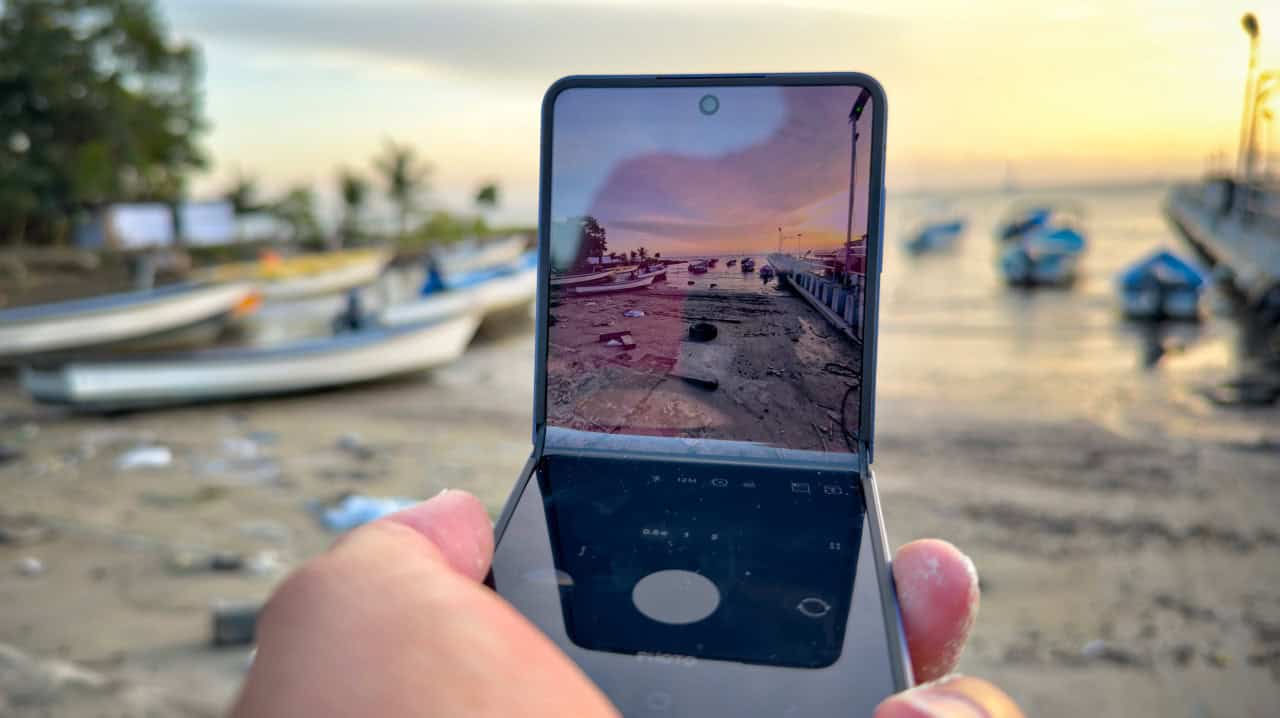
Samsung’s ZFlip 7 shows steady improvement
January 5, 2026
 Digital New Year’s resolutions
December 29, 2025
Digital New Year’s resolutions
December 29, 2025
 WiPay announces new strategy for services,...
December 22, 2025
WiPay announces new strategy for services,...
December 22, 2025

Sorry to hear that Mark,
…not that I was subscribed to anything Newsday.
Personally, I enjoy reading bitdepth.
Reading about folks trying to build, make change.
More than the lime and wine, political bacchanal, it is refreshing.
.. building anything requires a vision, some work, commitment, discipline.
Good Luck.
\Wayne
Doh fret. The work continues with the same emphasis.
Sad to see a major newspaper end especially now when we need journalists more than ever.
I know media is struggling everywhere in the world right now with the same transition but it seems like the ones that are making it work are going all in on paid subscriptions. Makes me wonder if that’s just a lot harder to do here with our lack of a truly widespread digital payment service.
I’ve written about this particular challenge before. Paid subscriptions work when two things are present. A large enough audience that you can hive off into paid and unpaid readership. A good reason to subscribe. That means investment in additional content, early access to material, deeper dives into stories and other incentives that would entice the serious newsreader to put out some cash. A good middle ground, which I am considering at this point, is a donor level, but before I do anything like that, I’d have to create at least some starter incentives. Putting material behind a paywall would not work with the small (by internet standards) niche audience that I can reliably draw.