
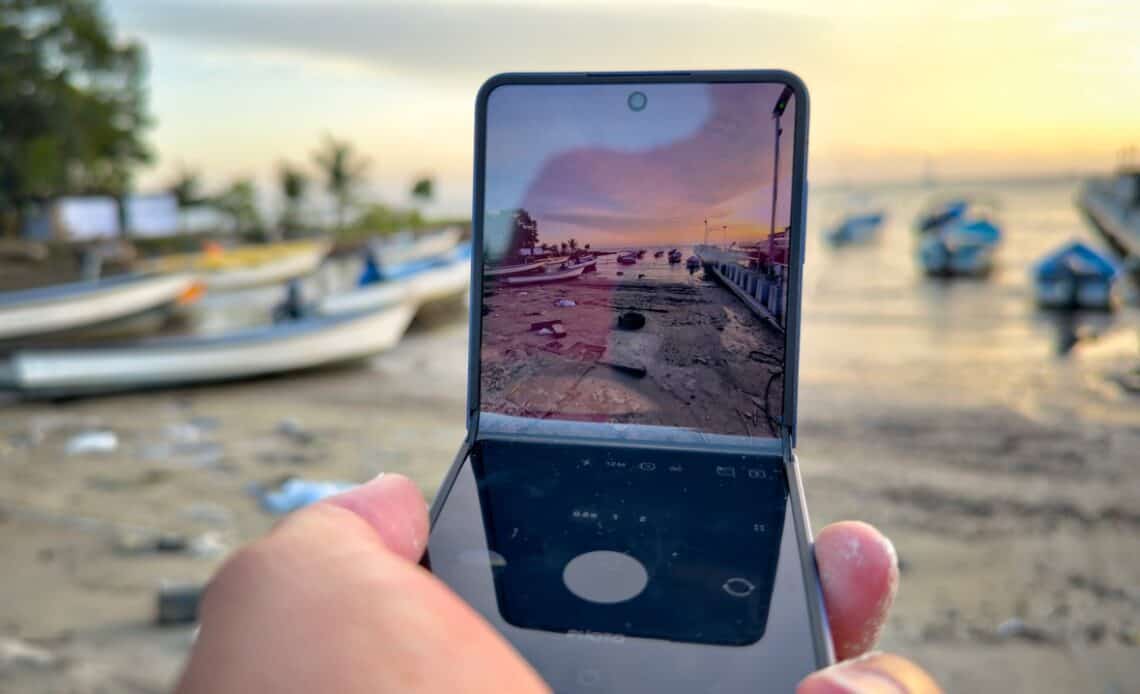
- Square, pocket-friendly design with a larger cover screen
- A fully functional display surrounds the twin main cameras,enhancing usability when the device is folded
- The polished aluminum finish is prone to slipping, use a case for a better grip
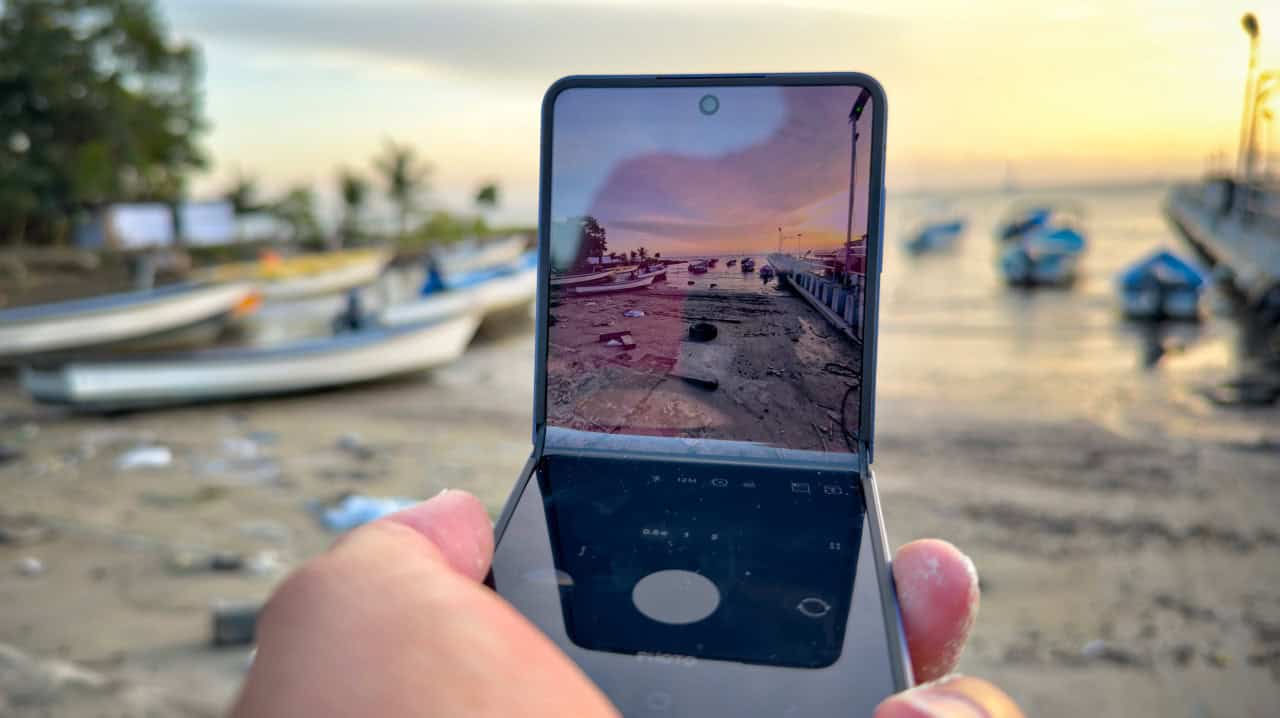
Above: Even if you fold the phone and get this view, the camera still captures a vertical if you don’t switch the aspect ratio to square. Photo by Mark Lyndersay.
BitDepth 1544 for January 05, 2026
As Samsung continues its confident dominance of the foldable smartphone market, the ZFlip 7, the most affordable device in the line remains the most accessible entry point for anyone curious about hinged phones.
In November, the company introduced the Z Trifold, a double hinged version of its ZFold line that opens to the size of a small tablet.
The ZFlip 7 goes in the opposite direction, scaling down the traditional smartphone’s slab profile to a pocket friendly square.
The ZFlip 7 has rejigged dimensions from the ZFlip 3 that I tested in 2021 (link.technewstt.com/bd1316) and though the change is fractions of a millimetre, the folded device feels more obviously square than the ZFlip 3.
It’s also been slimmed rather vigorously since it was introduced in 2020. The phone is so thin that the USB-C port is starting to look squeezed in.
One of the most visible changes to the ZFlip since 2020 is the introduction and expansion of the cover screen; a display that’s viewable when the ZFlip is folded shut.
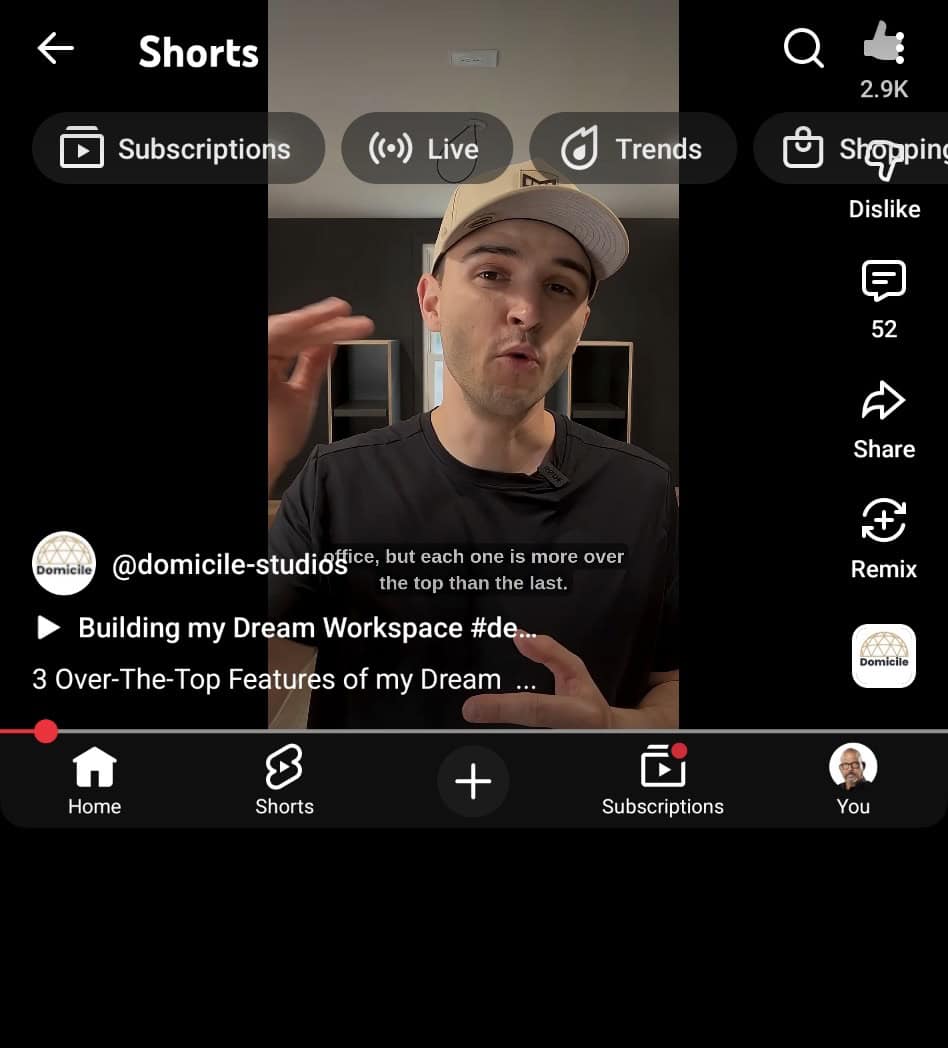
At first, it didn’t exist at all. Then it was introduced as a sliver of display on which a few status items were allowed, most usefully, the date and time.
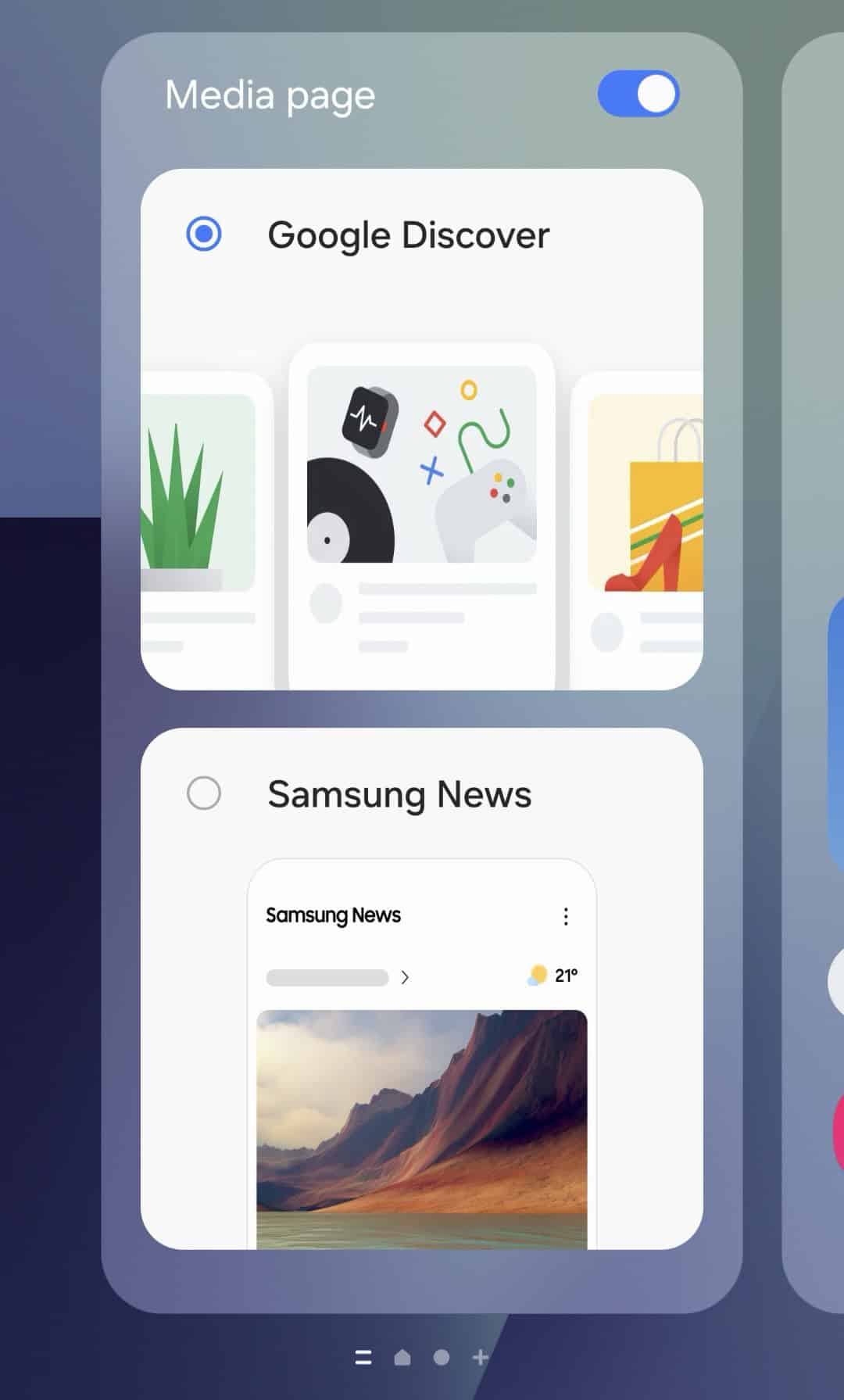
On the ZFlip 7, the screen isn’t quite the fully featured smartphone display that you get on the Fold line, but it is dramatically more useful.
The cover screen now fills an entire face of the folded device, surrounding the twin cameras. Those cameras have remained largely unchanged over the life of the device. You get the semi-wide lens that’s regarded as normal for a smartphone and an ultrawide, 123 degree lens.
It’s an agreeable pairing for a device that’s clearly meant for close range, intimate photography, both of self and friends.
The cover screen is a very usable 948 x 1048 pixel display with a 348 ppi density. That’s in shouting distance of the phone’s unfolded main display, which delivers 397 pixels per inch.

That’s more than enough for the widgets you can now park on the cover screen, but also enables a whole new way to work with the phone for selfies, since a version of the camera app can be used on the cover screen and it makes use of both main lenses.
The app allows you to make “telephoto” captures at between 2x and 10x, but they are all software interpolated and get worse the more you digitally zoom in.
At 2x, there’s some AI generated image artifacts, but it’s passable. Above 4x, images get annoyingly mushy.
But being able to use a powerful wide-angle lens in what is essentially a next level selfie mode is a big step up for the phone’s target market. How you do it, though is another matter.
You can take a photo on the cover screen by either pressing the power button on the side of the device or by tapping the screen, but the optimal solution seems to be the onscreen self-timer with it’s very visible countdown timer to get into the right position before the immortal selfie snap is captured.
It does take a bit of practice to keep a finger out of the way of that very wide lens.
When the ZFlip 7 is open, all but a quarter of the device is glass, closed, it’s half. The metal finish is a polished aluminum surface available in four colours, but it takes just a hint of grease or sweat to give the ZFlip 7 the traction of wet soap.
Brushed aluminum with some grippable tooth would have been a better choice for that metal frame.
A case for the phone seems almost mandatory for most users particularly if snapping after eating fries is in their future, but the cases available since the phone’s introduction in July look more like early Iron Man armor than something that reflects the sleek design ethos of the ZFlip 7.
You get a lot in this small, flexible package. I hadn’t expected inductive charging, RAW image support (download Samsung’s Expert Raw app for additional control), or a 50MP image capture option, but that’s the magic of adding features iteratively, responding to customer needs.
Do I wish some of those image options were available on the cover screen? Better battery life would have been great too. But turning the ZFlip’s cover screen into a useful interface was inspired and looks set to only improve.
A 256GB model retails for US$900, which translates into prices between six and seven thousand dollars locally. This is not an impulse buy, but for the fashionably social, it may be a necessity.












 Is Apple’s Neo the One?
March 22, 2026
Is Apple’s Neo the One?
March 22, 2026
 Privacy and your travel information
March 15, 2026
Privacy and your travel information
March 15, 2026
 TATT announces ambitious three-year strategic plan
March 9, 2026
TATT announces ambitious three-year strategic plan
March 9, 2026
 Samsung’s S26 leans in hard on...
March 1, 2026
Samsung’s S26 leans in hard on...
March 1, 2026
 A 2026 manifesto for Carnival
February 23, 2026
A 2026 manifesto for Carnival
February 23, 2026
 A hiss from a rose
February 15, 2026
A hiss from a rose
February 15, 2026
 News is a niche until it’s...
February 9, 2026
News is a niche until it’s...
February 9, 2026
 FT’s second Next Gen News report...
February 9, 2026
FT’s second Next Gen News report...
February 9, 2026
 Ransomware report notes fourth quarter 2025...
February 2, 2026
Ransomware report notes fourth quarter 2025...
February 2, 2026
 Hands-on with Apple’s Creator Studio as...
January 30, 2026
Hands-on with Apple’s Creator Studio as...
January 30, 2026
 Apple flirts with subscription software
January 26, 2026
Apple flirts with subscription software
January 26, 2026
 So long, and thanks for all...
January 19, 2026
So long, and thanks for all...
January 19, 2026
 Cyberedge reports on cybersecurity trends
January 12, 2026
Cyberedge reports on cybersecurity trends
January 12, 2026
 Samsung’s ZFlip 7 shows steady improvement
January 5, 2026
Samsung’s ZFlip 7 shows steady improvement
January 5, 2026
 Digital New Year’s resolutions
December 29, 2025
Digital New Year’s resolutions
December 29, 2025
 WiPay announces new strategy for services,...
December 22, 2025
WiPay announces new strategy for services,...
December 22, 2025
 Old Mac, new OS
December 15, 2025
Old Mac, new OS
December 15, 2025
 Regional cybersecurity faces fire
December 8, 2025
Regional cybersecurity faces fire
December 8, 2025
 Unfinished symphonies
December 1, 2025
Unfinished symphonies
December 1, 2025
 Do you know who your child...
November 24, 2025
Do you know who your child...
November 24, 2025