
- Serif Labs offered affordable alternatives to Adobe’s InDesign, Illustrator, and Photoshop with its apps Publisher, Designer, and Photo.
- Canva acquired Serif Labs and made Affinity free for everyone, potentially to leverage synergy with Canva’s user base.
- One million users signed up for Affinity in the first two weeks, indicating a promising market segment.
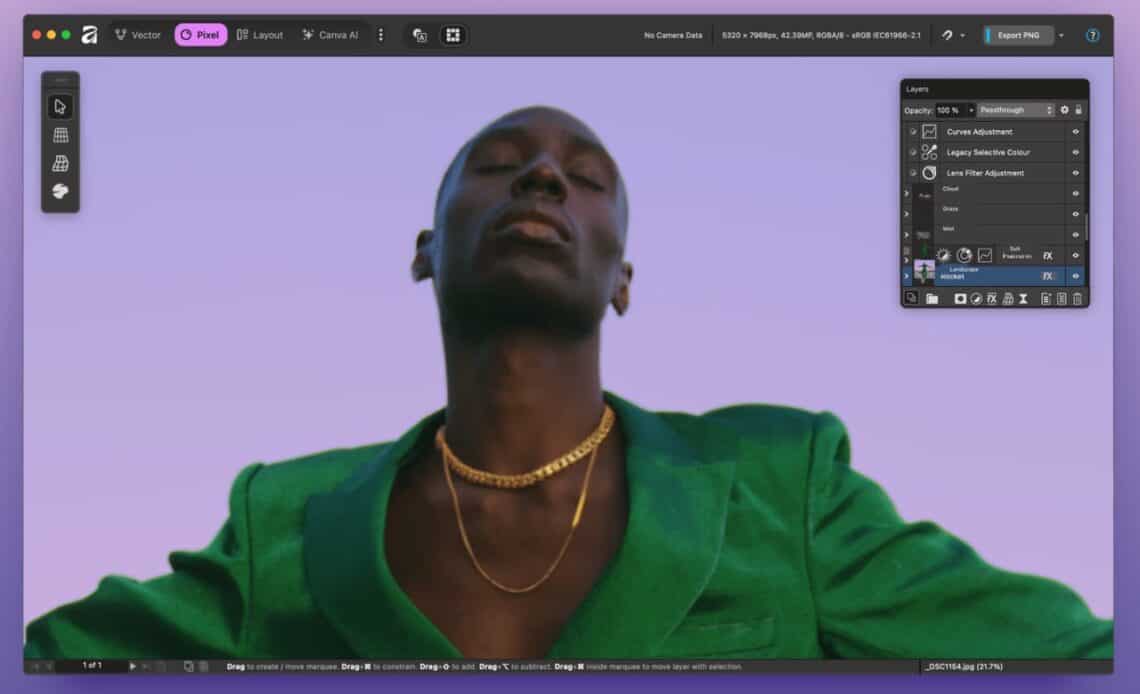
Above: Affinity’s pixel editing studio. Images courtesy Canva.
BitDepth 1536 for November 10, 2025
At the end of October, Canva announced its game plan for the software it bought from Serif Labs.
The Affinity software suite developed for Windows and MacOS was a budget priced alternative to Adobe’s premium graphics software, with products that offered affordable alternatives to InDesign, Illustrator and Photoshop.
You could own Affinity’s suite of three apps for the cost of three months’ rent payments to Adobe.
Adobe’s software, from the audio production tool Audition to XD (a discontinued mobile app UI design tool), is available on a monthly subscription model but if you stop paying, the software stops working, a source of significant annoyance in the creative community.
Affinity’s alternatives, Publisher, Designer and Photo were always capable options, but their feature set never quite matched that of Adobe flagship apps.
Early versions launched slowly and the design was just “off” enough to throw sand in the gears of a practiced graphics professional.
I’ve been courting Affinity’s Photo since it was introduced, but it seemed that we’d never get creatively hitched, as it were.
That day arrived at the end of 2024, when it became clear that maintaining a legacy computer system just to run my perpetually licensed copy of Photoshop CS6 was in a graveyard spiral of diminishing returns.
It took me a month to get to the point that I could confidently tackle production work using Affinity’s software.
To be fair, by 2024 I was also fighting 35 years of Photoshop-specific muscle memory and a reflexive mindmap of the software’s features.
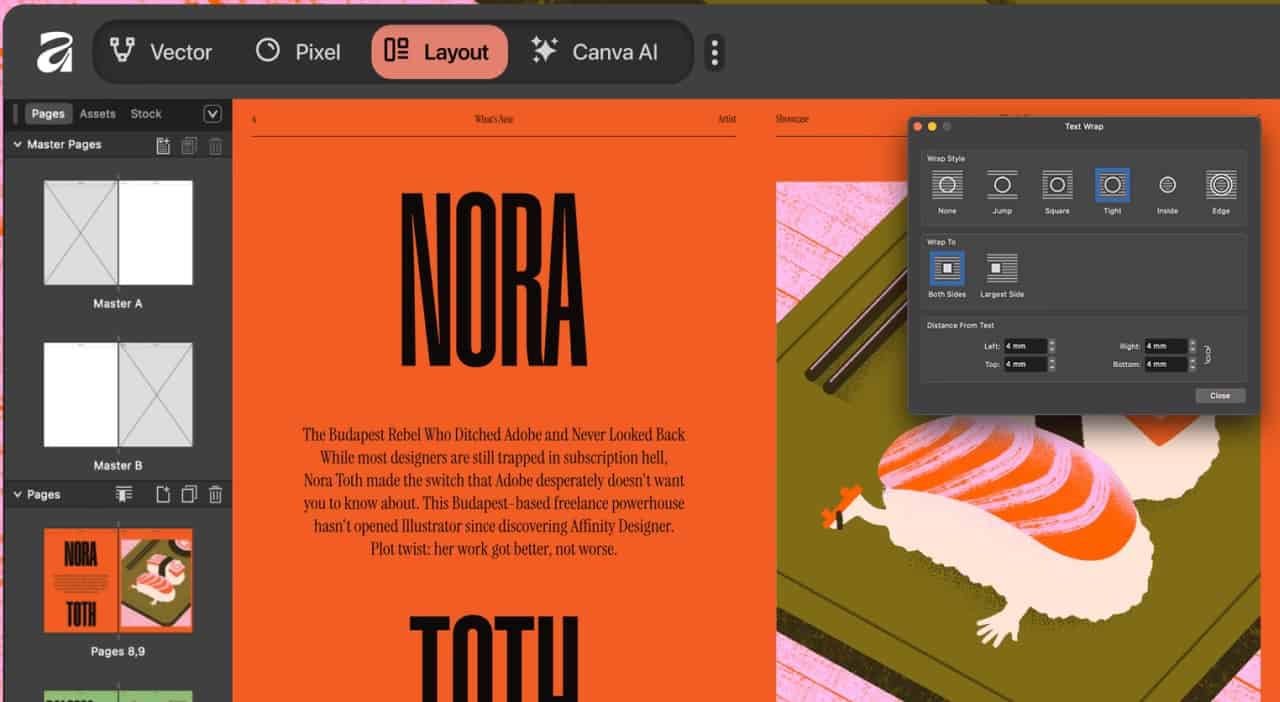
Affinity Photo offered similar features (that Unsharp Mask tool is still not quite there yet), but it wasn’t until I customized the tools to create a facsimile of my Photoshop workspace that I began to make some headway.
Those quirks, along with Adobe’s decades long dominance of the publishing space, made it difficult for Affinity to gain more than a 0.1 per cent share of the market for graphic design tools.
Canva bought Serif Labs and the Affinity products in March 2024, and the October announcement revealed that the software, renamed Affinity, would be free, for everyone, forever.
The v2 Affinity apps are no longer available.
This is clearly not a plan to make money, if only because it’s more evidently a plan to not make money, but that assessment discounts the potential value of synergy with Canva itself.
Canva is widely used to create a blizzard of colorful promotions, ads and other visual collateral largely destined for web use.
It is hugely popular and offered for free, but does thriving business with a subscription tier, which adds AI tools, stock photos and templates that overworked social media marketers love.
That creative work, however, sometimes requires the input of graphics professionals who are almost entirely appalled by the way Canva works.
But professionally oriented software that integrates seamlessly with a consumer grade design tool is next level gamesmanship.
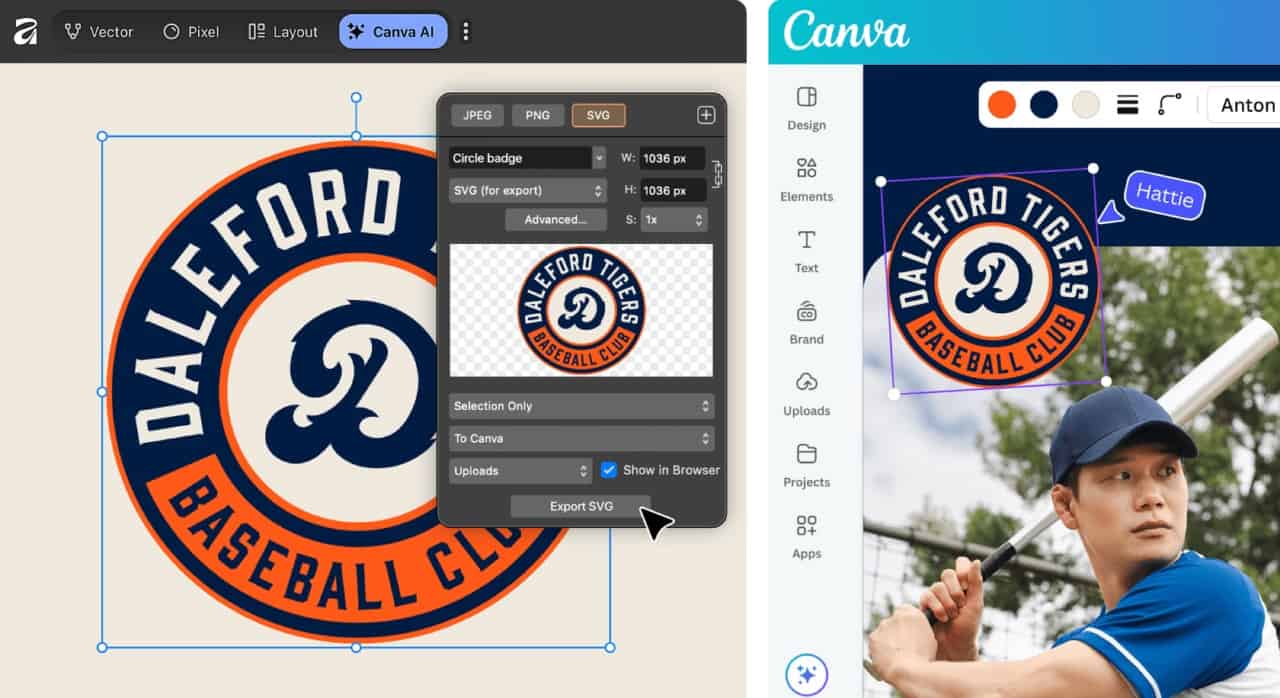
It now literally costs nothing for a graphics pro to prepare sophisticated design work in Affinity and send a native file to a Canva user.
From an end user perspective, the first big change is that all three apps have been welded together into one massive 3.5GB file now called just Affinity.
The different modes of operation that Affinity once described rather obscurely as “personas” are now more sensibly divided into “studios,” which gather the tools according to their expected use in vector, pixel-based and page layout work.
Now that there are three times as many features bundled into a single app, the ability to create your own studio and populate it with just the tools you need is sensible.
Menus now bundle tools together sensibly as well. Affinity Photo v2 scattered important features all over the place and Affinity’s tools for pixel based editing are now gathered under a new pixel menu.
Some commands have been moved, but this new arrangement makes sense, so it’s actually a welcome inconvenience.
Canva subscribers get their AI tools in Affinity, but the most useful tool for graphics professionals, which automates object selection using a downloadable 290MB LLM model, remains part of the free version.
If you’re on Mac, Affinity works with systems that run Catalina (10.15) and up. Pixelmator Pro, another Photoshop/Illustrator alternative was bought by Apple and offers a different but complementary approach to combining vector and pixel editing features.
I did a huge six-week image editing and retouch/repair project in March through April, and it was my first Photoshop-free pro job. I used both Affinity Photo v2 and Pixelmator Pro to prepare 240 images for publication without issues.
Adobe has 37 million Creative Cloud subscribers. Canva has 16 million paid subscribers and 260 million active users. One million users have signed up to use the new Affinity app in its first two weeks.
Canva doesn’t need Affinity to win, but locking in a new market segment with an app it’s adapting to support its moneymaker (the first major bug fix improves Canva art exports) is likely to prove a winning gamble.










 Is Apple’s Neo the One?
March 22, 2026
Is Apple’s Neo the One?
March 22, 2026
 Privacy and your travel information
March 15, 2026
Privacy and your travel information
March 15, 2026
 TATT announces ambitious three-year strategic plan
March 9, 2026
TATT announces ambitious three-year strategic plan
March 9, 2026
 Samsung’s S26 leans in hard on...
March 1, 2026
Samsung’s S26 leans in hard on...
March 1, 2026
 A 2026 manifesto for Carnival
February 23, 2026
A 2026 manifesto for Carnival
February 23, 2026
 A hiss from a rose
February 15, 2026
A hiss from a rose
February 15, 2026
 News is a niche until it’s...
February 9, 2026
News is a niche until it’s...
February 9, 2026
 FT’s second Next Gen News report...
February 9, 2026
FT’s second Next Gen News report...
February 9, 2026
 Ransomware report notes fourth quarter 2025...
February 2, 2026
Ransomware report notes fourth quarter 2025...
February 2, 2026
 Hands-on with Apple’s Creator Studio as...
January 30, 2026
Hands-on with Apple’s Creator Studio as...
January 30, 2026
 Apple flirts with subscription software
January 26, 2026
Apple flirts with subscription software
January 26, 2026
 So long, and thanks for all...
January 19, 2026
So long, and thanks for all...
January 19, 2026
 Cyberedge reports on cybersecurity trends
January 12, 2026
Cyberedge reports on cybersecurity trends
January 12, 2026
 Samsung’s ZFlip 7 shows steady improvement
January 5, 2026
Samsung’s ZFlip 7 shows steady improvement
January 5, 2026
 Digital New Year’s resolutions
December 29, 2025
Digital New Year’s resolutions
December 29, 2025
 WiPay announces new strategy for services,...
December 22, 2025
WiPay announces new strategy for services,...
December 22, 2025
 Old Mac, new OS
December 15, 2025
Old Mac, new OS
December 15, 2025
 Regional cybersecurity faces fire
December 8, 2025
Regional cybersecurity faces fire
December 8, 2025
 Unfinished symphonies
December 1, 2025
Unfinished symphonies
December 1, 2025
 Do you know who your child...
November 24, 2025
Do you know who your child...
November 24, 2025

[…] Caribbean – At the end of October, Canva announced its game plan for the software it bought from Serif Labs… more […]