

Above: Minister of Finance Davendranath Tancoo.
BitDepth 1533 for October 20, 2025
The 2025-2026 budget read by Finance Minister Davendradath Tancoo last week struggled to balance the work done in the first half of the financial year by the PNM and the work of the new UNC government since May.
External factors limit any new direction for tech. Commitments to external agencies like the UN and positions taken to ensure that investors find future opportunities attractive largely stymie efforts to put a new government stamp on digital transformation.
But after two consecutive terms of chafing while Colm Imbert pilloried the 2010-2015 UNC government on budget day, the new Finance Minister didn’t miss the opportunity to wield the budget speech like an anti-PNM bludgeon.
“The entire country knows that the PNM left our country in financial difficulties and economic ruin,” Tancoo lamented.
“None of us could have guessed how far this country had fallen.”
As the Irish spy Dudley Bradstreet wrote in the 1700s, “Turnabout is fair play.”
So, what does the first budget by this UNC government promise for technology and digital transformation?
Notably, this year’s Public Sector Investment Programme (PSIP) mentions iGovTT just three times and makes no mention at all of the TT International Finance Centre.
A fair bit of the extended budget documents restates a commitment to continuing technology programmes started under the PNM, including, rather surprisingly, the D’Hub developer platform a project that seemed to be abandoned after the election.
To be fair, the site also appeared to be abandoned before the election.
The smart city project planned for Arima was declared complete in a single line buried in the Housing and Shelter report of the 2026 PSIP.
“The Connected Arima (Smart Town) project was completed as various areas in Arima received Wi-Fi connectivity.”
Which is a bit like saying that a car was delivered after four tyres were rolled into the customer’s front yard.
Other critical digital transformation projects are mentioned in the vaguest possible terms, including continuing promises of an electronic ID (e-ID) and the mainstreaming of digital payments using India’s Unified Payments Interface.
It’s unclear whether any digital wallets offered by this system will also power a planned Social Benefits Wallet promised in the Social Sector Investment Programme (SSIP).
A government data centre remains on the cards, but the Public Administration Ministry will not build its own Tier 4 installation, but will, “Following the signing of a contract between iGovTT and the Trinidad and Tobago Telecommuications Service, construct and install a data centre at a cost of $60 million [and] ICT equipment and modules were procured.”
We are well into our fourth year of the “modernisation” of the Police Service.
Big promises are being made across a range of ministries and the budget allocation is there to underwrite it.
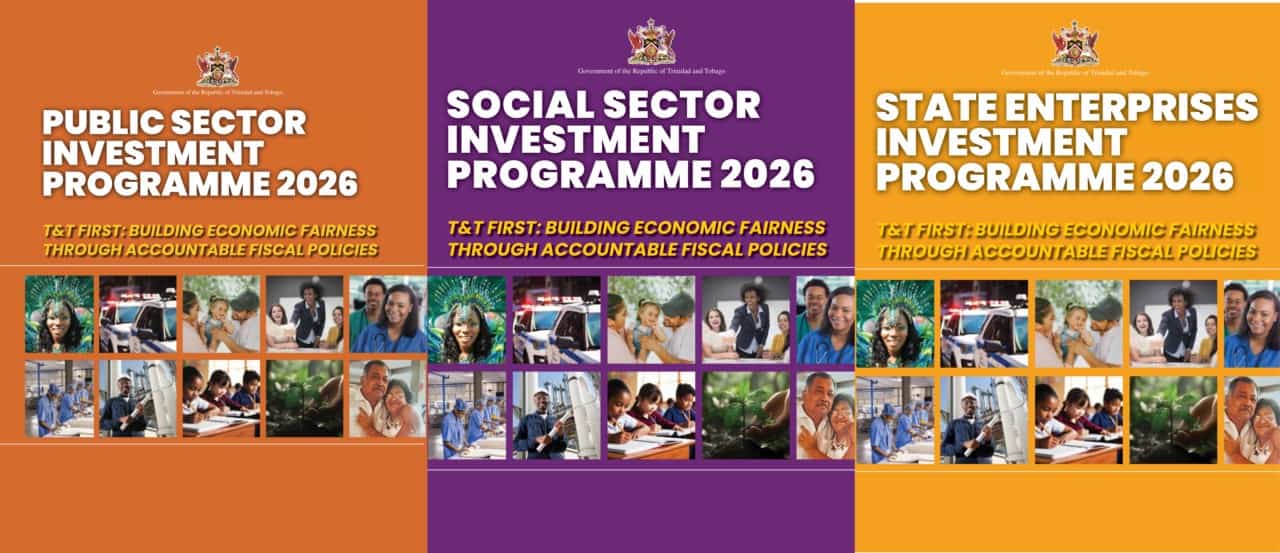
ICT is now the single largest line item under economic infrastructure spending in the 2026 PSIP with almost a third of that budget at $400 million ($210m in 2025, 25.7 per cent of sector allocation in 2026).
In 2025, the largest commitment was to roads and bridges ($590m), but the spend on that dropped to second place in 2026 at $261m.
It’s the third largest of the PSIP allocations overall, behind health ($489m – $338m in 2025) and the administration of Public Administration ($402m – $655m in 2025).
Most of this money appears to be allocated to hardware and infrastructure.
The Digital Government Programme, a project costing $630m and heavily weighted to hardware planned to upgrade the Police Service, National Security and “other ministries” gets $377m in 2026.
By comparison, the ICT Support Programme, a project costing $492m overall, gets $7.5 m to improve IT at the Foreign Affairs Ministry IT and oil spill fingerprinting technology at the EMA.
Hardware spending on laptops, tablets and accessories for students and educators are allocated $105m, with the Digital Education Programme getting $15m for expanding ICT infrastructure in public schools, ostensibly to “ensure reliable access to digital tools, such as [the] eBook Platform and textbooks.”
To date, nobody has explained where these digital textbooks are going to come from. Globally, publishers prefer paper to bits for their teaching materials and traditionally charge high prices with time-delimited digital rights management for access to e-textbooks.
Unlike the SSIP, which is a model of exhaustive detail and specific reporting on the spending of public money, the PSIP continues to be an extended promissory note that shamelessly recycles promised projects for years on end.
If the Finance Minister really wants to make a change in how the country’s money is managed, he could take a cue from the rigor of the SSIP, where the results of spending are reported and budgets are tied to specific programmes with defined outcomes.
Everything about technology in the budget is shrouded in fuzzy descriptions without clear goals or milestones. Server, desktop and laptop purchases are carefully enumerated; the impact of their deployment is almost universally absent.
Of the e-ID project, the PSIP rather unhelpfully notes that, “An agreement for the e-ID was signed [by] iGOVTT, the Ministry, and the United Nations Development Programme (UNDP) in fiscal year 2024 at a total cost of US$8.2 million. Development of the platform began and activities were completed.”
That unfocused, deliberately obscurantist approach is unsuitable for a budget sector allocated almost a half-billion dollars in public money.
















 Is Apple’s Neo the One?
March 22, 2026
Is Apple’s Neo the One?
March 22, 2026
 Privacy and your travel information
March 15, 2026
Privacy and your travel information
March 15, 2026
 TATT announces ambitious three-year strategic plan
March 9, 2026
TATT announces ambitious three-year strategic plan
March 9, 2026
 Samsung’s S26 leans in hard on...
March 1, 2026
Samsung’s S26 leans in hard on...
March 1, 2026
 A 2026 manifesto for Carnival
February 23, 2026
A 2026 manifesto for Carnival
February 23, 2026
 A hiss from a rose
February 15, 2026
A hiss from a rose
February 15, 2026
 News is a niche until it’s...
February 9, 2026
News is a niche until it’s...
February 9, 2026
 FT’s second Next Gen News report...
February 9, 2026
FT’s second Next Gen News report...
February 9, 2026
 Ransomware report notes fourth quarter 2025...
February 2, 2026
Ransomware report notes fourth quarter 2025...
February 2, 2026
 Hands-on with Apple’s Creator Studio as...
January 30, 2026
Hands-on with Apple’s Creator Studio as...
January 30, 2026
 Apple flirts with subscription software
January 26, 2026
Apple flirts with subscription software
January 26, 2026
 So long, and thanks for all...
January 19, 2026
So long, and thanks for all...
January 19, 2026
 Cyberedge reports on cybersecurity trends
January 12, 2026
Cyberedge reports on cybersecurity trends
January 12, 2026
 Samsung’s ZFlip 7 shows steady improvement
January 5, 2026
Samsung’s ZFlip 7 shows steady improvement
January 5, 2026
 Digital New Year’s resolutions
December 29, 2025
Digital New Year’s resolutions
December 29, 2025
 WiPay announces new strategy for services,...
December 22, 2025
WiPay announces new strategy for services,...
December 22, 2025
 Old Mac, new OS
December 15, 2025
Old Mac, new OS
December 15, 2025
 Regional cybersecurity faces fire
December 8, 2025
Regional cybersecurity faces fire
December 8, 2025
 Unfinished symphonies
December 1, 2025
Unfinished symphonies
December 1, 2025
 Do you know who your child...
November 24, 2025
Do you know who your child...
November 24, 2025