
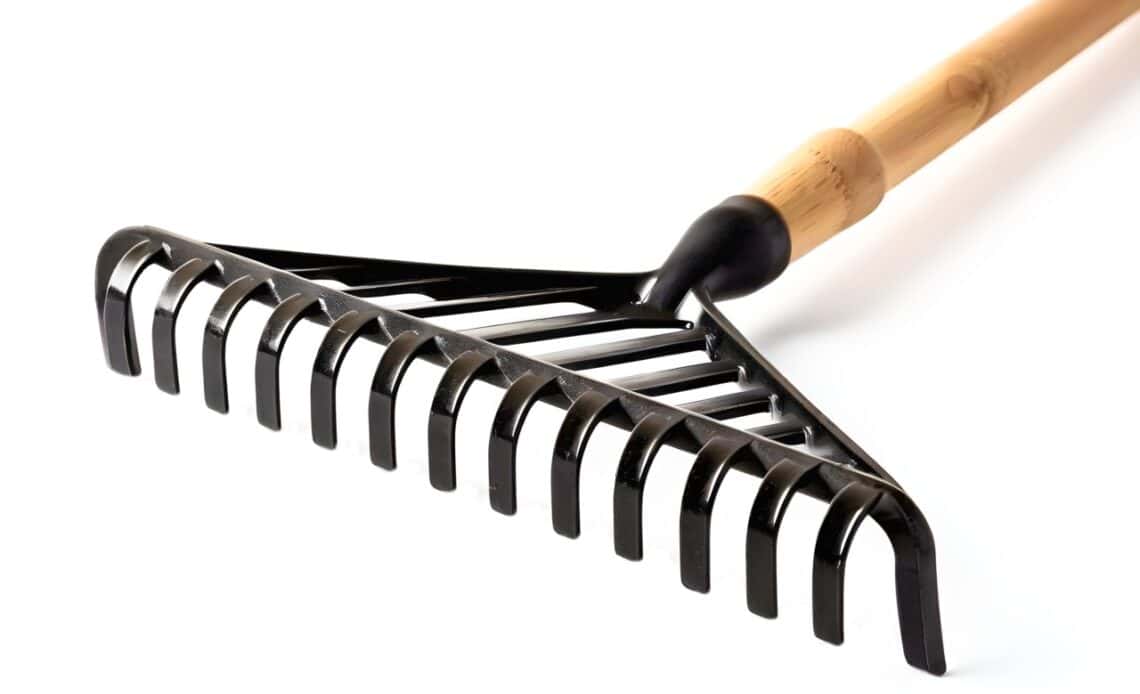
Above: AI Illustration created using the Amazon Nova tool on 123rf.com
BitDepth#1529 for September 22, 2025
At the back of the school trophy room, tucked into a corner and forgotten under cobwebs and dust, was an unused rake.
This was an old farming implement. Though unused, the painted metal was fringed at the edges with rust, the wooden handle turned dark brown, dry and dull with age.
How did it get there?
To understand that, you have to know about the era when rakes were everywhere in schools.
It began with a mandate. Food security. Awareness of the land. Agriculture at the centre of the economy. Plant what you eat.
Secondary schools were where the country needed to start. Primary schools would work, appropriately, with seedlings and early growth, but secondary school students would go hands on, at home and in schools to understand the relationship between humanity and the land. This was the future.
What tool would represent this commitment best?
Clearly not the cutlass. Too readily weaponised. The spade was simply too heavy and unwieldy. The hoe was too specific in usability.
The rake though, could be turned to many of the tasks of those tools and more important, did not have to be dangerously sharp to be useful.
An official specification for the school rake was created and manufacturers began building them.
Instead of sharpened fork-like tines, the school rake was forged with a wave pattern, curving tongues with deep wells between them that made the rake slightly less efficient but more of a general purpose tool.
A standard four-foot wooden handle, unpolished, provided leverage. The design was sturdy and robust, fit for purpose and it was cheap to manufacture in bulk.
The first school reopening that included rake distribution was, predictably, somewhat chaotic.
Would children take the rakes home for assignments? Where would they be stored in the school? Would they be stolen? Sold? Thrown away?
Teachers puzzled over the order to integrate the rake into the curriculum. Literature did not generally address the rake in fiction. Or nonfiction for that matter. The history of the rake was brutally thin and practical.
Some teachers got inventive. A few art teachers privately circulated documents that examined the oddly calming wave-form profile of the modified school rake and suggested art projects that might make use of it.
Geography and biology students soon found themselves using the tool on field trips.
Newly resurgent agriculture and food nutrition teachers put the rakes to their intended use, creating plots on their school grounds and planting and cultivation were moved off the whiteboard and into practice.
Some enterprising urban schools broke concrete and asphalt to create small garden beds on their compounds, but the projects weren’t always successful.
The ground was sometimes unsuitable for cultivation or was found to cover almost impenetrable rock or poured concrete.

Here again Trini inventiveness was turned to advantage. After weeks of neglect, these failed efforts at turning concrete into land were abandoned, and the first crude Zen gardens began to appear in these spaces.
Rocks were cleared to create boundary borders and sacks of sand surreptitiously poured into the failed plots to create simple sandboxes.
The resulting karesansui Zen gardens were raked into sophisticated patterns and the idea quickly spread.
“Karensand,” as they eventually became known, became a niche offshoot of the rake project, spaces that were policed diligently by the students who created, used, and competed creatively in them, the intricate, thoughtful patterns in turn inspiring art students.
Any tool that has a simple aspect eventually becomes something to modify. Aftermarket replacement handles made of folding metal became popular with students who took the tools home regularly and could afford the third-party upgrades.
Cultish attention to decoration of the wooden handles through engraving, pyrographic art, wood treatments, stain patterning and polishing were used to enhance and personalize the tools. Such instruments were described as rakish by their admirers.
Unfortunately, pursuant to the law of unintended consequences, there were other ways that the rakes were put to use.
The industriously violent felt limited in attacking arable dirt and found ways to sharpen the edges of the determinedly blunt rake tines, covering the handiwork with paint after the fact.
Lots of threats were made, but very few people actually got hurt, at least partly because of a self-defense movement that arose among the bullied and physically less capable in schools.
For them, the rake became a force multiplier. The wooden shaft became a staff, and the metal rake head a melee weapon, in this secretive adaptation of traditional attack-response self-defense techniques cobbled together from Eskrima, Kendo and Gatka techniques.
The approach came to be known as rake fu, and a student who was adept at it was instantly recognisable by his casually confident handling of his implement.
Eventually, it became clear that the rakes would not achieve the hoped for improvement in agricultural development that had been envisioned at the start.
Schools were not ready for them at their introduction. Teachers, save for a few with the background and experience to respond, were at a loss trying to make use of the tool.
Schools with the arable acreage and interest profited greatly from the rake project and their students left the education system at a distinct agricultural advantage.
Eventually, it would become clear that the right tool, supported by the right teacher and adaptive curriculum could change a student’s life for the better.
But no single tool would do that for everyone.

















 Is Apple’s Neo the One?
March 22, 2026
Is Apple’s Neo the One?
March 22, 2026
 Privacy and your travel information
March 15, 2026
Privacy and your travel information
March 15, 2026
 TATT announces ambitious three-year strategic plan
March 9, 2026
TATT announces ambitious three-year strategic plan
March 9, 2026
 Samsung’s S26 leans in hard on...
March 1, 2026
Samsung’s S26 leans in hard on...
March 1, 2026
 A 2026 manifesto for Carnival
February 23, 2026
A 2026 manifesto for Carnival
February 23, 2026
 A hiss from a rose
February 15, 2026
A hiss from a rose
February 15, 2026
 News is a niche until it’s...
February 9, 2026
News is a niche until it’s...
February 9, 2026
 FT’s second Next Gen News report...
February 9, 2026
FT’s second Next Gen News report...
February 9, 2026
 Ransomware report notes fourth quarter 2025...
February 2, 2026
Ransomware report notes fourth quarter 2025...
February 2, 2026
 Hands-on with Apple’s Creator Studio as...
January 30, 2026
Hands-on with Apple’s Creator Studio as...
January 30, 2026
 Apple flirts with subscription software
January 26, 2026
Apple flirts with subscription software
January 26, 2026
 So long, and thanks for all...
January 19, 2026
So long, and thanks for all...
January 19, 2026
 Cyberedge reports on cybersecurity trends
January 12, 2026
Cyberedge reports on cybersecurity trends
January 12, 2026
 Samsung’s ZFlip 7 shows steady improvement
January 5, 2026
Samsung’s ZFlip 7 shows steady improvement
January 5, 2026
 Digital New Year’s resolutions
December 29, 2025
Digital New Year’s resolutions
December 29, 2025
 WiPay announces new strategy for services,...
December 22, 2025
WiPay announces new strategy for services,...
December 22, 2025
 Old Mac, new OS
December 15, 2025
Old Mac, new OS
December 15, 2025
 Regional cybersecurity faces fire
December 8, 2025
Regional cybersecurity faces fire
December 8, 2025
 Unfinished symphonies
December 1, 2025
Unfinished symphonies
December 1, 2025
 Do you know who your child...
November 24, 2025
Do you know who your child...
November 24, 2025