

- Google holds a 90% market share in search and generates a significant portion of its profits from search-related advertising.
- The rise of AI tools like ChatGPT has prompted Google to incorporate AI into its search results, leading to a decrease in click-through rates on traditional search links.
- Reliance on AI-generated content in search hinders intellectual curiosity and the interconnectedness of ideas.
Above: Illustration by milkos/123rf.com
BitDepth#1523 for August 11, 2025
Google is the dominant search tool globally, with an effective marketshare of 90 per cent. For decades, the fight in website creation has been to get on the first screenful of the first page of Google’s search results and some businesses just pay to be found there.
Google itself makes much of its profit from search-related advertising; profiting handsomely from Pay Per Click (PPC) revenue when visitors click on an advertising link delivered on its search results pages.
In 2023, the company raked in 57 per cent of its profits, a handsome US$175 billion from its search business, so it’s no small surprise that the real estate of that first screenful of search results has traditionally been closely guarded, kept sparse, and determinedly designed to deliver relevant and useful search results and targeted advertising links over the last decade.
For the company to decide to dedicate two inches of depth in that first search results page was a dramatic move, clearly triggered by the inroads that ChatGPT has been making into the information gathering and query response business.
Google might have started late out of the gate competing with OpenAI’s product, but it has a dramatic advantage.
The company has been indexing the collective wisdom of the open internet for the last two-and-a-half decades.
The company’s winning ranking system not only knows where raw information is to be found, it knows which information is, algorithmically calculated, the best.
So in the rush to out-ChatGPT OpenAI, Google has delivered a product that not only helps users looking for information; it is increasingly the only thing they read on the search results page.
In July, Pew research issued a report that found Google search pages with an AI overview cut click through by half. Links followed in a search result dropped to eight per cent when an AI overview was present compared to 15 per cent when it was not.
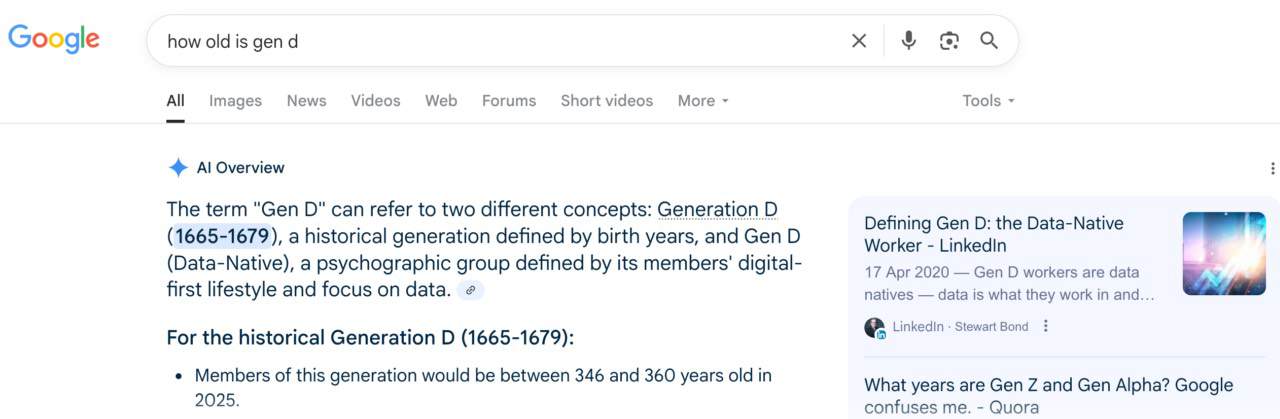
Google’s traditional search results page not only encouraged click-through to a link, it also encouraged users to scroll through results and summaries which also resulted in new searches with refined queries based on the initial result.
Pew also found that longer search queries, phrased as a full question, were more likely to trigger an AI overview.
For publishers and authors already reeling from de-prioritisation on social media platforms, losing click-through on Google is a devastating second blow.
Traffic from Google referrals are in free-fall, with major news sites seeing drops above 25 per cent since the introduction of AI overviews.
Google now embeds ads in AI overview summaries because…PPC advertising revenue.
Users who find out what they want to know in a couple of paragraphs on the search page are surely the big winners here, aren’t they?
For students trying to find answers to a complicated question, the challenges begin when every student gets the same overview and accepts it as the gospel statement on the issue.
Without searching further to find dissenting views, alternative opinions or deeper explanations of the subject matter, scholarship turns into stenography.
Even worse, complex and sophisticated issues can elude literal-minded AI systems, resulting in information that is taken out of context, misinterpreted or simply wrong.
There have been multiple stories about the early, egregious errors of Google’s AI overview, but the company is diligent about addressing them as quickly as they appear, a strategy that’s also used by OpenAI.
AI output is a kind of intellectual pablum, wishy-washy blends of more challenging work.
Students and researchers looking for the straight McCallan’s of primary sources end up with a watery slurry of regurgitated factoids.
In some ways, the Caribbean region is lucky. Google’s search bots have found far less information about topics relevant to the archipelago and many very island-specific searches simply fail to produce any overview at all.
Instant answers may be convenient and for some simple queries, may prove to be a boon, but reliance on these bland, packaged responses rarely does any justice to the original source material, drains the information of any character and distances fact from experienced reality.
Context, in sophisticated writing, is everything and AI still can’t tell the difference between deadpan satire and documented fact, blurring reliability even further.
Beyond this quiet murder of intellectual curiosity is another death, the concept of an interconnected internet of ideas.
With AI overviews, Google is quietly challenging OpenAI in a race to become the primary source of information for search, forgoing its responsibility as the major search engine to improve the reliability of a much wider pool of information through its search results.
Users of ChatGPT are not generally trying to find anything, they are seeking specific answers or AI powered assistance in either gathering or recasting information.
There is a delightful new term for the manicured, largely inoffensive and studiously unchallenging information spewed by AI generators, AI slop.
It tends to be used to characterise the pervasive AI generated images that are on the way to replacing memes as the most common images found on social media.
But, the term also applies to the characterless blandness of AI generated text, information without the rough edges of human thinking, appealingly polished facts presented authoritatively with limited context and no nuance at all.

















 The state of ransomware in the...
April 12, 2026
The state of ransomware in the...
April 12, 2026
 Digital döstädning
April 5, 2026
Digital döstädning
April 5, 2026
 The garbage infesting my in-box
March 30, 2026
The garbage infesting my in-box
March 30, 2026
 TSTT’s payments problem (updated)
March 30, 2026
TSTT’s payments problem (updated)
March 30, 2026
 Is Apple’s Neo the One?
March 22, 2026
Is Apple’s Neo the One?
March 22, 2026
 Privacy and your travel information
March 15, 2026
Privacy and your travel information
March 15, 2026
 TATT announces ambitious three-year strategic plan
March 9, 2026
TATT announces ambitious three-year strategic plan
March 9, 2026
 Samsung’s S26 leans in hard on...
March 1, 2026
Samsung’s S26 leans in hard on...
March 1, 2026
 A 2026 manifesto for Carnival
February 23, 2026
A 2026 manifesto for Carnival
February 23, 2026
 A hiss from a rose
February 15, 2026
A hiss from a rose
February 15, 2026
 News is a niche until it’s...
February 9, 2026
News is a niche until it’s...
February 9, 2026
 FT’s second Next Gen News report...
February 9, 2026
FT’s second Next Gen News report...
February 9, 2026
 Ransomware report notes fourth quarter 2025...
February 2, 2026
Ransomware report notes fourth quarter 2025...
February 2, 2026
 Hands-on with Apple’s Creator Studio as...
January 30, 2026
Hands-on with Apple’s Creator Studio as...
January 30, 2026
 Apple flirts with subscription software
January 26, 2026
Apple flirts with subscription software
January 26, 2026
 So long, and thanks for all...
January 19, 2026
So long, and thanks for all...
January 19, 2026
 Cyberedge reports on cybersecurity trends
January 12, 2026
Cyberedge reports on cybersecurity trends
January 12, 2026
 Samsung’s ZFlip 7 shows steady improvement
January 5, 2026
Samsung’s ZFlip 7 shows steady improvement
January 5, 2026
 Digital New Year’s resolutions
December 29, 2025
Digital New Year’s resolutions
December 29, 2025
 WiPay announces new strategy for services,...
December 22, 2025
WiPay announces new strategy for services,...
December 22, 2025
[…] Caribbean – Google holds a 90% market share in search and generates a significant portion of its profits from search-related advertising… more […]