
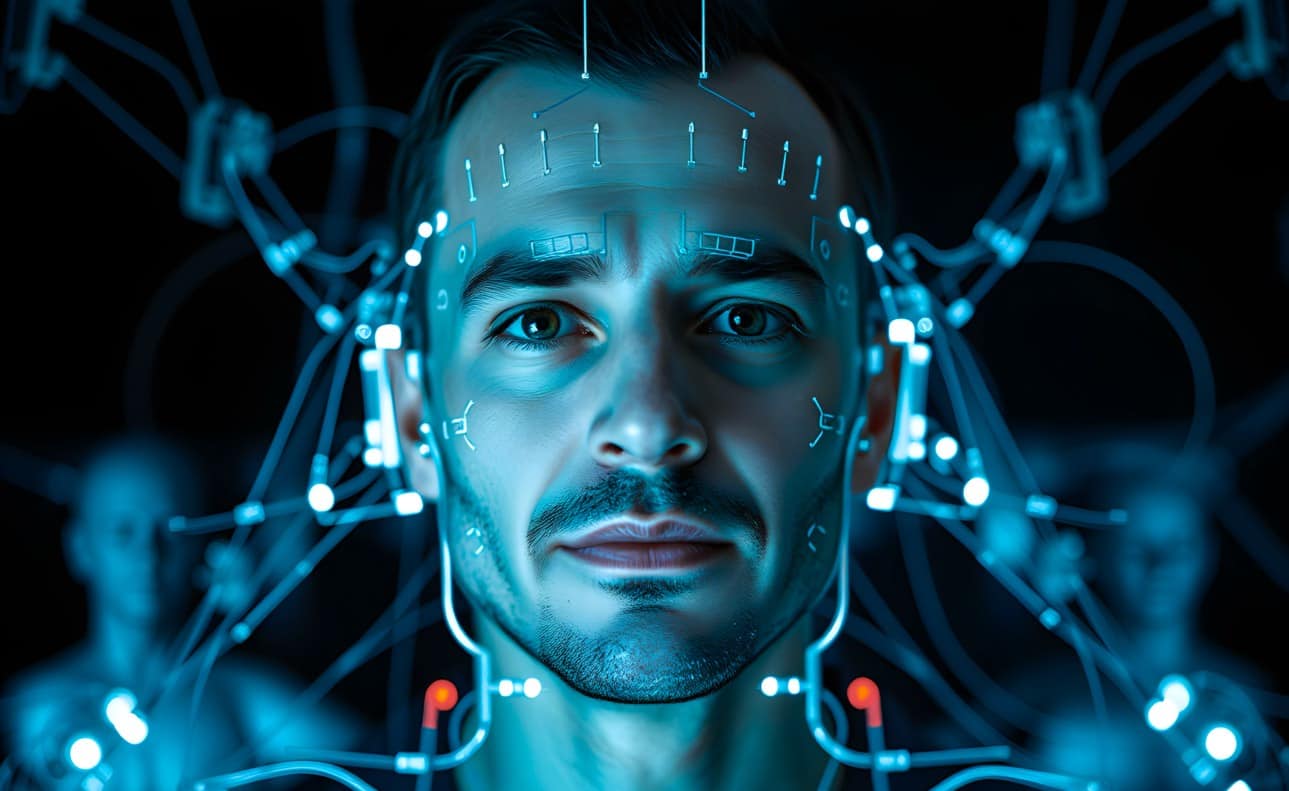

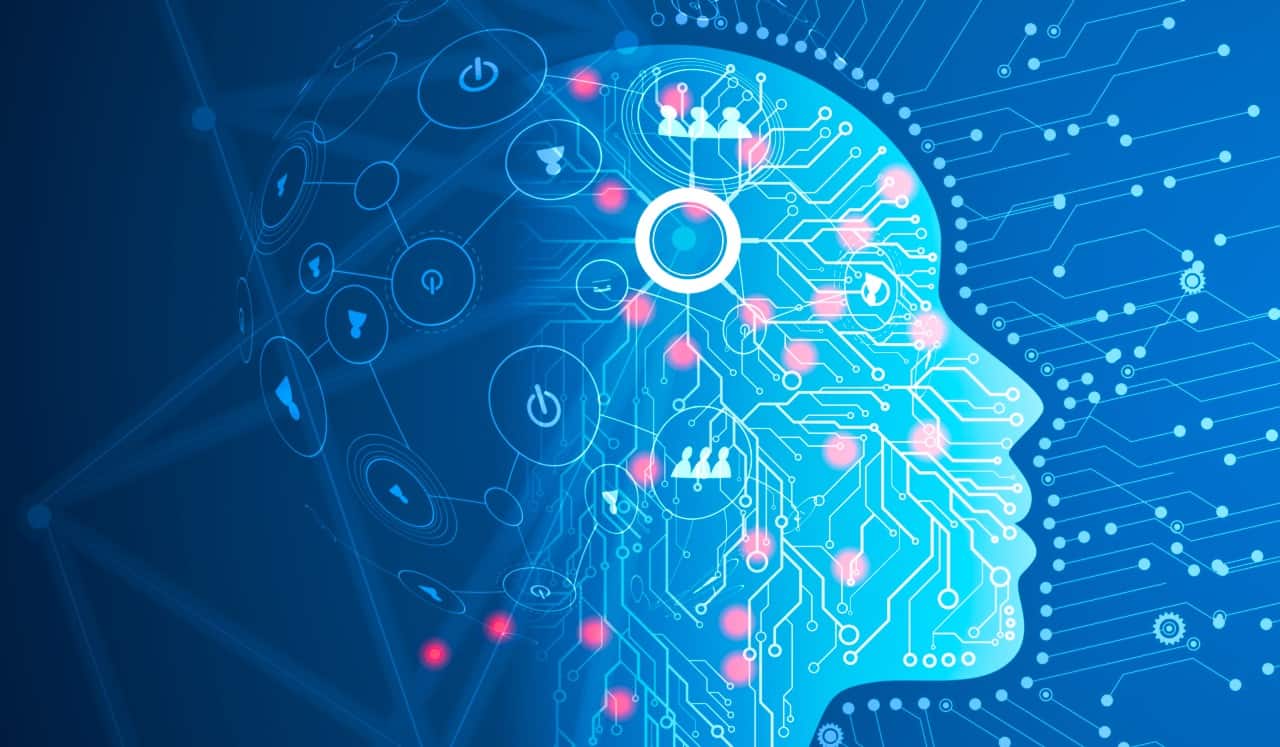
Above: Deepfake concept image. Illustration created using the Flux model on 123RF.com
BitDepth#1516 for June 23, 2025
When the conversation turns to the impact of AI on society, the strip-mining of intellectual property by Large Language Models (LLMs) and the impact on future jobs tends to dominate.
Much of what’s at stake in the future of artificial intelligence development is nothing less than a shared understanding of what is true and what is not.
Nowhere is that being put to the test more dramatically than in the rapidly advancing field of deepfakes, which use AI technology to map facial characteristics and voice patterns then use that information to create increasingly convincing facsimiles of real people apparently saying real things.
According to Perry Carpenter, chief human risk management strategist of KnowBe4, a cybersecurity investigation firm, the risk to companies is real.
In a recent online webinar, he referenced a Deloitte study that found that at least 26 per cent of businesses are experiencing deepfake-related attacks, a number that is set to rise sharply.
The era of casually dismissing deepfakes is definitely behind us. Carpenter notes that studies assessing the ability of focus groups to pick deepfakes from original media discovered that 80 per cent of the time, participants picked incorrectly, despite being primed to look out for falsehoods.
“I think we’re already past the time that anyone will be able to reliably tell what is real and what is not real when it comes to voice and video, when it comes to imagery, and then we’ll not be able to tell what’s real or AI generated when it comes to text,” Carpenter said.
“We all see tells for those things right now, but again, those may be artifacts of the past or they may be artifacts of a lazy attacker.”
“As security people and as people who think about this a lot, we usually [think of] nation-state or APT (Advanced Persistent Threat, nation state attack) level of thinking when it comes to creating these types of attacks. There are very few of those APT level attacks but there’s are a flood of [deepfakes that are] very effective and are tricking people today.”
“When you’re starting to find ways to inoculate your people to this through simulations or through awareness exercises, you need to give them the full range. They need to see the bad stuff. They need to see the scary stuff, and they need to see the nation-state level stuff, so that they see the spectrum.”
But deepfakes on their own, while persuasive, depend to a great deal on context. How they are used and implemented to influence thinking or urge action, whether it is political persuasion, sharing sensitive company information or just weaponising defamation of character.
Carpenter argues that the narrative framing and targeting of deepfakes is as important as the improving technology that generates them.
He outlines four steps that everyone should take and, I’d argue, journalists must take before accepting information delivered by provocative videos or acting on unusual phone calls, which he describes as the FAIK framework for evaluating these messages (book available here).
F Freeze & Feel.
A Analyze the Narrative & Emotional Triggers.
I Investigate (claims, sources, etc.)
K Know, confirm, and keep vigilant.
Specifically, he encourages netizens to cross-examine online media snippets by asking why the message exists, what’s the story it tells, who benefits from the story’s distribution and what the goal of sharing might be.
Deepfakes have been used in recent elections globally. There was even one in TT’s April election which altered Mrs Persad-Bissessar and Roger Alexander’s greeting after his onstage political introduction to manufacture a fake kiss from the footage.
A 2018 BuzzFeed video faking a Barack Obama address (link.technewstt.com/fake) was state of the art then, not anymore.
Expect more of this kind of thing to play a part in political jousting, cybersecurity infiltrations and general muddying of the waters of fact in favour of agenda-driven fiction.
The tools are becoming more powerful, are more widely available and accessible and are becoming simpler to use.
With a sufficiently powerful computer system, it is already possible to do live deepfakes, contemporaneously replacing the face of a live speaker with a deepfake mask that matches their movements and expressions while altering voice to match previously sampled vocal patterns.
This is now.
With the reliability of truth crumbling in real time, the need for greater awareness of these pervasive digital deceptions is growing exponentially greater, and a commitment to reporting truth in the face of persuasive and widespread falsehoods may be the last great differentiator for journalism.
The UNESCO Artificial Intelligence Policy Roadmap for the Caribbean.













 Declaring independence from mobile roaming
August 31, 2026
Declaring independence from mobile roaming
August 31, 2026
 Urgency, awareness needed to combat sextortion
August 24, 2026
Urgency, awareness needed to combat sextortion
August 24, 2026
 The silent, growing danger of ransomware
August 17, 2026
The silent, growing danger of ransomware
August 17, 2026
 How should a newsroom of the...
August 10, 2026
How should a newsroom of the...
August 10, 2026
 FNP’s halting stumble to dubious relevance
August 3, 2026
FNP’s halting stumble to dubious relevance
August 3, 2026
 Samsung’s big bet on AI
July 27, 2026
Samsung’s big bet on AI
July 27, 2026
 The data centre dilemma
July 20, 2026
The data centre dilemma
July 20, 2026
 How should business and government embrace...
July 13, 2026
How should business and government embrace...
July 13, 2026
 How influencer marketing works in the...
July 5, 2026
How influencer marketing works in the...
July 5, 2026
 Yes, a website is work. Yes,...
June 29, 2026
Yes, a website is work. Yes,...
June 29, 2026
 No more fire in these wires
June 22, 2026
No more fire in these wires
June 22, 2026
 What the heck is chip binning?
June 14, 2026
What the heck is chip binning?
June 14, 2026
 Solving the region’s journalism problem
June 8, 2026
Solving the region’s journalism problem
June 8, 2026
 Tambini to journalists: “Keep doing what...
May 31, 2026
Tambini to journalists: “Keep doing what...
May 31, 2026
 How do we unfetter journalism from...
May 25, 2026
How do we unfetter journalism from...
May 25, 2026
 What the Canvas hack tells us...
May 15, 2026
What the Canvas hack tells us...
May 15, 2026
 Ghost women in AI? Hardly!
May 10, 2026
Ghost women in AI? Hardly!
May 10, 2026
 IShowSpeed: Here and gone
May 4, 2026
IShowSpeed: Here and gone
May 4, 2026
 How TT journalists can turn modern...
April 26, 2026
How TT journalists can turn modern...
April 26, 2026
 Reuters report on young news readers...
April 20, 2026
Reuters report on young news readers...
April 20, 2026



[…] Caribbean – When the conversation turns to the impact of AI on society, the strip-mining of intellectual property by Large Language Models (LLMs) and the impact on future jobs tends to dominate… more […]