
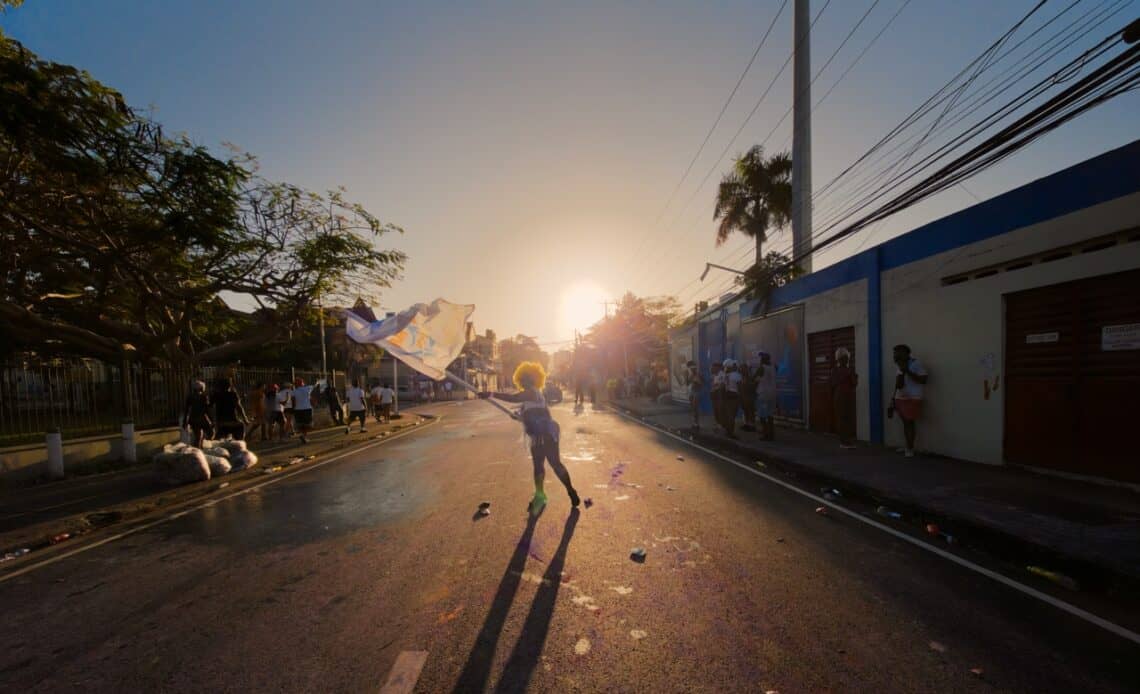
Above: J’Ouvert morning, St Clair Avenue, Carnival 2025. Photos by Mark Lyndersay.
BitDepth#1501 for March 10, 2025
For most of the 30-year life of this column, I’ve used this space, around this time, to comment on the state of the nation’s signature festival.
The commentary had been ongoing for more than a decade before BitDepth came along, and it seems appropriate, barring some particularly egregious development in the festival, to bow out of commenting anymore.
At least part of the reason is that I’ve said everything I felt moved to say about Carnival over the years, sometimes repeatedly, so that’s done.
If you’re curious, you can find some of the writing over the last decade or so here.
Carnival is, overwhelmingly, a young person’s game.
As it has evolved from a street parade of thoughtful and elaborate costumes into a fortnight’s marathon of pardy, the industrious commitment to nationwide wining has steadily pushed its contemplative, artisan elements to the periphery and sometimes off the stage entirely.
Should I still be tapping away at a keyboard for another year, I’ll have managed to be a working journalist for five full decades by 2026, which by definition gives me an old man’s perspective on the event.
My involvement has always been that of observation and documenting, in the thing, as the elders would say, but never of the thing.
Carnival may never have interested me as participatory entertainment, but it’s remained endlessly fascinating as process and expression of art, and more recently artisan commerce, in a uniquely Trinbagonian medium.
That’s resulted in a total disinclination on my part to, for instance, wine down low (even when that was easier to do) but I’d go into investigative overdrive pondering the why of The Mighty Shadow’s phrasing of a lyric or nurture an ongoing curiosity about what was under the flimsy fabric costumes of The Original Whipmasters when they flogged each other mercilessly (correct answer: nothing).
Even as I held this year’s Carnival at arm’s length (quite literally, since I shot most of it with a smartphone), the sight of a medium-sized J’Ouvert band trying to implement ropes to partition their players while two portable toilets wobbled dangerously on nearby flatbed truck raised fascinating parallels between this paint-spattered-jumping-under-sodium-vapour-lights exercise and the more polished customer service innovations of Tribe.
Returning to my portraits of local calypsonians working in tents led me back to the Divas calypso tent, where I’d started the project in February 2020.
A half-decade later, I found an almost entirely new cast and an energising spirit of support and camaraderie that suggested that a woman-led calypso tent is a very different proposition from the traditional testosterone fueled aggregations that have lured the traditional calypso tent to the brink of extinction.
Calypsonians from the Divas Tent



Calypso continues to be crippled by the compromises a past generation of bards made with government for subsidy.
Freed of an imperative to entertain a wide cross-section of society, mudslinging and venal verse chased away half of the tent audience and most of the remainder left to listen to soca performed in fetes.
But these are old concerns that should be widely understood, if adamantly ignored at this point.
Entirely too many institutional systems created by stakeholder representative bodies and the NCC continue their efforts to narrow the path to true innovation and creativity in the music and masquerade.
Those bodies remain numb to the increased flux in audience engagement. Among the three stakeholder groups, only Pan Trinbago is recording an upsurge in audience interest.
Carnival masquerade bands may be expanding their customer base, but the emphasis remains vigorously insular, masqueraders playing mas for themselves, not the thinning, disinterested audiences.
Even the lure of television cameras has dimmed for the be-feathered, with the upsurge in capable selfie cameras and ready-made video streaming and capture.
A modern mas band doesn’t need an audience or even television coverage, it just needs a good DJ, all-inclusive drinks and good light.
The Carnival of 2025 is not my carnival, but no era of the festival has ever inspired nostalgia for me.
Freed of such sentiment, it’s clearer that there is a fundamental change in the way the event is realised today.
Managing it using the same structure that was first devised 68 years ago under the Carnival Development Committee seems particularly misguided.
But the big wheel keeps on turning. Copyright remains as misunderstood this year as it has been for the last 25.
The Grandstand stage remains the catchall for events although it is really constructed for large steelbands, unwieldy kings and queens and the large mas band category. Everything else gets lost in its gray expanse.
“That’s the way we’ve always done it” is the Arbeit macht frei of modern Carnival management, an unintentionally ironic architecture that defies the festival’s mercurial evanescence that fails to cater to the participants and audiences almost universally ignore it in favour of attractions that speak to the potential of a new century’s Carnival.















 Is Apple’s Neo the One?
March 22, 2026
Is Apple’s Neo the One?
March 22, 2026
 Privacy and your travel information
March 15, 2026
Privacy and your travel information
March 15, 2026
 TATT announces ambitious three-year strategic plan
March 9, 2026
TATT announces ambitious three-year strategic plan
March 9, 2026
 Samsung’s S26 leans in hard on...
March 1, 2026
Samsung’s S26 leans in hard on...
March 1, 2026
 A 2026 manifesto for Carnival
February 23, 2026
A 2026 manifesto for Carnival
February 23, 2026
 A hiss from a rose
February 15, 2026
A hiss from a rose
February 15, 2026
 News is a niche until it’s...
February 9, 2026
News is a niche until it’s...
February 9, 2026
 FT’s second Next Gen News report...
February 9, 2026
FT’s second Next Gen News report...
February 9, 2026
 Ransomware report notes fourth quarter 2025...
February 2, 2026
Ransomware report notes fourth quarter 2025...
February 2, 2026
 Hands-on with Apple’s Creator Studio as...
January 30, 2026
Hands-on with Apple’s Creator Studio as...
January 30, 2026
 Apple flirts with subscription software
January 26, 2026
Apple flirts with subscription software
January 26, 2026
 So long, and thanks for all...
January 19, 2026
So long, and thanks for all...
January 19, 2026
 Cyberedge reports on cybersecurity trends
January 12, 2026
Cyberedge reports on cybersecurity trends
January 12, 2026
 Samsung’s ZFlip 7 shows steady improvement
January 5, 2026
Samsung’s ZFlip 7 shows steady improvement
January 5, 2026
 Digital New Year’s resolutions
December 29, 2025
Digital New Year’s resolutions
December 29, 2025
 WiPay announces new strategy for services,...
December 22, 2025
WiPay announces new strategy for services,...
December 22, 2025
 Old Mac, new OS
December 15, 2025
Old Mac, new OS
December 15, 2025
 Regional cybersecurity faces fire
December 8, 2025
Regional cybersecurity faces fire
December 8, 2025
 Unfinished symphonies
December 1, 2025
Unfinished symphonies
December 1, 2025
 Do you know who your child...
November 24, 2025
Do you know who your child...
November 24, 2025

One government did propose a national carnival center in the Queens Park Savannah that would have allowed multiple forms of expression on different stages. This was shot down, ironically, by the public who complained about the use of the savannah, and of course the opposition. We certainly don’t have the money now for something like that, but at one point there was at least a proposal for change. I think the Epic cruise, that parks a cruise ship at Hyatt for thousands of people to partake in carnival, is a form of advancement. It’s a solution to a few problems, one being accommodation. Carnival remains the strongest economic engine in Trinidad that encompasses a broad range of social and economic classes.over a hundred million US$ at least passes through the island as a result of this, and there is nothing else we have done that provides the same cashflows. This article seems unreasonably gloomy about what was, and what could have been. I think there is a lot of hope for what could be.
Yes, I can accept being perceived as a gloomy Gus, but that comes from 40 years of staring into the abyss of the belly of the beast as it were, and seeing the erosion of the core principles of Carnival happen in near real time. I have stories about those experiences, but I also have great faith in the resilience and cussedness of Carnival’s creative forces, even as my despair over its management reaches its nadir. Have a look at this project. I do make time for the people who work at this thing, even to this day. https://lyndersaydigital.com/kaiso2020/