
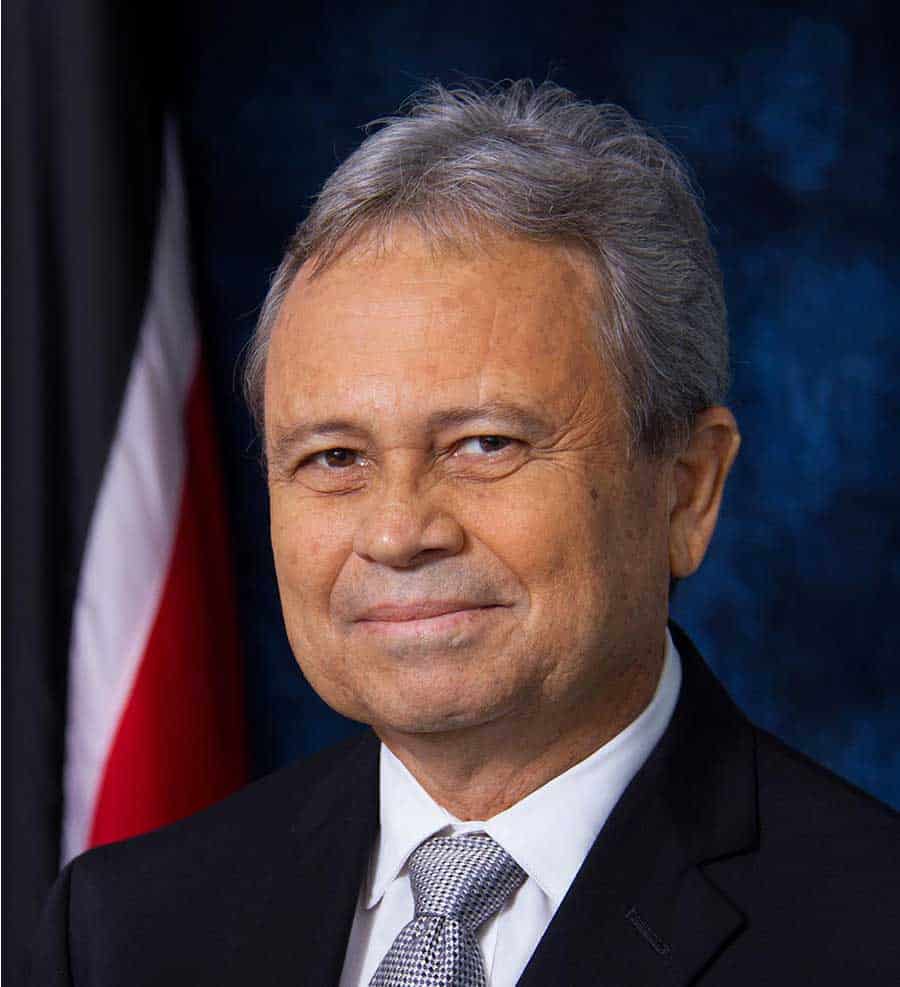

Above: Finance Minister Colm Imbert
BitDepth#1428 for October 16, 2023
The 2024 budget, read in Parliament on October 02 by Finance Minister Colm Imbert, leans in heavily on infrastructure.
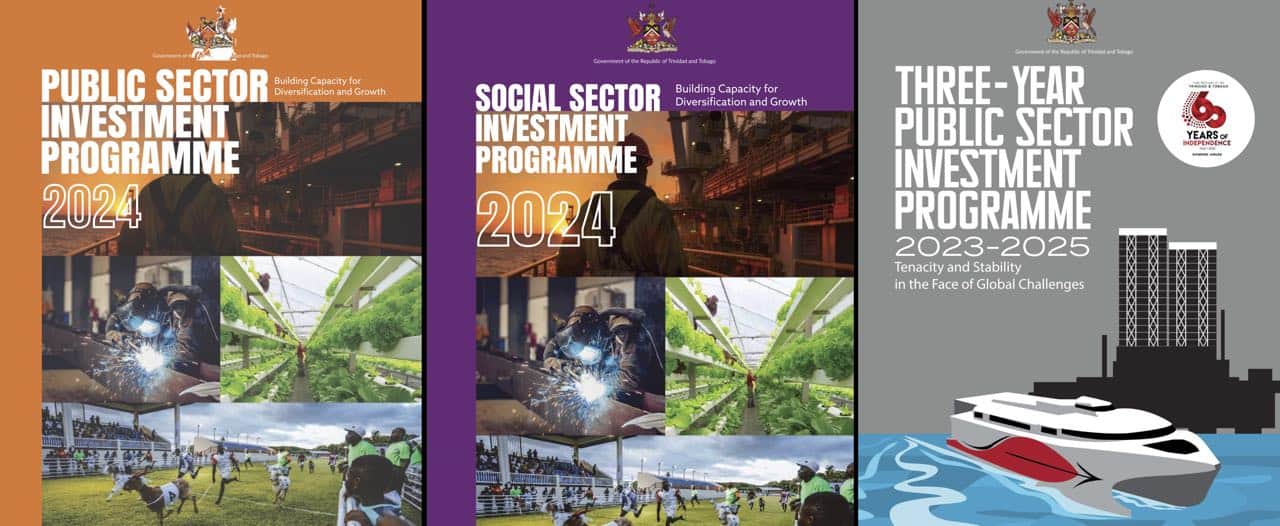
A review of the support documents, the Social Sector Investment Programme (SSIP) and Public Sector Investment Programme (PSIP) elaborate in detail on the strategic overview offered by the Finance Minister that’s expressed largely in concrete.
Interestingly, one item is only to be found in the budget speech, a tax exemption of $500,000 for companies who invest in cybersecurity. A last minute notion?
The scattershot accounting in the budget of the myriad efforts to create a digital economy remains true in the 2024 budget documents, two years after the creation of the Ministry of Digital Transformation (MDT) and the appointment of a Cabinet level advocate for the digital economy.
You’ll find digital transformation ideas scattered throughout the support documents.
Alongside natterings about telemedicine and health information systems at the Ministry of Health, a Digital Skills Development Programme called WeLearnTT, and a continued commitment to TTWIFI, a persistently wrongheaded plan to bring 26 open-area, public access sites of which no more than five are currently operational despite efforts dating from 2016.
In his budget speech, the Finance Minister couldn’t seem to reconcile the claims of de facto state agency TSTT’s claim of country coverage “approaching 100 per cent,” and the availability of satellite based Starlink services with lingering claims of “underserved areas.”
A survey by the Telecommunications Authority (TATT) in 2022 revealed that just 0.12 of households are underserved by broadband connectivity.
TATT’s Universal Service Fund, raised through a licensing tax on telecommunications providers that’s raised more than $150 million for the authority, should be more than enough to fix a shrinking problem.
Unless someone, somewhere, likes talking about “unserved and underserved areas” when discussing the internet in TT.
For the second year running, the Finance Minister reported that it is “engaging” UNCTAD to develop the National E-commerce Strategy.
Vague threats of a unification of booklists and ensuring continuity of use of textbooks also made an appearance, with hints of turning some of these learning tools into e-books, a rights issue it isn’t clear that anyone at the Education Ministry has fully considered.
The digitalisation of the public service continues with document scanning at Town and Country Planning, but there’s been no move on the overdue digitalisation of the Police Service beyond plans to “operationalise body cams,” a move largely stymied by reluctant officers.
The Three-Year Public Sector Investment Programme (3Y-PSIP) produced in 2022 to cover the government’s strategic planning for the years 2023-2024 proposes bolder changes to the service, including “A resource shift towards enterprise reporting systems, virtual meetings, investigations using access rooms and redeployment of human capital to higher level skill sets.”
The PSIP allocates $15 million to body cameras while gesturing rather vaguely in the direction of digital fingerprint capture and a planned expansion of the police computing network.
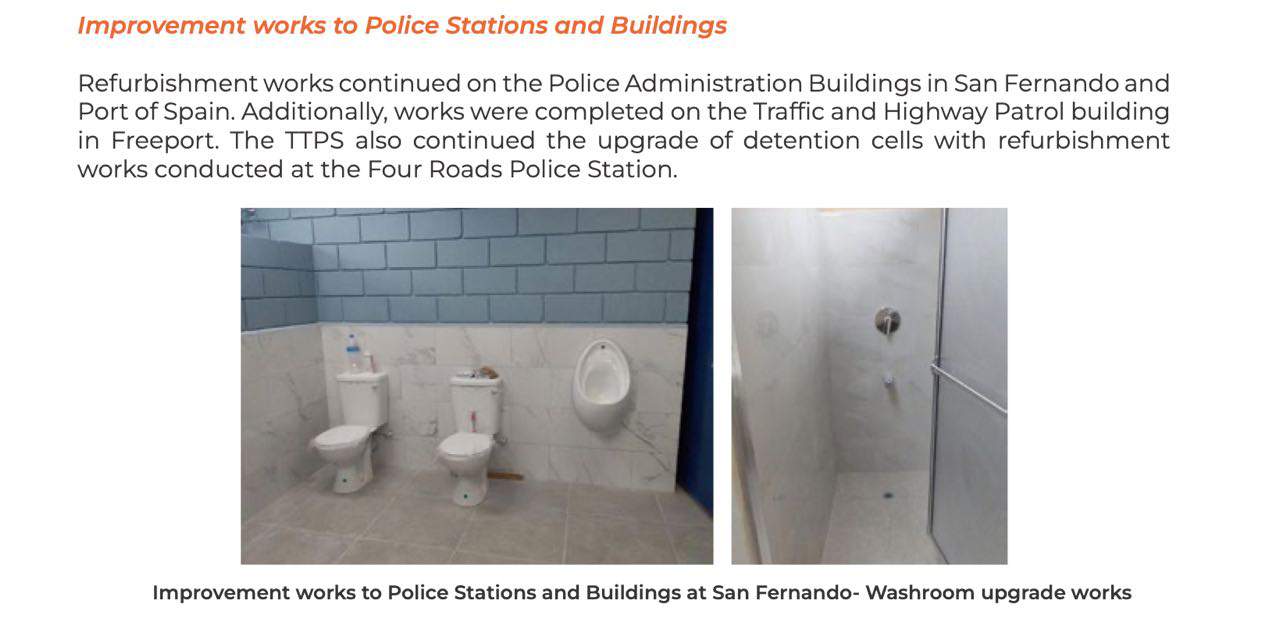
In a document that offers detailed boasts of the concrete to be poured for police building refurbishment – and even proudly includes a photo of side by side sit toilets installed at the San Fernando Administration building, built without benefit of a modesty divider – this lack of clarity is confusing.
There is no clarity about computer systems, management systems for Firearms User Licenses and property rooms, computerisation of the Crime Scene Photo Lab or server room upgrades.
Nothing is said about the proposed deployment of closed circuit television systems and a half-dozen other initiatives outlined for the Police Service in the 3Y-PSIP.
The gaps between planning and execution, even for critical matters like the gathering of accurate statistical information about governance, remains a hallmark of the sprawl of government budget documents.
The National Statistical Institute of Trinidad and Tobago (NSITT) was first proposed as a replacement to the Central Statistical Office (CSO) in a 2018 bill. The CSO has been hamstrung by its inability to access governance datasets and increasingly limited resources.
The idea of the NSITT still haunts budget documents, but the planned Population and Housing Census in 2024 will be managed by a last gasp CSO. The last census was done in 2011.
The formation of the MDT was expected to herald a new commitment to digital transformation in TT, but a comparison of the ambitions of the 3Y-PSIP with this year’s document suggests a dramatic scaling down of ambitions.
The current emphasis of the MDT appears to be on the implementation of a national electronic identification system (e-ID), even if the minister doesn’t miss an opportunity to celebrate fresh concrete when a new public internet access centre is opened.
The e-ID system, a proposed government cloud and the implementation of a cybersecurity strategy have attracted the largest budget allocation to the MDT at $50 million.
But the e-ID project alone is likely to demand the focus of the MDT entirelya if it hopes to implement it before the next election.



















 Declaring independence from mobile roaming
August 31, 2026
Declaring independence from mobile roaming
August 31, 2026
 Urgency, awareness needed to combat sextortion
August 24, 2026
Urgency, awareness needed to combat sextortion
August 24, 2026
 The silent, growing danger of ransomware
August 17, 2026
The silent, growing danger of ransomware
August 17, 2026
 How should a newsroom of the...
August 10, 2026
How should a newsroom of the...
August 10, 2026
 FNP’s halting stumble to dubious relevance
August 3, 2026
FNP’s halting stumble to dubious relevance
August 3, 2026
 Samsung’s big bet on AI
July 27, 2026
Samsung’s big bet on AI
July 27, 2026
 The data centre dilemma
July 20, 2026
The data centre dilemma
July 20, 2026
 How should business and government embrace...
July 13, 2026
How should business and government embrace...
July 13, 2026
 How influencer marketing works in the...
July 5, 2026
How influencer marketing works in the...
July 5, 2026
 Yes, a website is work. Yes,...
June 29, 2026
Yes, a website is work. Yes,...
June 29, 2026
 No more fire in these wires
June 22, 2026
No more fire in these wires
June 22, 2026
 What the heck is chip binning?
June 14, 2026
What the heck is chip binning?
June 14, 2026
 Solving the region’s journalism problem
June 8, 2026
Solving the region’s journalism problem
June 8, 2026
 Tambini to journalists: “Keep doing what...
May 31, 2026
Tambini to journalists: “Keep doing what...
May 31, 2026
 How do we unfetter journalism from...
May 25, 2026
How do we unfetter journalism from...
May 25, 2026
 What the Canvas hack tells us...
May 15, 2026
What the Canvas hack tells us...
May 15, 2026
 Ghost women in AI? Hardly!
May 10, 2026
Ghost women in AI? Hardly!
May 10, 2026
 IShowSpeed: Here and gone
May 4, 2026
IShowSpeed: Here and gone
May 4, 2026
 How TT journalists can turn modern...
April 26, 2026
How TT journalists can turn modern...
April 26, 2026
 Reuters report on young news readers...
April 20, 2026
Reuters report on young news readers...
April 20, 2026



[…] Trinidad and Tobago – The 2024 budget, read in Parliament on October 02 by Finance Minister Colm Imbert, leans in heavily on infrastructure… more […]