


BitDepth#1579 for September 07, 2026
The last time I saw Ryan C Khan, he was the image of the brooding modern director/cinematographer, just off the success of two shorts, Minutes to Midnite and The Midnite Affair, projects that he hoped would be the start of a post-modern exploration of local folklore.
That was just over 16 years ago and he was 29. Things happened since then.
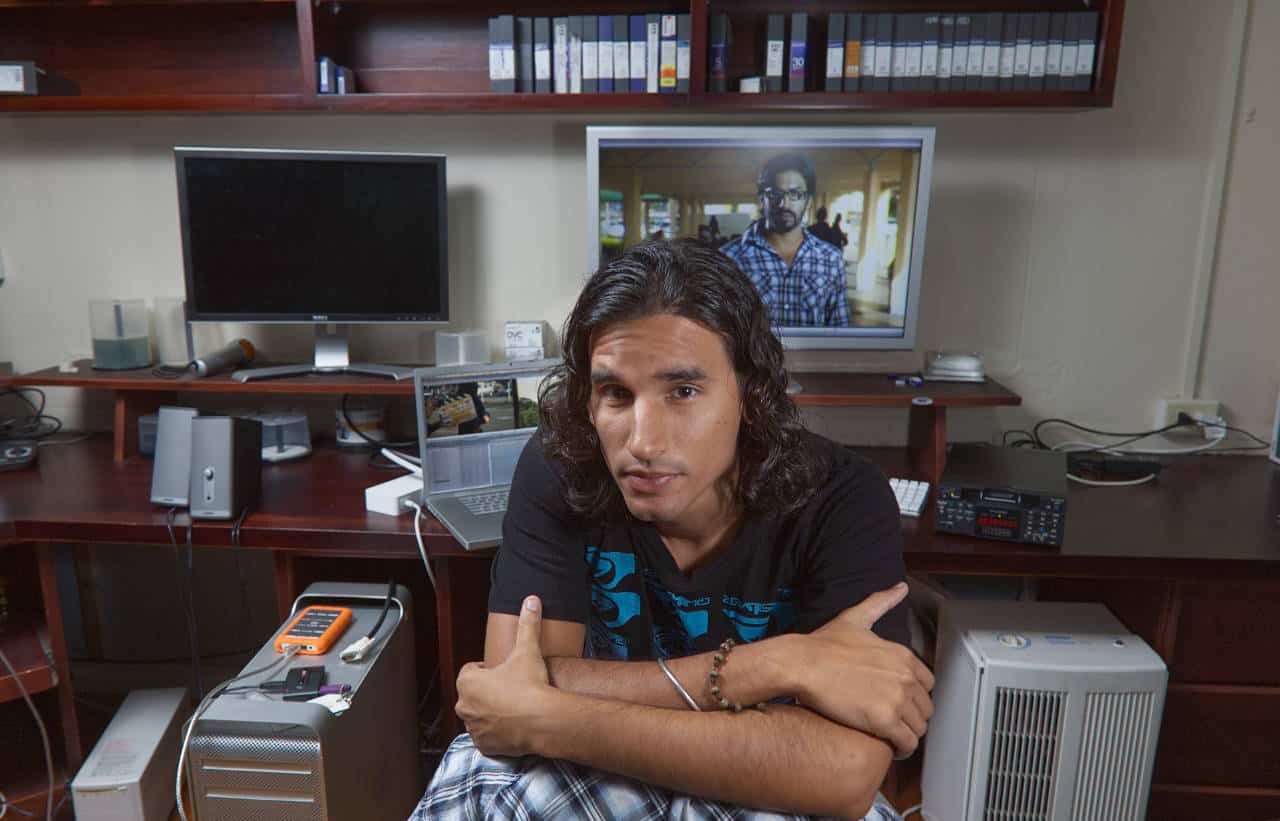
“After The Midnite Affair, I moved through music videos into commercials and agency work”, Khan said in response to emailed questions. “Alongside that, I kept producing my own projects and editing other filmmakers’ features. I gained experience, if not much wealth.”
“Migrating wasn’t by design; things were going well, actually. But you can’t live in two economies, so it became a partial reset, smaller jobs, doing everything myself again.”
“The North Carolina State University (NCSU) role came through broad post-production experience lining up with what the university needed, and someone who knew my work and saw something in me.”
Khan popped back up on my radar when he posted a note on LinkedIn about a new school project he’d worked on, the construction of a virtual production set for a short film project at NCSU.
Virtual production isn’t a new solution for reducing costs and risk in film-making. It has its roots in rear projection, which was used extensively on big budget films.
Before the days of the camera and vehicle cam rigs used today, moving vehicles were simulated by projecting footage onto a screen behind actors sitting in a set.
The process reduced cost, improved audio capture of conversations between key characters and kept actors out of danger.
You can see the technique, usually quite obviously, in films and television shows made between 1940 and 1960, shots where the background blurring outside the moving vehicle’s windows is clearly disconnected from the action.
Rear and later front projection improved over the next few decades, but techniques have moved along quite a bit since then.
The first major use of virtual production, which matches high resolution background footage with massive LED screens that create complete shooting stage environments was on the WestWorld television series.
The technique’s real-time rear projection technology moved into higher gear with Disney’s The Mandalorian, which synchronised camera movements with projected footage on massive, curved LED screens for even greater verisimilitude.
Actors who might have struggled on older green screen technologies have the advantage of practical set dressing in these projected environments, which gives actors more to work with in their performances.
What Ryan Khan does these days
“I didn’t arrive [at NCSU] with a virtual production background,” Khan said.
“What I’m actually good at is spotting a technique early and getting into it before the crowd. Virtual production was that thing at the time. Rather than compete for the popular jobs, I went where it was new: one of the first universities in North Carolina building a virtual production program.”
“AI is [in that same space] now, though it’s more crowded because it’s so accessible. Most people are pressing buttons. The work is in defining what the buttons do. I think being a filmmaker from Trinidad is what taught me that. You build your own thing because nobody hands you one. Partly training, partly just how I’m wired.”
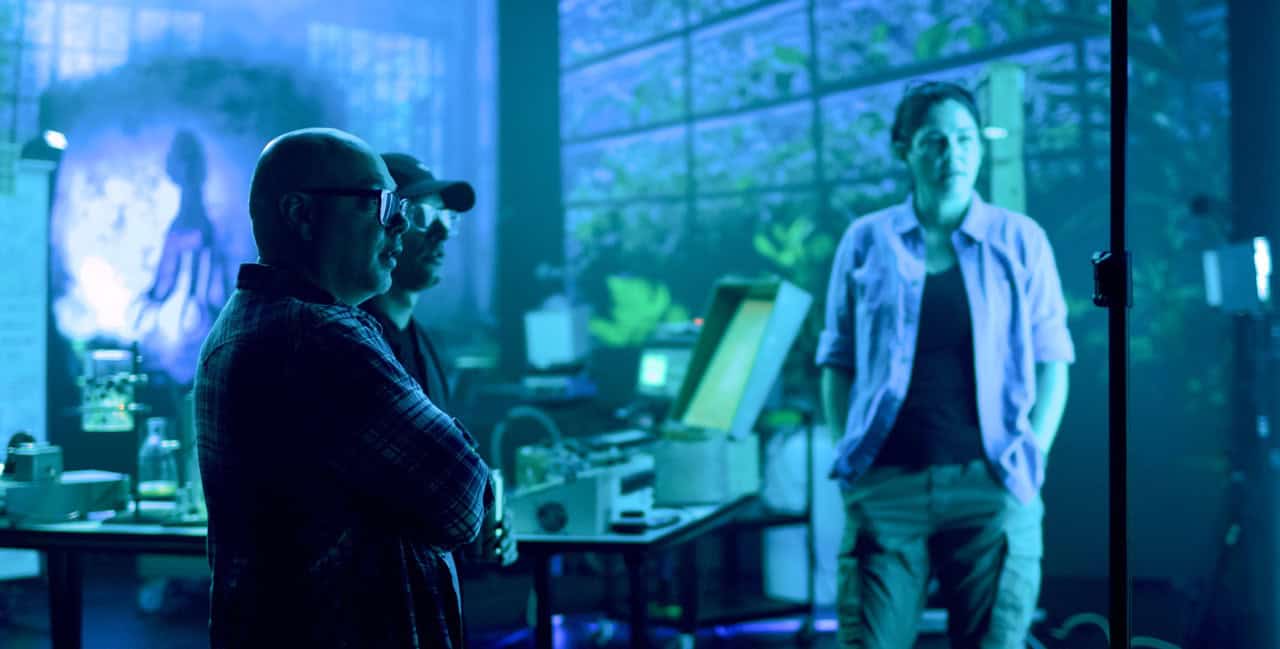
Khan is Virtual Production Lab Manager at NCSU’s MADTech, a role that begins with studio management (equipment inventory and checkout), managing the space, facilitating students and faculty and physical design of the space, including the build of the lighting design and camera positions.
The facility also shoots standard productions, and he is often the person running the room as well as working in it.
“The part that actually matters is that about half the job is research and development, collaborating with faculty to experiment in ways a commercial shoot never allows. On a normal production you’d never take those risks. You’d find the cheaper, safer route.”
“Hollywood buys R&D with money. Independents can’t afford it. But a university is built for it. You’re expected to experiment and to document what you find.”
“That’s an unusual position to be in, and it’s what’s changed my sense of what low budget can do. On a commercial job it’s get the shot, move on, next production. Here I can stay in the moment and stay flexible, and that’s where the discoveries come from.”
“And what comes out of it is transferable, which is the genuinely exciting part. Real-time in-camera work no longer requires an LED volume,— you can do it with projection or consumer screens driven live by Unreal (a gaming engine), make the change on set and see it immediately.”
“Green screen hasn’t gone anywhere either, and now it pairs with generative tools: you can generate your plates and backgrounds, using reference images to keep them consistent, and composite behind what you shot. Between those two approaches, a filmmaker with very little money has access to things that used to sit behind a studio budget.”
The humble underpinnings and big ideas behind Strange Forces
The project, Las Fuerzas Extrañas (Strange Forces), is a five minute sci-fi short inspired by a 1906 novel written by Leopoldo Lugones. The project, helmed by Alex Restrepo and Ricardo Tobon, the Latin American founders of Alecardo, an LA-based VFX studio, was produced at NCSU with a US$15K Virtual Production Fellowship in Spring 2025.
The short went on to win an Award of Excellence for Best Sci-Fi Short at the San Diego Movie Awards 2025 hosted by the Museum of Photographic Arts, was a Finalist at the Manhattanhenge 2025 Film Festival in New York, and an Honorable Mention from the Kraken International Film Festival 2025 in Milan Italy.

“One of our professors organized the shoot and brought in a filmmaker from LA, someone quite seasoned who had worked on Hollywood films like Planet of the Apes and on triple-A video game titles. He had real experience across motion capture, film and VFX.”
“It was the professor’s project, and what he specifically wanted to test was real-time motion capture driving the LED wall while an actor performed live in front of it. That’s the virtual puppetry you noticed. Because it was exploratory, we didn’t have many set rules, and what the virtual production workflow showed us was how quickly you can build.”
“The stack was mainly Unreal Engine. The motion capture itself was handled through Radical, a browser-based, markerless system that captures performance from a single webcam, no suit and no marker rig, which is a large part of why this was achievable with no budget.”
“Camera tracking was handled by HTC Vive’s virtual production kit, the Mars CamTrack, hardware and software together. It’s fairly recent, and it’s by far the most affordable and accessible tracking system at an independent’s scale.”
“There are cheaper rungs below that. Before we had that, we were strapping a VR controller to the camera. Unreal has a workaround where you mount an iPhone to the camera and track with that. Those work, but they have real limitations.”
“The track isn’t solid enough to be fully dependable. So it depends on your scope. I’d say it’s worth investing a little more for the standard tools rather than going bargain-basement, but you also shouldn’t pour money into it. There’s a balance to strike, and striking it is the whole art of filmmaking.”
What can local filmmakers take away from Khan’s experiences?
“Keep at it. I’ve spent most of my career in Trinidad, and it’s been a journey.— Starting in a small post-production boutique, making my own short films, moving into commercials (https://www.outlish.com/ryan-khan-directing-an-affair/), and now I’m in the States running a virtual production studio for a university and making AI work alongside it. Still producing the same things, just from somewhere else.”
“There’s no way to plot that out in advance, and I think that’s the point. Yes, we want to earn a living, that’s why you choose a career. But filmmaking is one of the hardest ways to do it. So you find that it’s more of a journey than a career. You can be successful at it anywhere in the world, and it’s hard everywhere. Still, I wouldn’t say it isn’t worth it.”
“For anyone intrigued by these techniques, a good place to start is our website for the NC State Virtual Production Lab (https://design.ncsu.edu/research/virtual-production/). Our program isn’t only virtual production; it gives you access to the technology alongside other forms of creation. That’s the educational route.”
“At home, start with Unreal Engine. But Unreal isn’t the only way to do virtual production. There’s a lot coming online now. Foundry’s Nuke Stage, Vu, and others that used to be server-based systems and are now just software you can access and use.”
“Really it’s about staying curious, investigating the tools, and creating with them while you learn. Some of my peers and associates in Trinidad have done a good job of staying on top of things. But it’s tough, I won’t pretend otherwise.”
“One last thing worth remembering. Trinidad invented the steelpan out of discarded oil drums. That metal had some value as scrap, but what we chose to do with it was make a musical instrument. I don’t imagine the people who did that were thinking about whether it was worth it. They wanted to make music. They wanted to party.”
“That’s what we should be doing as artists here, not worrying first about whether it will be successful or what it’s worth. We get caught up in valuing ourselves through capitalism, and capitalism has its place, but it doesn’t have to be the main reason we make things. I’m not saying work for free. I’m saying there’s something in that instinct worth paying attention to, and it’s already ours. Embodying it will make you a better artist.”